Product Design, Manufacturing & Innovation Resources
Home » Protein Denaturation

Protein Denaturation

1930
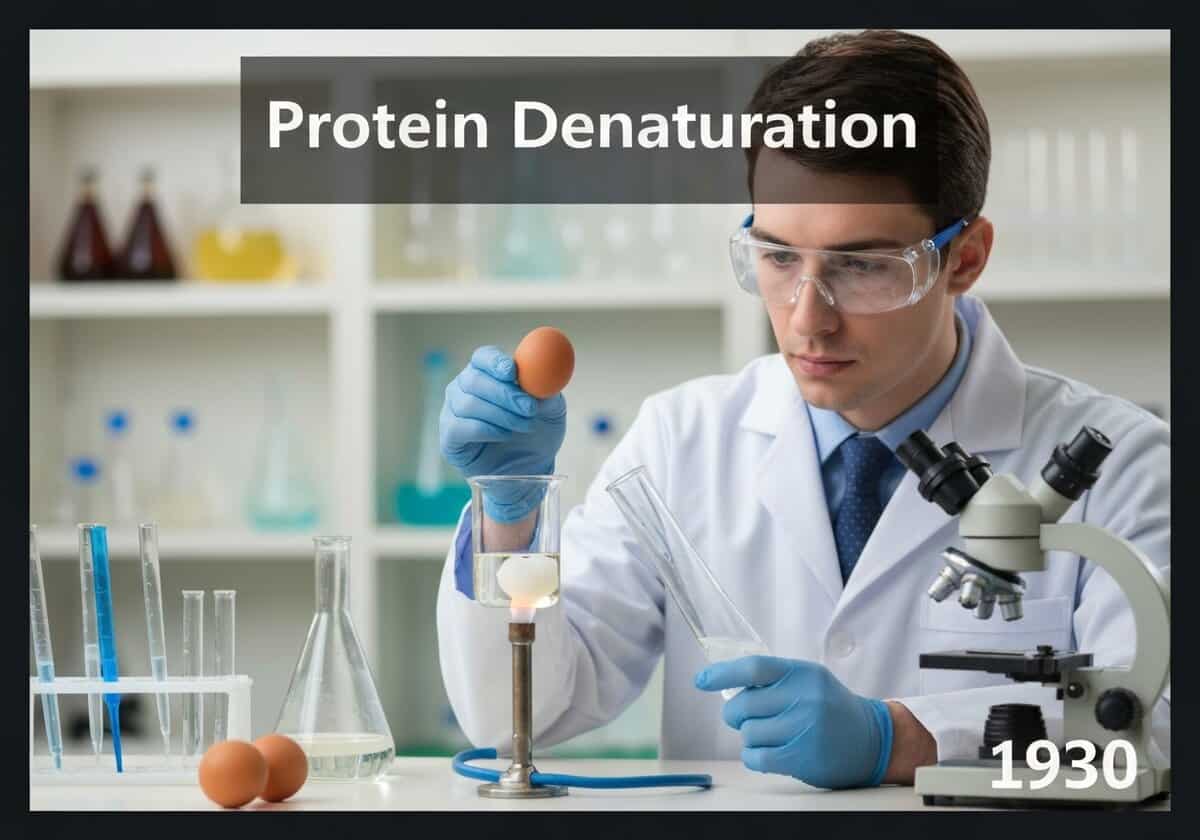
Biochemist demonstrating protein denaturation in a laboratory setting.

(generated image for illustration only)

Protein denaturation is the process in which a protein loses its native three-dimensional structure. This disruption of secondary, tertiary, and quaternary structures is caused by external stressors such as heat, extreme pH, organic solvents, or radiation. While the primary sequence of amino acids remains intact, the loss of shape results in the loss of the protein’s biological function.
Denaturation disrupts the weak, non-covalent interactions that stabilize a protein’s native conformation. These include hydrogen bonds, hydrophobic interactions, and ionic bonds. For example, heat increases the kinetic energy of atoms, causing vibrations that break these weak bonds. Extreme pH alters the protonation state of acidic and basic amino acid side chains, disrupting salt bridges and hydrogen bonds. Organic solvents can disrupt the hydrophobic core that is crucial for the stability of many globular proteins. In some cases, denaturation is reversible; if the denaturing agent is removed and conditions are returned to physiological norms, some proteins can spontaneously refold into their native state, a process called renaturation, as demonstrated in Anfinsen’s experiments. However, for many proteins, especially large ones, denaturation is irreversible, often leading to aggregation where the unfolded hydrophobic regions stick together non-specifically. This aggregation is a hallmark of several neurodegenerative diseases, such as Alzheimer’s and Parkinson’s disease.

Understanding denaturation is critical in both biology and biotechnology. It explains why organisms must maintain a stable internal environment (homeostasis) and is a key consideration in the purification, storage, and handling of protein-based drugs and enzymes to maintain their activity.

UNESCO Nomenclature: 2401
– Biochemistry

Type

Chemical Process

Disruption

Substantial

Usage

Widespread Use

Precursors

  • observation of food cooking and coagulation (e.g., egg whites)
  • early studies on protein solubility by hofmeister and others
  • development of the concept of a specific 3d protein structure
  • understanding of non-covalent interactions like hydrogen bonds and hydrophobic effects

Applications

  • cooking food (e.g., frying an egg, where heat denatures albumin)
  • sterilization of medical equipment using heat or chemicals to denature microbial proteins
  • use of alcohol as a disinfectant, which denatures bacterial proteins
  • permanent hair waving, which uses chemicals to break and reform disulfide bonds in keratin
  • biochemical assays that use denaturing agents (e.g., sds-page) to analyze proteins by mass

Patents:

NA

Potential Innovations Ideas

Due to scrapping bot traffic, currently more than 40k per day, this content is reserved to community members.
> Login < or > Register < (100% free) to access this, so as all other restricted content and tools.

Related to: denaturation, protein folding, protein structure, unfolding, aggregation, homeostasis, enzyme activity, albumin, heat, ph.

Historical Context

Protein Denaturation

1902
1920
1928
1930
1940
1950
1950
1900
1910
1921
1930
1930
1940
1950
1951

(if date is unknown or not relevant, e.g. "fluid mechanics", a rounded estimation of its notable emergence is provided)

Related Invention, Innovation & Technical Principles

Full size images and downloads are only available, 100% free, for registered members.

> Login <