Precipitation Hardening
Precipitation hardening, or age hardening, is a heat treatment process that increases the yield strength of malleable materials. It involves heating an alloy to dissolve solute elements (solutionizing), rapidly cooling (quenching) to trap them in a supersaturated solid solution, and then aging at a lower temperature to allow fine particles of a second phase (precipitates) to form, which obstruct dislocation movement.
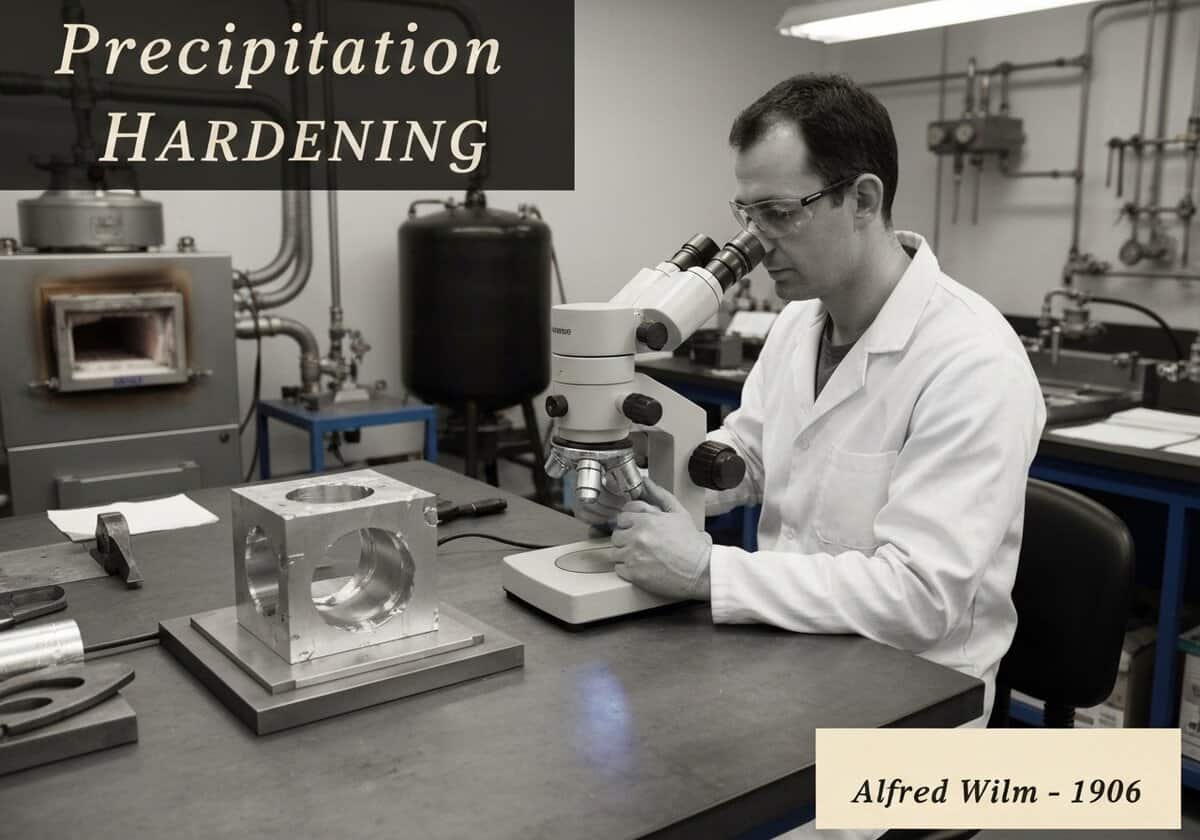
The discovery of precipitation hardening by Alfred Wilm was accidental. While studying an aluminum alloy containing copper, magnesium, and manganese (later named Duralumin), he noticed its hardness increased over several days after quenching, even at room temperature. This phenomenon is now understood as a three-step process. First, in solution treatment, the alloy is heated to a temperature high enough to dissolve all the solute atoms into a single-phase solid solution. Second, the alloy is rapidly quenched in a medium like water, which freezes the atoms in place, creating a supersaturated solid solution. This state is thermodynamically unstable. Third, during aging (either at room temperature or an elevated temperature), the supersaturated solute atoms diffuse and cluster together to form extremely small, coherent particles of a new phase called precipitates.
These precipitates act as powerful obstacles to the movement of dislocations, which are the primary carriers of plastic deformation in crystalline materials. The effectiveness of the strengthening depends on the size, shape, and distribution of these precipitates. Initially, as precipitates form and grow, the strength increases. However, if the aging process continues for too long (over-aging), the precipitates become too large and lose coherency with the matrix, allowing dislocations to bypass them more easily, which leads to a decrease in strength. This process allows for the precise tailoring of an alloy’s mechanical properties.
UNESCO Nomenclature: 3308
– Metallurgy
Precursors
- discovery of dislocations in crystals by vito volterra and others
- understanding of solid-state diffusion and arrhenius equation
- development of controlled heat treatment furnaces
- metallography techniques for observing microstructures, pioneered by henry clifton sorby
Applications
- high-strength aluminum alloys (e.g., 2024, 7075) for aircraft structures
- maraging steels for tooling, rocket casings, and landing gear
- nickel-based superalloys (e.g., inconel 718) for jet engine turbine blades
- copper-beryllium alloys for non-sparking tools and high-performance springs
- specialized stainless steels (e.g., 17-4ph)
Potential Innovations Ideas
Due to scrapping bot traffic, currently more than 40k per day, this content is reserved to community members.
> Login < or > Register < (100% free) to access this, so as all other restricted content and tools.
Related to: precipitation hardening, age hardening, heat treatment, yield strength, dislocation, precipitate, duralumin, superalloy, metallurgy, strengthening mechanism.