Polymerase Chain Reaction (PCR)
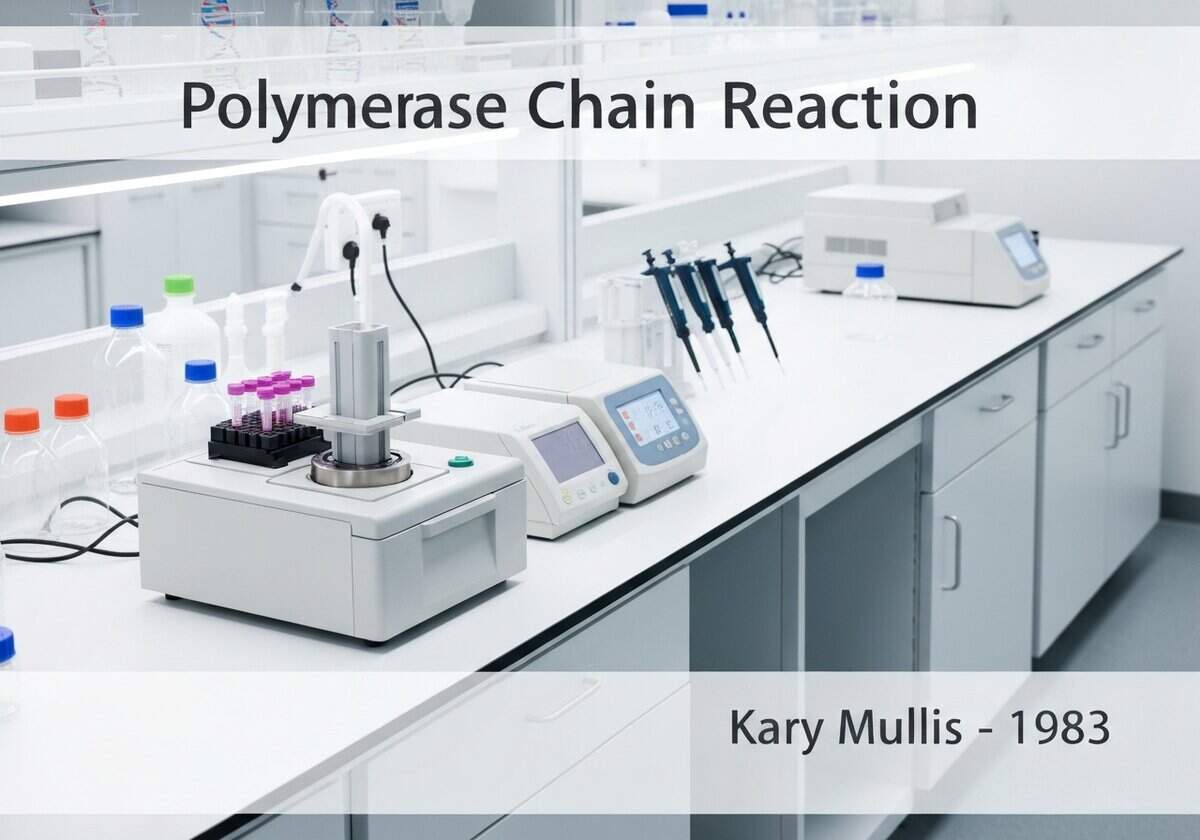
The Polymerase Chain Reaction (PCR) is a laboratory technique used to amplify a specific segment of DNA, generating millions to billions of copies from a small initial sample. The method relies on thermal cycling, consisting of repeated cycles of heating and cooling for DNA melting, primer annealing, and enzymatic replication of the DNA using a thermostable DNA polymerase, resulting in exponential amplification.
The Polymerase Chain Reaction (PCR) is a revolutionary in vitro method for exponentially amplifying a specific target DNA sequence. Its power lies in its ability to generate billions of copies from a minute starting quantity of DNA, making it possible to analyze DNA from samples as small as a single cell. The process is driven by a series of temperature changes, or thermal cycles, managed by a machine called a thermal cycler. Each cycle consists of three core steps. First, Denaturation: the reaction mixture is heated to 94–98 °C for a short period, causing the double-stranded DNA template to separate into single strands. Second, Annealing: the temperature is lowered to 50–65 °C, allowing short, single-stranded DNA primers to bind (anneal) to their complementary sequences on the now single-stranded template DNA. These primers flank the target region to be amplified. Third, Extension: the temperature is raised to 72 °C, the optimal temperature for the key enzyme, a thermostable DNA polymerase, to work. The most commonly used is Taq polymerase, isolated from the thermophilic bacterium *Thermus aquaticus*. The polymerase binds to the primer-template complex and begins synthesizing a new complementary DNA strand, extending from the primer. This three-step cycle is repeated 20-40 times. With each cycle, the number of copies of the target DNA sequence doubles, leading to an exponential amplification, mathematically described as \(2^n\), where n is the number of cycles. The result is a solution containing a vast quantity of the specific DNA fragment, which can then be easily visualized by gel electrophoresis or used in subsequent molecular biology applications like sequencing or cloning.
UNESCO Nomenclature: 2406
– Molecular Biology
Precursors
- discovery of DNA structure
- understanding of DNA replication principles
- isolation of DNA polymerase enzymes
- discovery of thermostable organisms and their enzymes (e.g., Taq polymerase)
- development of oligonucleotide synthesis for primers
Applications
- DNA fingerprinting for forensics
- medical diagnostics for infectious diseases (e.g., COVID-19)
- genetic testing for hereditary diseases
- cloning genes
- sequencing genomes
- phylogenetic analysis
Patents:
- US4683195
- US4683202
- US4965188
Potential Innovations Ideas
Due to scrapping bot traffic, currently more than 40k per day, this content is reserved to community members.
> Login < or > Register < (100% free) to access this, so as all other restricted content and tools.
Related to: PCR, polymerase chain reaction, DNA amplification, kary mullis, taq polymerase, thermal cycling, forensics, diagnostics, molecular cloning, genetic testing.