Permaculture Systems
1978
- Bill Mollison
- David Holmgren
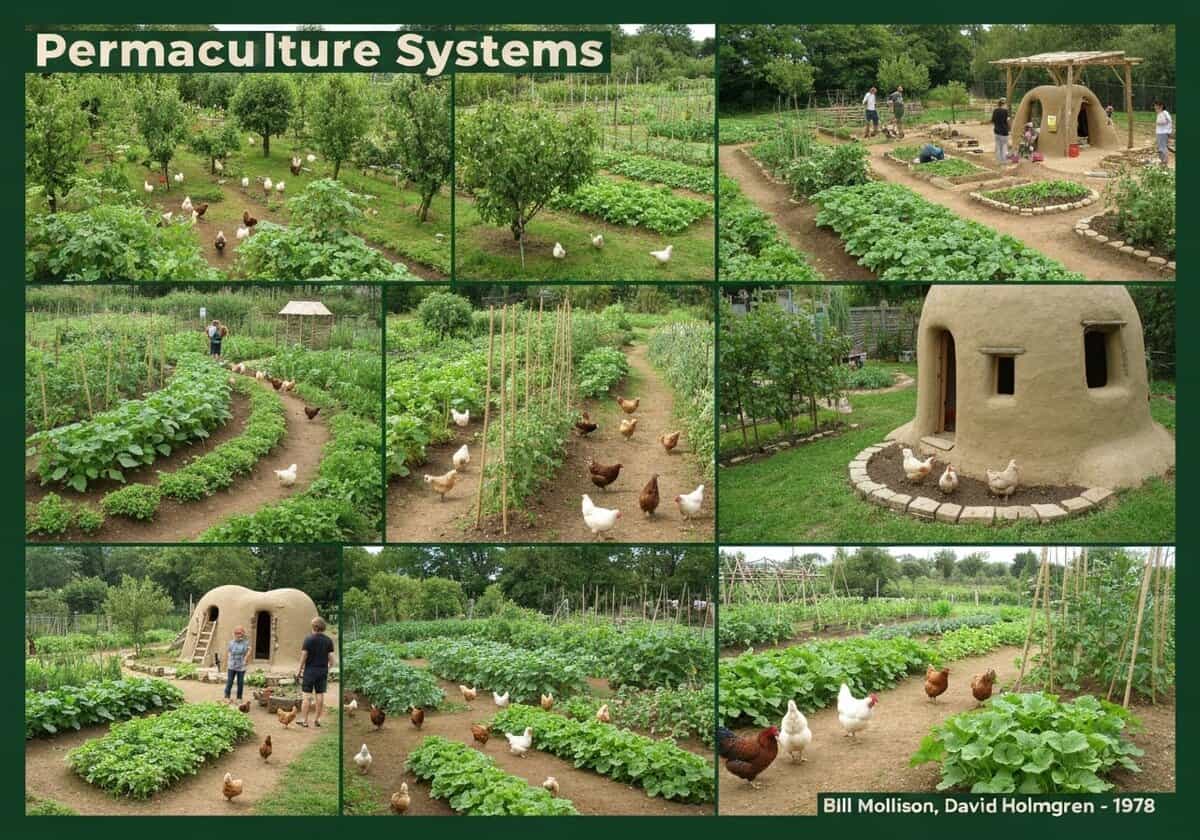
An approach to land management and philosophy that adopts arrangements observed in flourishing natural ecosystems. It includes a set of design principles derived from systems thinking, and it aims to create sustainable human settlements and agricultural systems by modeling them on natural patterns. Core tenets include care for the Earth, care for people, and fair share (returning surplus).
Permaculture, a portmanteau of “permanent agriculture” and “permanent culture,” is a design philosophy for creating sustainable and self-sufficient human habitats. Developed in the 1970s by Australians Bill Mollison and David Holmgren, it draws inspiration from the resilience, stability, and diversity of natural ecosystems. It is not a specific farming technique but rather a holistic design framework that integrates land, resources, people, and the environment through mutually beneficial synergies.
The system is guided by a set of ethics (Earth Care, People Care, Fair Share) and design principles. These principles, such as “Observe and Interact,” “Catch and Store Energy,” “Use and Value Diversity,” and “Produce No Waste,” serve as tools for thinking about and designing systems. A key concept is “stacking functions,” where a single element in a design serves multiple purposes. For example, a pond can provide irrigation water, support aquaculture, attract beneficial insects, and create a microclimate. Another core idea is “zoning,” which involves placing elements of the design based on how frequently they are used or need attention, minimizing energy expenditure. Permaculture seeks to create closed-loop systems where the outputs of one component become the inputs for another, mimicking the waste-free cycles of nature.
UNESCO Nomenclature: 2505
– Ecology
Precursors
- p. a. yeomans’ keyline design for land and water management (1950s)
- masanobu fukuoka’s natural farming philosophy (“the one-straw revolution”)
- indigenous agricultural practices and traditional ecological knowledge
- systems theory and cybernetics
- h.t. odum’s work on ecosystem ecology
Applications
- food forests and agroforestry systems
- rainwater harvesting and swale systems for land hydration
- natural building using materials like cob and straw-bale
- integrated animal systems (e.g., chicken tractors)
- urban gardening and community-supported agriculture (csa) projects
Potential Innovations Ideas
Due to scrapping bot traffic, currently more than 40k per day, this content is reserved to community members.
> Login < or > Register < (100% free) to access this, so as all other restricted content and tools.
Related to: permaculture, Bill Mollison, David Holmgren, sustainable agriculture, agroecology, systems thinking, food forest, ecological design, regenerative agriculture, whole systems design.