Product Design, Manufacturing & Innovation Resources
Home » P-N Junction Electroluminescence

P-N Junction Electroluminescence

1927
  • Oleg Losev
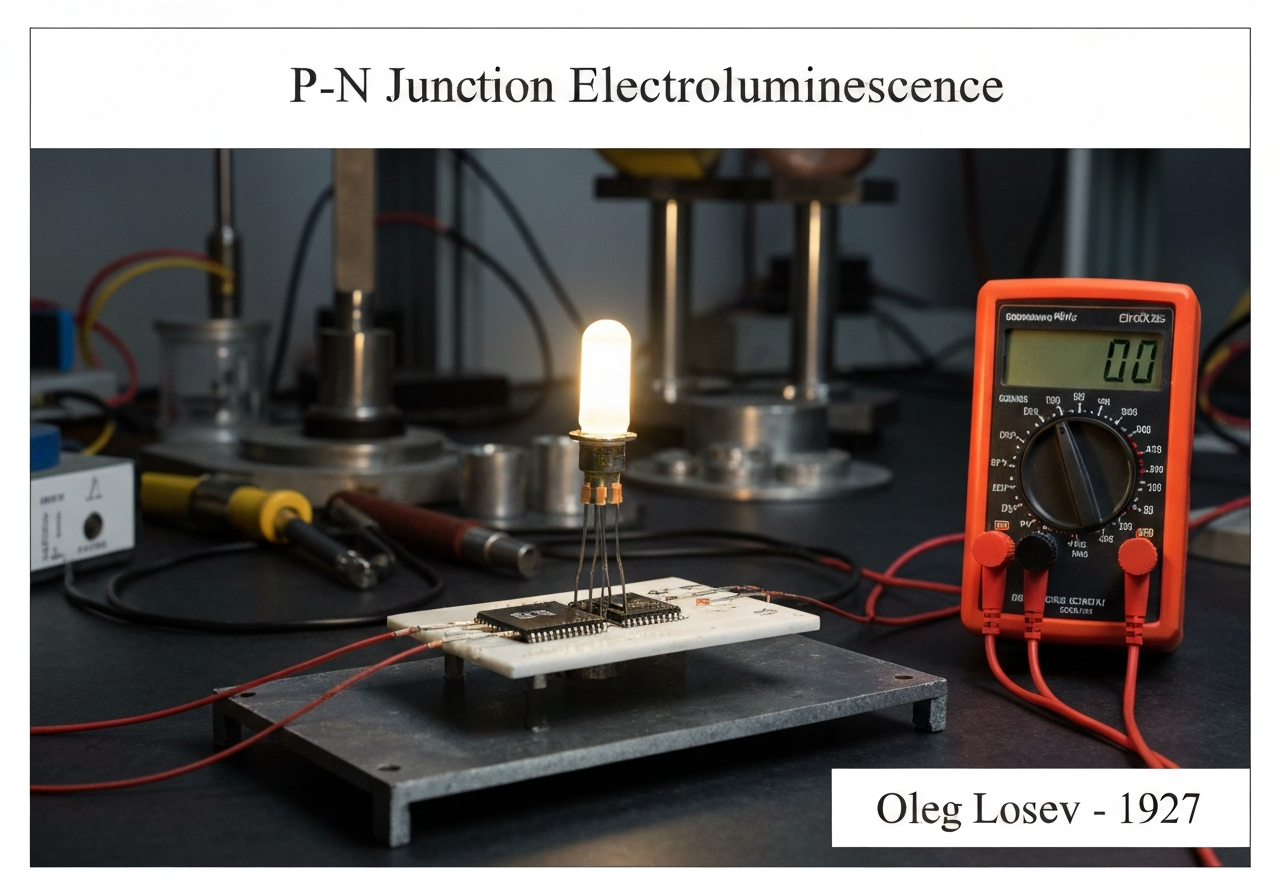
Light-emitting diode testing in solid state physics laboratory.

(generated image for illustration only)

A light-emitting diode is a semiconductor p-n junction. When a suitable forward voltage is applied, electrons from the n-side and holes from the p-side are injected into the depletion region. As they recombine, energy is released. In direct band gap semiconductors, this energy is efficiently emitted as photons of light, a process known as electroluminescence.

The fundamental principle of an LED lies in the quantum mechanics of a semiconductor p-n junction. A semiconductor is ‘doped’ with impurities to create two types of regions: n-type, with an excess of free electrons, and p-type, with an excess of electron ‘holes’. Where these two regions meet, a depletion zone forms, creating a potential energy barrier that prevents current flow under zero bias.

When a forward voltage is applied, it lowers this potential barrier, allowing electrons from the n-side and holes from the p-side to be injected across the junction. In the active region, these electrons and holes meet and recombine. Each recombination event causes an electron to fall to a lower energy level, releasing energy. This energy can be dissipated as heat (non-radiative recombination) or emitted as a photon of light (radiative recombination). The key to an efficient LED is to maximize radiative recombination. This is typically achieved using direct band gap semiconductors, where the momentum of the electron and hole are conserved during recombination, allowing a photon to be emitted directly.

UNESCO Nomenclature: 2211
– Solid state physics

Type

Physical Device

Disruption

Foundational

Usage

Widespread Use

Precursors

  • discovery of semiconductors
  • development of the p-n junction theory by William Shockley
  • quantum theory of solids and energy bands
  • invention of the point-contact transistor
  • early observations of light emission from silicon carbide by H. J. Round in 1907

Applications

  • indicator lights
  • solid-state lighting
  • optical fiber communication
  • remote controls
  • seven-segment displays

Patents:

  • US2569347A

Potential Innovations Ideas

Due to scrapping bot traffic, currently more than 40k per day, this content is reserved to community members.
> Login < or > Register < (100% free) to access this, so as all other restricted content and tools.

Related to: p-n junction, electroluminescence, semiconductor, radiative recombination, forward bias, diode, band gap, solid-state physics, electron-hole pair, doping.

Historical Context

P-N Junction Electroluminescence

1926
1926
1927
1927
1930
1930
1930
1925
1926
1927
1927
1930
1930
1930
1931

(if date is unknown or not relevant, e.g. "fluid mechanics", a rounded estimation of its notable emergence is provided)

Full size images and downloads are only available, 100% free, for registered members.

> Login <