Product Design, Manufacturing & Innovation Resources
Home » Overpotential (chemistry)

Overpotential (chemistry)

1910
  • Julius Tafel
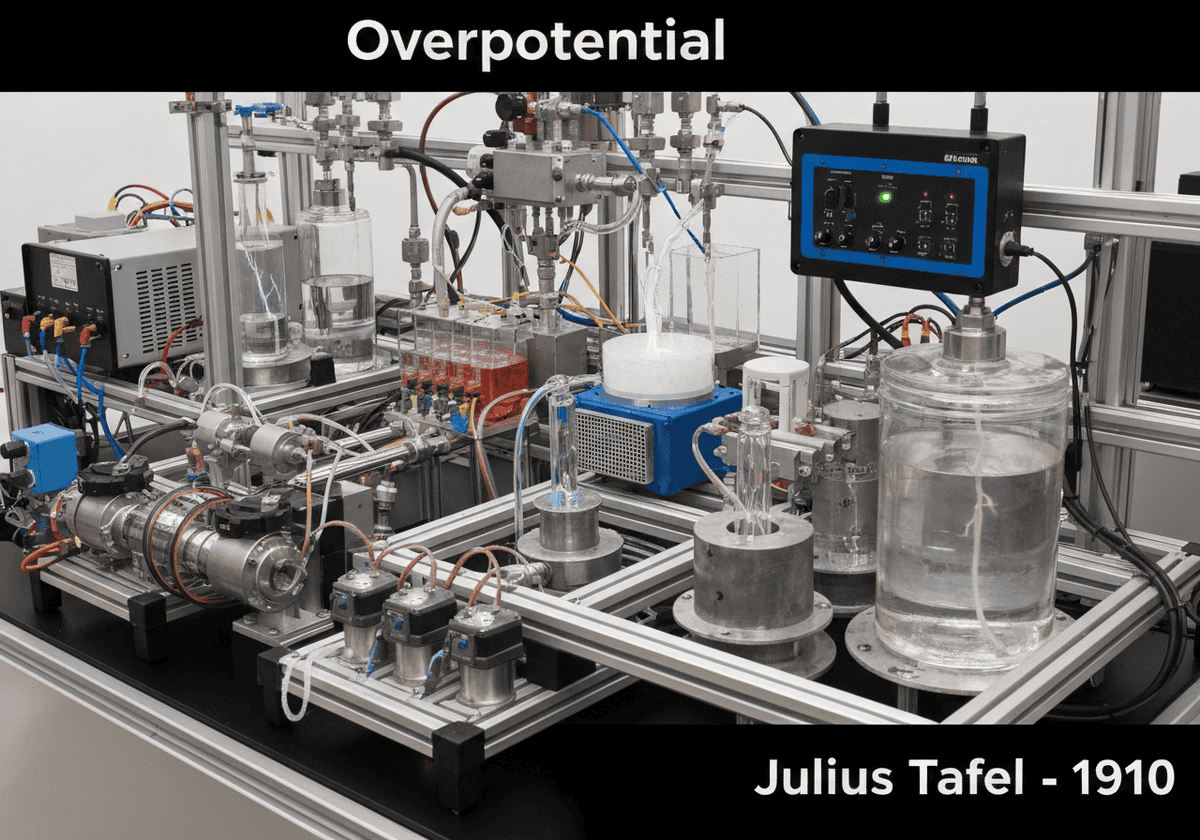
Industrial electrolyzer setup illustrating overpotential in electrochemistry.

(generated image for illustration only)

Overpotential is the potential difference (voltage) between a half-reaction’s thermodynamically determined reduction potential and the potential at which the redox event is experimentally observed. It represents the extra energy required to overcome activation barriers for the electrode reaction to proceed at a significant rate. It is a key factor in the energy efficiency of all electrolytic processes.

In an ideal electrolytic cell, the applied voltage needed to drive a reaction would be exactly equal to the cell’s standard electrode potential (\(E^0_{cell}\)). However, in reality, a significantly higher voltage is almost always required. This excess voltage is the overpotential (\(\eta\)). The total cell potential (\(E_{cell}\)) is the sum of the equilibrium potential, the overpotentials at both electrodes, and the ohmic drop (IR drop) across the electrolyte: \(E_{cell} = E^0_{cell} + \eta_{anode} + \eta_{cathode} + IR_{drop}\).

Overpotential arises from several sources. Activation overpotential is related to the kinetics of the electron transfer step at the electrode surface itself. Some reactions, like the evolution of hydrogen or oxygen gas, have inherently slow kinetics and require a large activation overpotential. Concentration overpotential occurs when the concentration of reactants at the electrode surface differs from the bulk concentration due to slow diffusion. Resistance overpotential is caused by the resistance of the electrolyte or films on the electrode surface.

The relationship between current density (j) and activation overpotential is often described by the Tafel equation: \(\eta = a + b \log(j)\), where ‘a’ and ‘b’ are constants (Tafel parameters) specific to the electrode reaction and material. This equation shows that to get a higher reaction rate (higher current density), a larger overpotential is required. The primary goal in designing efficient electrochemical systems is to minimize overpotential, which is typically achieved by using electrocatalysts (materials that lower the activation energy), increasing the operating temperature, or optimizing the electrode structure to enhance mass transport.

UNESCO Nomenclature: 2406
– Electrochemistry

Type

Physical Phenomenon

Disruption

Substantial

Usage

Widespread Use

Precursors

  • Nernst equation describing equilibrium electrode potentials
  • Arrhenius equation relating reaction rate to activation energy
  • development of the concept of chemical kinetics
  • Faraday’s laws of electrolysis

Applications

  • designing efficient industrial electrolyzers (e.g., for hydrogen production)
  • developing better catalysts to reduce energy loss in fuel cells
  • understanding and preventing corrosion
  • improving the performance of batteries during charging
  • optimizing electroplating processes for uniform coatings

Patents:

NA

Potential Innovations Ideas

Due to scrapping bot traffic, currently more than 40k per day, this content is reserved to community members.
> Login < or > Register < (100% free) to access this, so as all other restricted content and tools.

Related to: overpotential, electrolysis, electrochemistry, Tafel equation, activation energy, voltage efficiency, electrocatalysis, current density.

Historical Context

Overpotential (chemistry)

1800-05-02
1880
1900
1910
1921
1930
1930
1800
1834-01-01
1880
1902
1920
1928
1930
1940

(if date is unknown or not relevant, e.g. "fluid mechanics", a rounded estimation of its notable emergence is provided)

Related Invention, Innovation & Technical Principles

Full size images and downloads are only available, 100% free, for registered members.

> Login <