Product Design, Manufacturing & Innovation Resources
Home » Nuclear Magnetic Resonance (NMR) Spectroscopy

Nuclear Magnetic Resonance (NMR) Spectroscopy

1946
  • Isidor Isaac Rabi
  • Felix Bloch
  • Edward Mills Purcell
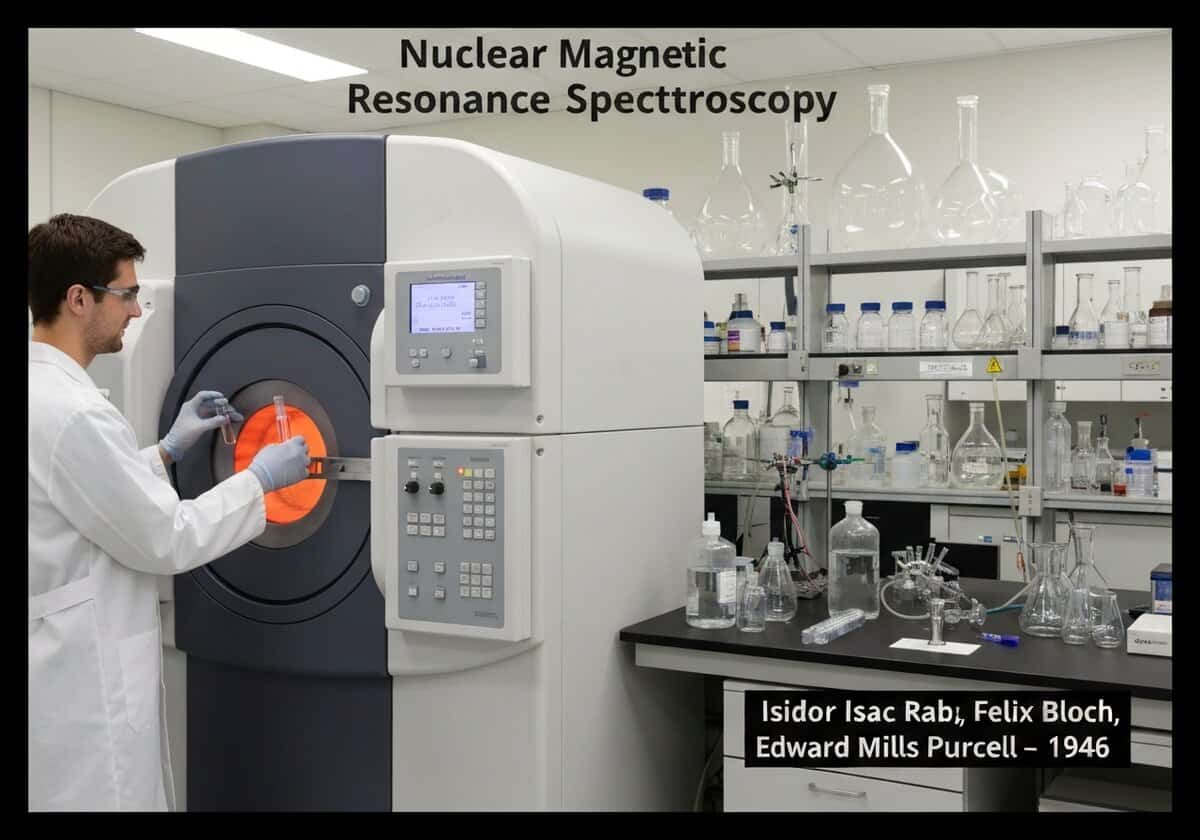
Nuclear Magnetic Resonance spectrometer in an analytical chemistry laboratory.

(generated image for illustration only)

Nuclear Magnetic Resonance (NMR) spectroscopy is a technique that exploits the magnetic properties of certain atomic nuclei. It places a sample in a strong, constant magnetic field and probes it with radio waves. The nuclei absorb and re-emit electromagnetic radiation at a specific resonance frequency, which depends on the intramolecular magnetic field, revealing detailed information about the structure, dynamics, and chemical environment of molecules.

The principle of NMR is based on the quantum mechanical property of nuclear spin. Nuclei with a non-zero spin, such as ¹H (protons) and ¹³C, behave like tiny magnets. When placed in an external magnetic field (\(B_0\)), these nuclear spins align either with or against the field, creating two distinct energy states. The energy difference between these states is proportional to the strength of \(B_0\). By applying a radiofrequency (RF) pulse at the precise frequency (the Larmor frequency) that matches this energy gap, the nuclei can be excited from the lower to the higher energy state. This absorption of energy is the “resonance” phenomenon. When the RF pulse is turned off, the nuclei relax back to their lower energy state, emitting a signal that is detected by the NMR spectrometer. Crucially, the exact resonance frequency of a nucleus is slightly altered by the local electronic environment, an effect called the “chemical shift”. This allows chemists to distinguish between, for example, protons in a methyl group (-CH₃) versus protons in a hydroxyl group (-OH) within the same molecule. Further complexities, like spin-spin coupling, provide information about which atoms are connected to each other, enabling the complete elucidation of molecular structures.

UNESCO Nomenclature: 2501
– Analytical chemistry

Type

Physical Device

Disruption

Revolutionary

Usage

Widespread Use

Precursors

  • Discovery of nuclear spin by Wolfgang Pauli (1924)
  • Isidor Rabi’s molecular beam magnetic resonance experiment (1938)
  • Development of strong, stable electromagnets and sensitive radiofrequency electronics

Applications

  • determining the 3D structure of proteins and other complex biomolecules
  • magnetic resonance imaging (MRI) in medicine
  • chemical synthesis quality control
  • metabolomics research
  • materials science for characterizing polymers and solids

Patents:

NA

Potential Innovations Ideas

Due to scrapping bot traffic, currently more than 40k per day, this content is reserved to community members.
> Login < or > Register < (100% free) to access this, so as all other restricted content and tools.

Related to: NMR, nuclear magnetic resonance, spectroscopy, chemical shift, MRI, molecular structure, spin, radiofrequency, Larmor frequency, magnetic field.

Historical Context

Nuclear Magnetic Resonance (NMR) Spectroscopy

1910
1940
1940
1946
1950
1960
1970
1900
1912
1940
1940
1950
1950
1960
1970

(if date is unknown or not relevant, e.g. "fluid mechanics", a rounded estimation of its notable emergence is provided)

Related Invention, Innovation & Technical Principles

Full size images and downloads are only available, 100% free, for registered members.

> Login <