Product Design, Manufacturing & Innovation Resources
Home » Lithium-ion Intercalation Mechanism

Lithium-ion Intercalation Mechanism

1980
  • M. Stanley Whittingham
  • John B. Goodenough
  • Akira Yoshino
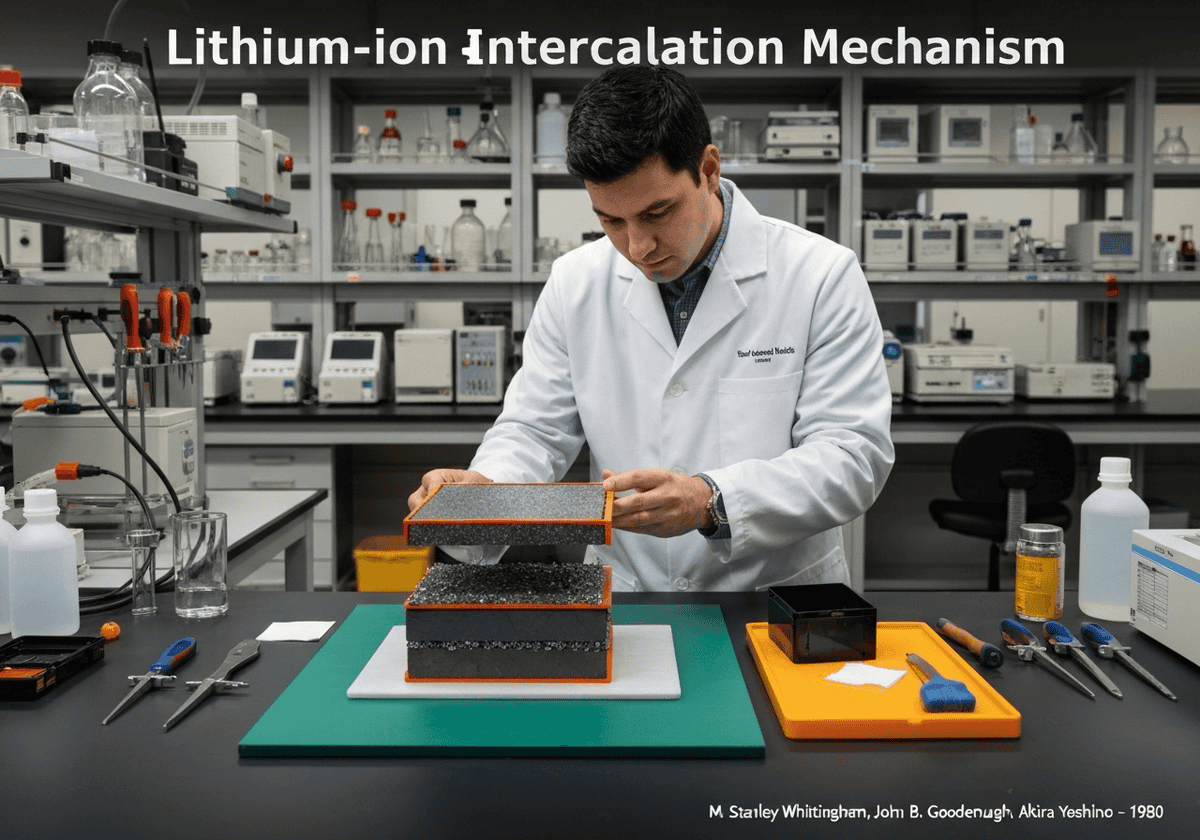
Lithium-ion battery disassembly process in electrochemistry laboratory.

(generated image for illustration only)

Lithium-ion batteries function via an intercalation mechanism, a reversible insertion of ions into a layered host material. During discharge, lithium ions (\(Li^+\)) de-intercalate from a negative electrode (anode), typically graphite, and move through a non-aqueous electrolyte to intercalate into a positive electrode (cathode), typically a metal oxide. Electrons travel through the external circuit, creating current.

The concept of intercalation is central to the success of lithium-ion batteries. Unlike older battery chemistries where the electrodes undergo significant chemical phase changes, intercalation involves lithium ions acting as ‘guests’ that slide into and out of the ‘host’ crystalline structure of the electrode materials. For the anode, the host is typically graphite, which has a layered structure allowing \(Li^+\) ions to fit between its graphene sheets, forming \(LiC_6\). For the cathode, the host is a metal oxide, such as lithium cobalt oxide (\(LiCoO_2\)), where lithium ions occupy layers between cobalt oxide sheets.

This process is highly reversible and does not dramatically alter the host’s structure, which leads to a long cycle life with minimal degradation. The movement of ions is facilitated by a non-aqueous organic electrolyte, as lithium is highly reactive with water. A micro-porous polymer separator keeps the anode and cathode from touching and short-circuiting while allowing ions to pass through.

During charging, an external voltage forces the process to reverse: lithium ions are extracted from the cathode, travel back across the electrolyte, and re-insert into the graphite anode. The high electrochemical potential of lithium, combined with its low atomic weight, allows for batteries with very high energy density and specific energy, which is why they have revolutionized portable electronics and are enabling the transition to electric vehicles.

UNESCO Nomenclature: 2203
– Electrochemistry

Type

Chemical Process

Disruption

Revolutionary

Usage

Widespread Use

Precursors

  • Discovery of lithium metal and its high electrochemical potential
  • Fundamental research on intercalation compounds in the 1970s
  • Development of stable non-aqueous electrolytes
  • Early, unsafe prototypes of rechargeable lithium metal batteries

Applications

  • smartphones, laptops, and tablets
  • electric vehicles (EVs)
  • cordless power tools and garden equipment
  • grid-scale energy storage systems
  • implantable medical devices and hearing aids

Patents:

  • US4357215A

Potential Innovations Ideas

Due to scrapping bot traffic, currently more than 40k per day, this content is reserved to community members.
> Login < or > Register < (100% free) to access this, so as all other restricted content and tools.

Related to: lithium-ion, intercalation, anode, cathode, electrolyte, rechargeable, energy density, graphite.

Historical Context

Lithium-ion Intercalation Mechanism

1970
1970
1975
1980
1980
1980
1984
1970
1970
1974-11-15
1980
1980
1980
1984
1985

(if date is unknown or not relevant, e.g. "fluid mechanics", a rounded estimation of its notable emergence is provided)

Related Invention, Innovation & Technical Principles

Full size images and downloads are only available, 100% free, for registered members.

> Login <