Product Design, Manufacturing & Innovation Resources
Home » Lead-Acid Battery

Lead-Acid Battery

1859
  • Gaston Planté
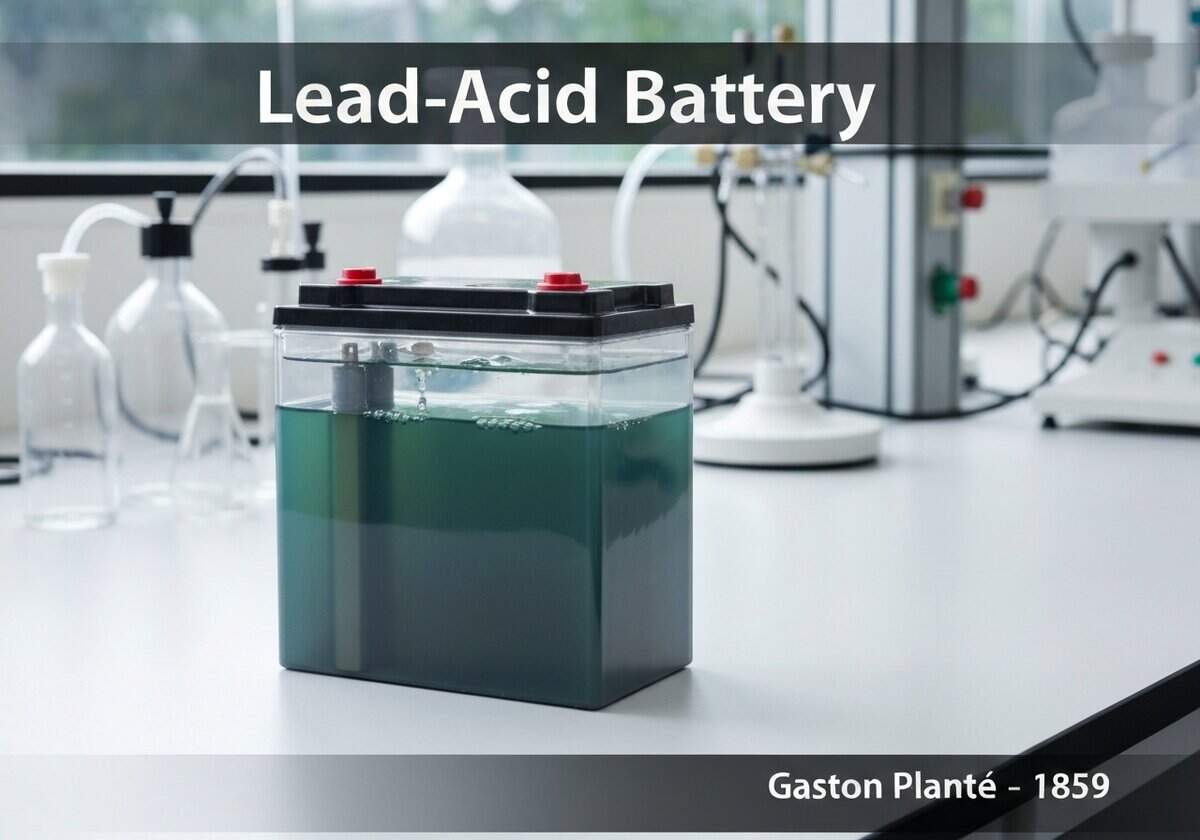
Lead-acid battery with lead and lead dioxide electrodes in sulfuric acid electrolyte, electrochemistry.

(generated image for illustration only)

Lead-Acid battery type is the first rechargeable battery, invented by Gaston Planté in 1859. It operates using a lead (Pb) anode and a lead dioxide (PbO₂) cathode immersed in a sulfuric acid (H₂SO₄) electrolyte. During discharge, both electrodes convert to lead sulfate (PbSO₄), a process that is reversed during charging, allowing for energy storage and reuse.


The lead-acid battery was a foundational invention in the field of electrical energy storage. French physicist Gaston Planté’s design in 1859 was simple yet effective, consisting of two lead sheets separated by rubber strips, rolled into a spiral, and submerged in a sulfuric acid solution. Its novelty lay in its reversibility. Unlike primary cells of the time, it could be recharged by passing a reverse current through it.

The electrochemical reactions are key to its operation. At the negative electrode (anode), lead reacts with sulfate ions from the electrolyte: [latex]Pb(s) + HSO_4^-(aq) rightarrow PbSO_4(s) + H^+(aq) + 2e^-[/latex]. At the positive electrode (cathode), lead dioxide reacts with hydrogen and sulfate ions: [latex]PbO_2(s) + HSO_4^-(aq) + 3H^+(aq) + 2e^- rightarrow PbSO_4(s) + 2H_2O(l)[/latex]. During charging, these reactions are reversed. The formation and dissolution of lead sulfate on the electrodes is the core mechanism for storing and releasing energy. Despite its low energy density and the environmental concerns of lead, its low cost, reliability, and high surge current capability have ensured its continued widespread use, particularly in automotive applications.

UNESCO Nomenclature: 2204
– Electrochemistry

Type

Physical Device

Disruption

Foundational

Usage

Widespread Use

Precursors

  • Alessandro Volta’s invention of the Voltaic pile (1800)
  • Michael Faraday’s laws of electrolysis (1834)
  • understanding of electrochemical cells and galvanic corrosion

Applications

  • automotive starting, lighting, and ignition (SLI) batteries
  • uninterruptible power supplies (UPS)
  • emergency lighting
  • grid energy storage
  • submarines

Patents:

NA

Potential Innovations Ideas

Due to scrapping bot traffic, currently more than 40k per day, this content is reserved to community members.
> Login < or > Register < (100% free) to access this, so as all other restricted content and tools.

Related to: lead-acid, Gaston Planté, rechargeable battery, electrochemistry, sulfuric acid, lead dioxide, anode, cathode, energy storage, SLI battery.

Historical Context

Lead-Acid Battery

1850
1851
1854
1859
1861
1865
1868
1850
1851
1852
1859
1860
1861
1865
1869

(if date is unknown or not relevant, e.g. "fluid mechanics", a rounded estimation of its notable emergence is provided)

Related Invention, Innovation & Technical Principles

Full size images and downloads are only available, 100% free, for registered members.

> Login <