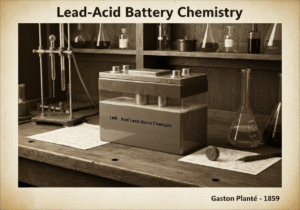
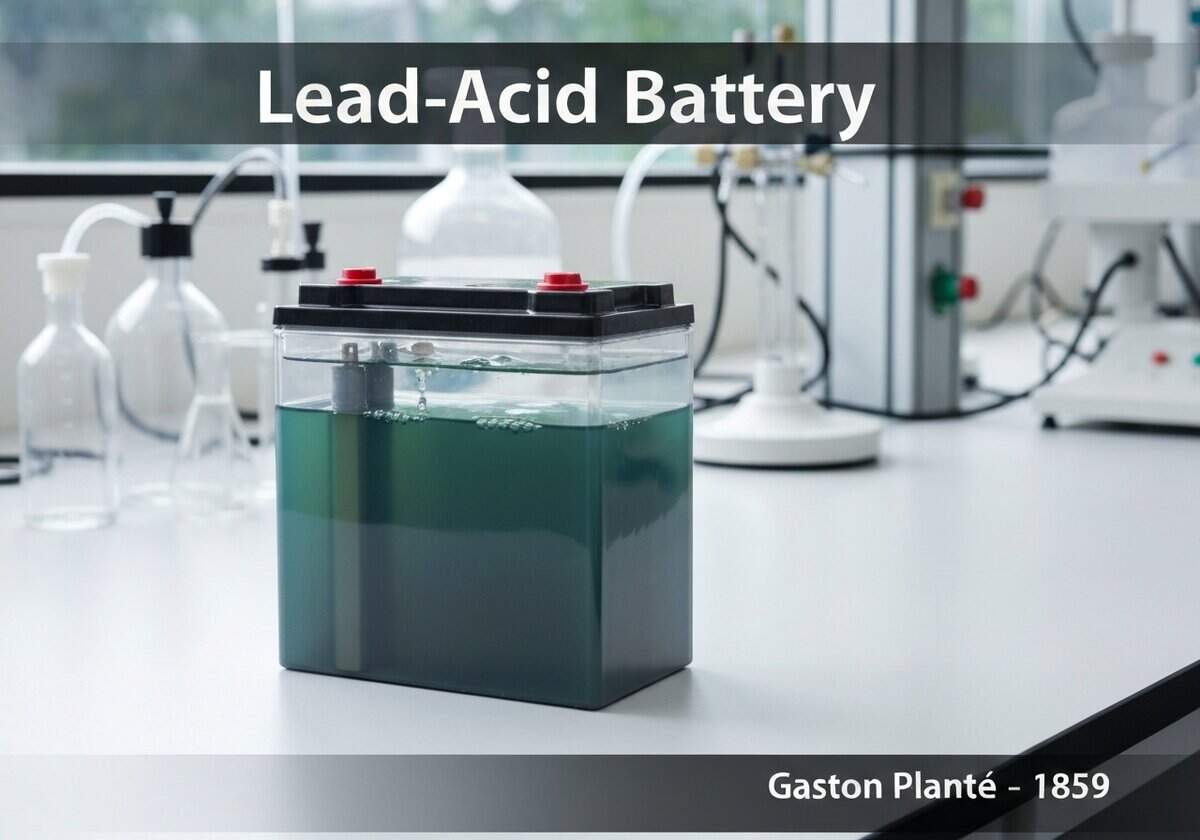
The lead-acid battery was a foundational invention in the field of electrical energy storage. French physicist Gaston Planté’s design in 1859 was simple yet effective, consisting of two lead sheets separated by rubber strips, rolled into a spiral, and submerged in a sulfuric acid solution. Its novelty lay in its reversibility. Unlike primary cells of the time, it could be recharged by passing a reverse current through it.
The electrochemical reactions are key to its operation. At the negative electrode (anode), lead reacts with sulfate ions from the electrolyte: [latex]Pb(s) + HSO_4^-(aq) rightarrow PbSO_4(s) + H^+(aq) + 2e^-[/latex]. At the positive electrode (cathode), lead dioxide reacts with hydrogen and sulfate ions: [latex]PbO_2(s) + HSO_4^-(aq) + 3H^+(aq) + 2e^- rightarrow PbSO_4(s) + 2H_2O(l)[/latex]. During charging, these reactions are reversed. The formation and dissolution of lead sulfate on the electrodes is the core mechanism for storing and releasing energy. Despite its low energy density and the environmental concerns of lead, its low cost, reliability, and high surge current capability have ensured its continued widespread use, particularly in automotive applications.
Related to: lead-acid, Gaston Planté, rechargeable battery, electrochemistry, sulfuric acid, lead dioxide, anode, cathode, energy storage, SLI battery.