Product Design, Manufacturing & Innovation Resources
Home » Laplace’s Equation

Laplace’s Equation

1780
  • Pierre-Simon Laplace
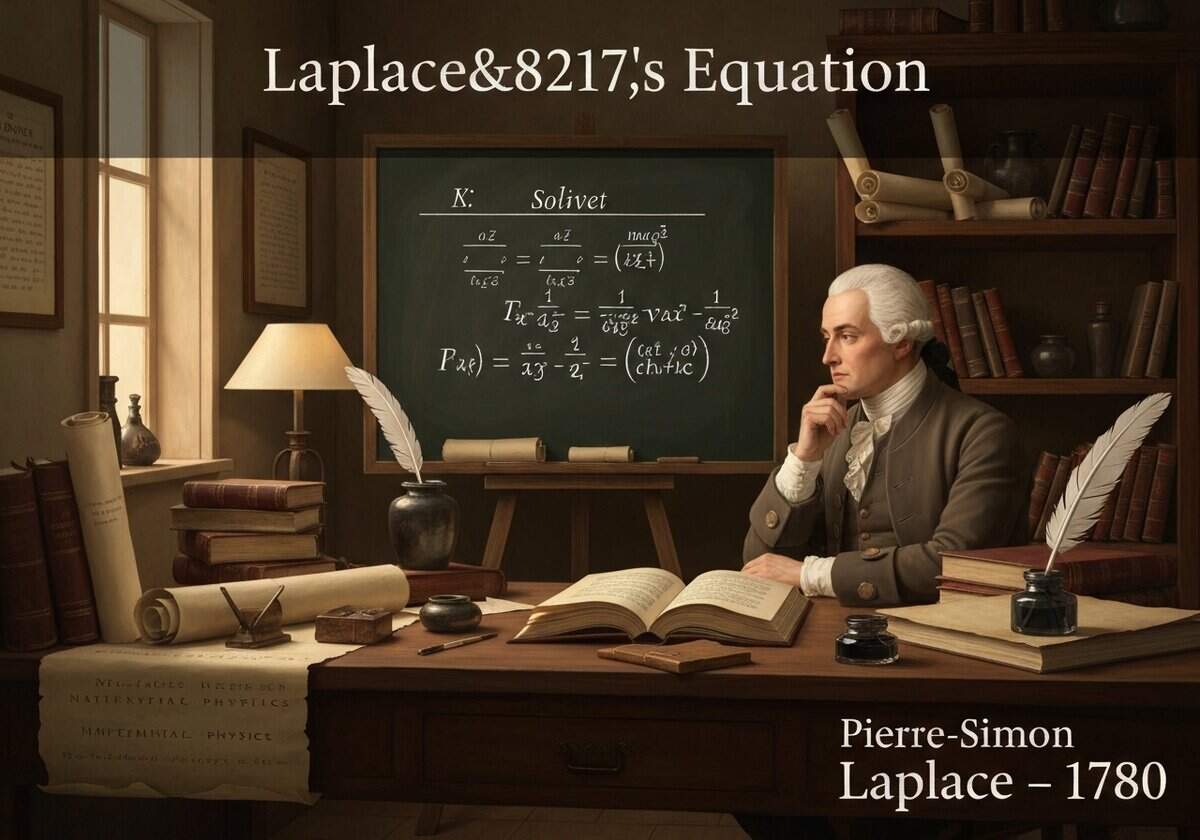
Mathematician solving Laplace's Equation in a historical laboratory setting.

(generated image for illustration only)

A second-order linear elliptic partial differential equation that describes systems in a steady-state or equilibrium condition. It is written as \(nabla^2 u = 0\) or \(Delta u = 0\), where \(nabla^2\) (or \(Delta\)) is the Laplace operator. Solutions, called harmonic functions, are the smoothest possible functions and represent potentials in fields like electrostatics, gravitation, and fluid flow.


Laplace’s equation is the canonical elliptic PDE. It arises in numerous physical contexts where a quantity is in equilibrium and its value at a point is the average of its values in the surrounding neighborhood. This averaging property is a defining characteristic of its solutions, known as harmonic functions. A direct consequence is the ‘maximum principle’ for harmonic functions, which states that a non-constant solution cannot attain its maximum or minimum value in the interior of its domain; these extrema must lie on the boundary. This prevents, for example, a hot spot from existing in a region of steady-state heat flow unless there is a source there (which would violate \(nabla^2 u = 0\)).

Solutions to Laplace’s equation are infinitely differentiable (analytic) even if the boundary conditions are not. This is a remarkable smoothing property, even stronger than that of the heat equation. The problem of finding a solution to Laplace’s equation in a domain given the values of the solution on the boundary is known as the Dirichlet problem. The related Neumann problem specifies the normal derivative on the boundary.

Unlike the time-dependent heat and wave equations, Laplace’s equation is typically solved for boundary value problems, where the entire boundary of a spatial domain influences the solution at every interior point simultaneously. This ‘global’ dependence contrasts with the causal, time-marching nature of parabolic and hyperbolic equations.

UNESCO Nomenclature: 1208
– Mathematical physics

Type

Abstract System

Disruption

Foundational

Usage

Widespread Use

Precursors

  • newton’s law of universal gravitation
  • coulomb’s law of electrostatics
  • concept of a potential field by lagrange
  • development of multivariable calculus and the laplace operator

Applications

  • electrostatics for calculating electric potential in charge-free regions
  • gravitation for determining gravitational potential
  • steady-state heat conduction
  • incompressible and irrotational fluid flow
  • describing the shape of a soap film stretched across a wire frame

Patents:

NA

Potential Innovations Ideas

Due to scrapping bot traffic, currently more than 40k per day, this content is reserved to community members.
> Login < or > Register < (100% free) to access this, so as all other restricted content and tools.

Related to: laplace’s equation, elliptic pde, harmonic function, potential theory, steady-state, electrostatics, boundary value problem, dirichlet problem.

Historical Context

Laplace’s Equation

1736
1750
1763-12-23
1780
1805
1822
1822
1650
1747
1758
1777
1799
1812
1822
1827

(if date is unknown or not relevant, e.g. "fluid mechanics", a rounded estimation of its notable emergence is provided)

Related Invention, Innovation & Technical Principles

Full size images and downloads are only available, 100% free, for registered members.

> Login <