Product Design, Manufacturing & Innovation Resources
Home » Keesom Force

Keesom Force

1921
  • Willem Hendrik Keesom
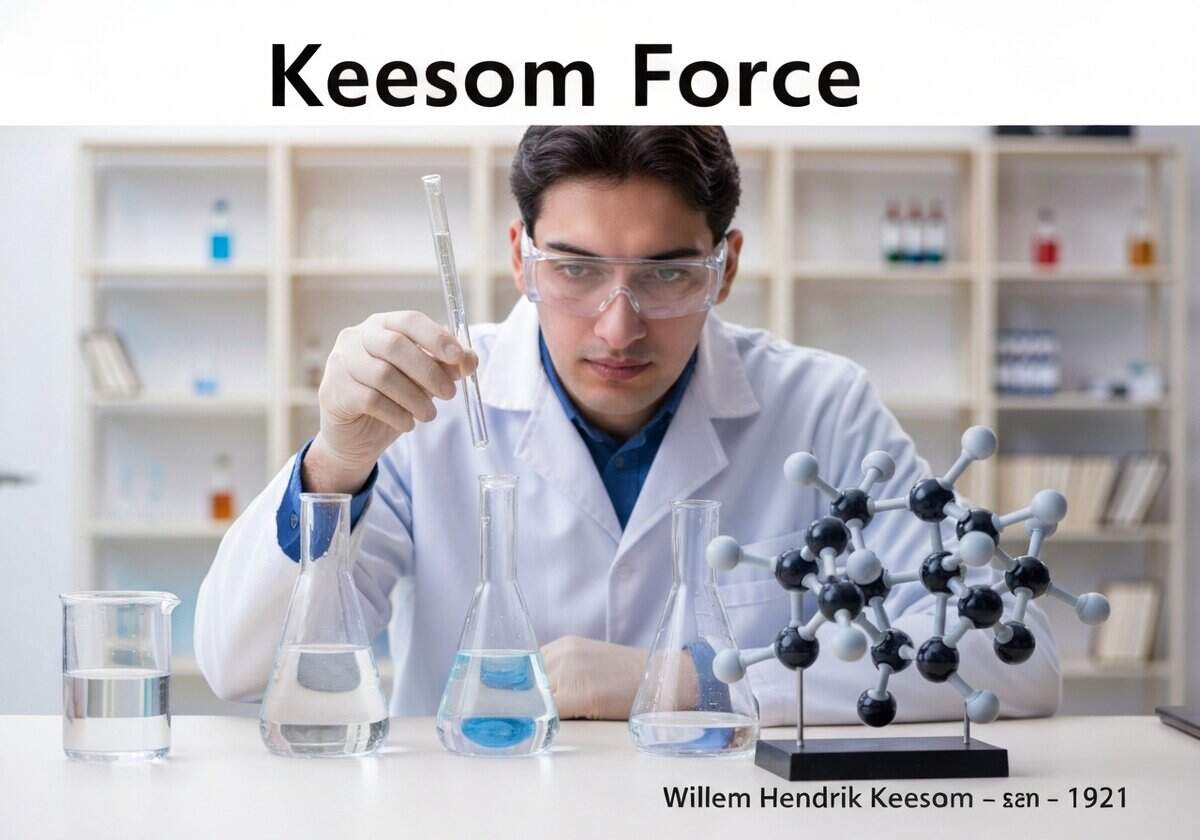
Laboratory experiment demonstrating Keesom force with polar liquids and molecular models.

(generated image for illustration only)

An electrostatic interaction between molecules that possess permanent electric dipole moments, such as water or hydrogen chloride. The force arises from the tendency of these dipoles to align head-to-tail, resulting in a net attraction. This interaction is temperature-dependent, as thermal motion disrupts the alignment. The orientation-averaged potential energy varies as \(V \propto -\frac{1}{r^6 k_B T}\).


The Keesom force, or permanent dipole-dipole interaction, is one of the three components of Van der Waals forces, specifically describing the interaction between two polar molecules. A polar molecule has a permanent separation of positive and negative charge, creating a permanent electric dipole moment. When two such molecules approach each other, their dipoles interact electrostatically. The lowest energy configuration is an attractive, head-to-tail alignment. However, molecules in a fluid are in constant thermal motion (rotating and translating), which tends to randomize their orientations.

Willem Keesom’s contribution was to perform a statistical mechanical average over all possible orientations, weighted by their Boltzmann factor. The result showed that, on average, attractive orientations are slightly more probable than repulsive ones, leading to a net attractive force. The strength of this interaction is uniquely dependent on temperature; as temperature increases, thermal energy more effectively disrupts the alignment, and the Keesom force weakens. This is reflected in the \(1/T\) term in the potential energy equation. This force is crucial for understanding the behavior of many common substances, particularly water, whose properties are dominated by strong dipole-dipole interactions known as hydrogen bonds.

UNESCO Nomenclature: 2202
– Atomic and molecular physics

Type

Physical Law

Disruption

Substantial

Usage

Widespread Use

Precursors

  • Classical Electrodynamics (Coulomb’s Law)
  • The concept of the electric dipole moment by Peter Debye
  • Boltzmann statistics for describing the thermal distribution of states

Applications

  • modeling the physical properties of polar liquids like water (e.g., high boiling point)
  • understanding the basis of hydrogen bonding, a strong type of dipole-dipole interaction
  • predicting solubility based on the ‘like dissolves like’ principle
  • design and function of liquid crystals, which rely on molecular alignment

Patents:

NA

Potential Innovations Ideas

Due to scrapping bot traffic, currently more than 40k per day, this content is reserved to community members.
> Login < or > Register < (100% free) to access this, so as all other restricted content and tools.

Related to: Keesom force, dipole-dipole, permanent dipole, polar molecules, intermolecular force, electrostatic interaction, hydrogen bond, temperature dependence, potential energy, van der waals.

Historical Context

Keesom Force

1918
1920
1920
1921
1922
1924
1925
1918
1919-05-29
1920
1920
1921
1924
1924
1925

(if date is unknown or not relevant, e.g. "fluid mechanics", a rounded estimation of its notable emergence is provided)

Related Invention, Innovation & Technical Principles

Full size images and downloads are only available, 100% free, for registered members.

> Login <