Product Design, Manufacturing & Innovation Resources
Home » Heijunka Production Leveling

Heijunka Production Leveling

1960
  • Taiichi Ohno
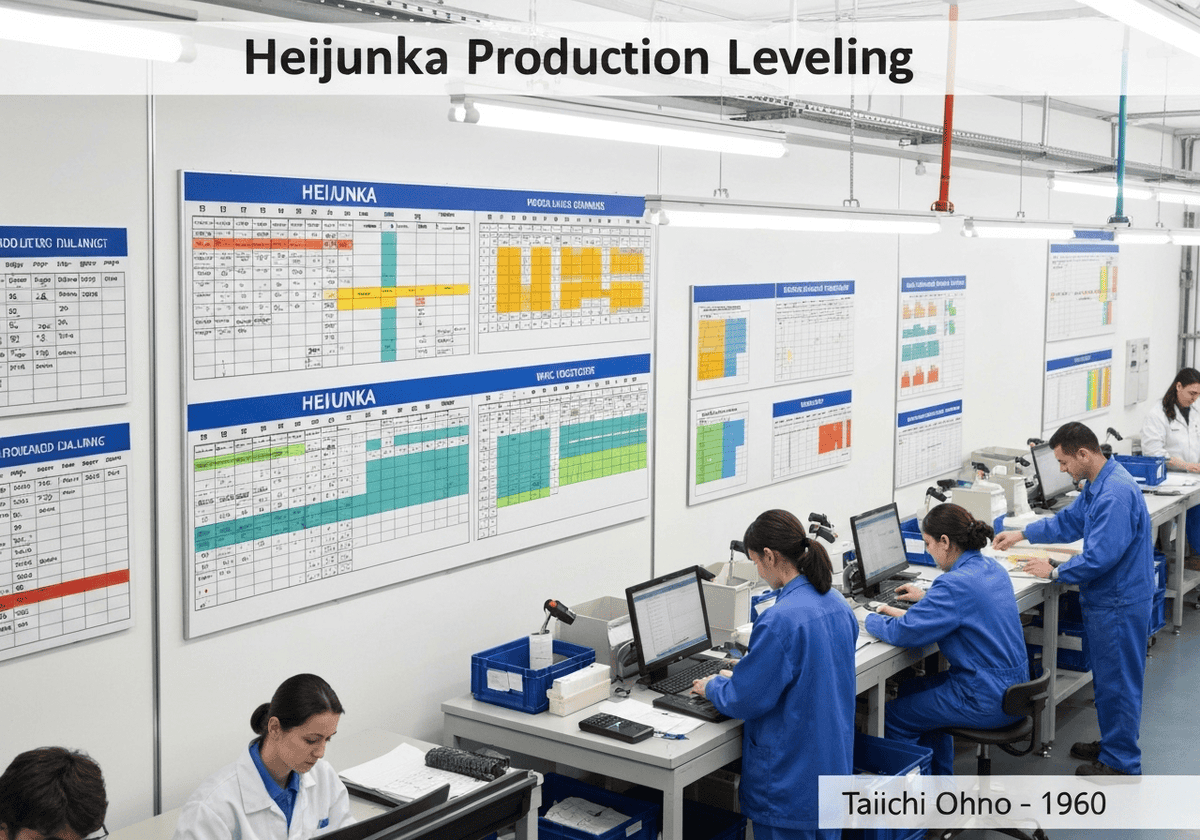
Heijunka board in a manufacturing facility demonstrating production leveling principles.

(generated image for illustration only)

Heijunka is the principle of production leveling or smoothing within the Toyota Production System. It involves averaging out the production volume and mix over a fixed period to eliminate peaks and valleys in workload. This creates a predictable and stable manufacturing environment, which is a prerequisite for implementing Just-in-Time (JIT) and standardized work effectively.


Instead of producing products in large batches according to customer orders (e.g., all of Model A, then all of Model B), Heijunka dictates producing a mixed model sequence in smaller batches. For example, if the weekly demand is for 500 of Model A, 300 of Model B, and 200 of Model C, a traditional system might produce all 500 A’s, then 300 B’s, etc. A Heijunka system would create a repeating sequence like A-B-A-C-A-B-A… This levels the demand for upstream processes and suppliers, preventing the “bullwhip effect” where demand fluctuations are amplified up the supply chain.

To achieve this, Toyota developed tools like the “Heijunka box,” a visual scheduling tool used to manage the production of different models. Each slot in the box represents a time interval, and Kanban cards for different products are placed in the slots to dictate the production sequence. This leveling of both volume and mix reduces inventory, shortens lead times, and stabilizes the workload for employees and equipment. It is a crucial enabler of the entire TPS, as the stability it creates is necessary for JIT and Kaizen to function properly. Without Heijunka, the fluctuations in demand would require large buffer stocks, undermining the core principles of waste elimination.

UNESCO Nomenclature: 3306
– Industrial Engineering

Type

Abstract System

Disruption

Substantial

Usage

Widespread Use

Precursors

  • concepts of production flow from henry ford’s assembly lines
  • need for stability to enable just-in-time production

Applications

  • call center staff scheduling to match average call volumes
  • agile software development sprint planning to maintain a consistent velocity
  • restaurant kitchen prep routines to handle daily rush hours smoothly
  • university course scheduling to balance classroom and faculty utilization
  • grid energy distribution to smooth out demand peaks

Patents:

NA

Potential Innovations Ideas

Due to scrapping bot traffic, currently more than 40k per day, this content is reserved to community members.
> Login < or > Register < (100% free) to access this, so as all other restricted content and tools.

Related to: heijunka, production leveling, production smoothing, lean manufacturing, toyota production system, mixed-model production, workload stability, kanban.

Historical Context

Heijunka Production Leveling

1955
1956
1960
1960
1960
1960
1960
1950
1955
1958
1960
1960
1960
1960
1960

(if date is unknown or not relevant, e.g. "fluid mechanics", a rounded estimation of its notable emergence is provided)

Related Invention, Innovation & Technical Principles

Full size images and downloads are only available, 100% free, for registered members.

> Login <