Product Design, Manufacturing & Innovation Resources
Home » pH Glass Electrode

pH Glass Electrode

1909
  • Fritz Haber
  • Zygmunt Klemensiewicz
  • Duncan A. MacInnes
  • Malcolm Dole
  • Arnold Orville Beckman
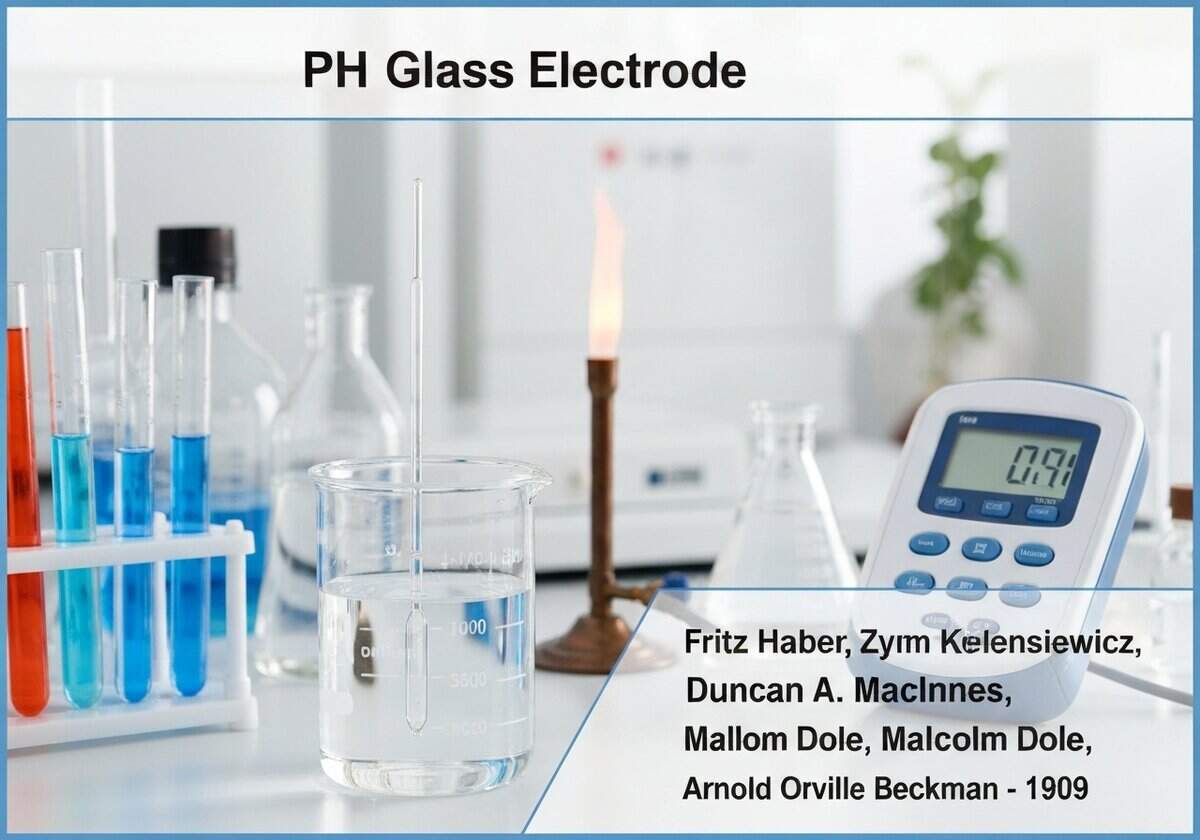
pH glass electrode used in analytical chemistry for measuring hydrogen ion concentration.

(generated image for illustration only)

A pH meter measures the voltage between two electrodes and converts it to a pH value. The core component is the glass electrode, which has a thin glass bulb sensitive to hydrogen ion activity. The potential difference, E, between the glass electrode and a stable reference electrode is linearly proportional to the pH according to a form of the Nernst equation: \(E = K + \frac{2.303RT}{F}pH\).


The glass electrode functions as an ion-selective electrode. Its tip is a thin membrane of a special glass (typically a silicate glass doped with alkali metal ions) that has been hydrated. This hydration creates a gel layer on both the inner and outer surfaces. An ion-exchange equilibrium is established between the alkali metal ions in the glass and the hydrogen ions in the solution. This process creates a boundary potential across the membrane that is dependent on the difference in hydrogen ion activity between the internal solution (which has a fixed pH) and the external sample solution.

This potential is measured against a reference electrode, such as a silver/silver chloride (Ag/AgCl) or calomel electrode, which maintains a constant potential. The complete device, often a single combination probe, is calibrated using buffer solutions of known pH. The high internal resistance of the glass electrode requires a high-impedance voltmeter (the pH meter itself) to accurately measure the small potential difference without drawing significant current, which would alter the system’s equilibrium.

UNESCO Nomenclature: 2201
– Analytical chemistry

Type

Physical Device

Disruption

Revolutionary

Usage

Widespread Use

Precursors

  • Nernst equation (1889)
  • discovery of galvanic cells by Volta
  • understanding of ion-exchange phenomena
  • development of stable reference electrodes (e.g., calomel electrode)

Applications

  • laboratory chemical analysis
  • industrial process control
  • environmental monitoring
  • medical diagnostics
  • food science
  • aquaculture

Patents:

  • US2058761

Potential Innovations Ideas

Due to scrapping bot traffic, currently more than 40k per day, this content is reserved to community members.
> Login < or > Register < (100% free) to access this, so as all other restricted content and tools.

Related to: pH meter, glass electrode, reference electrode, Nernst equation, potentiometry, electrochemistry, analytical instrument, calibration, buffer solution, voltage.

Historical Context

PH Glass Electrode

1902
1904
1907
1909
1910
1912
1915
1902
1902
1907
1909
1910
1911-04-08
1913
1915

(if date is unknown or not relevant, e.g. "fluid mechanics", a rounded estimation of its notable emergence is provided)

Related Invention, Innovation & Technical Principles

Full size images and downloads are only available, 100% free, for registered members.

> Login <