G-code: The Standard CNC Programming Language
1960
- MIT Servomechanisms Laboratory
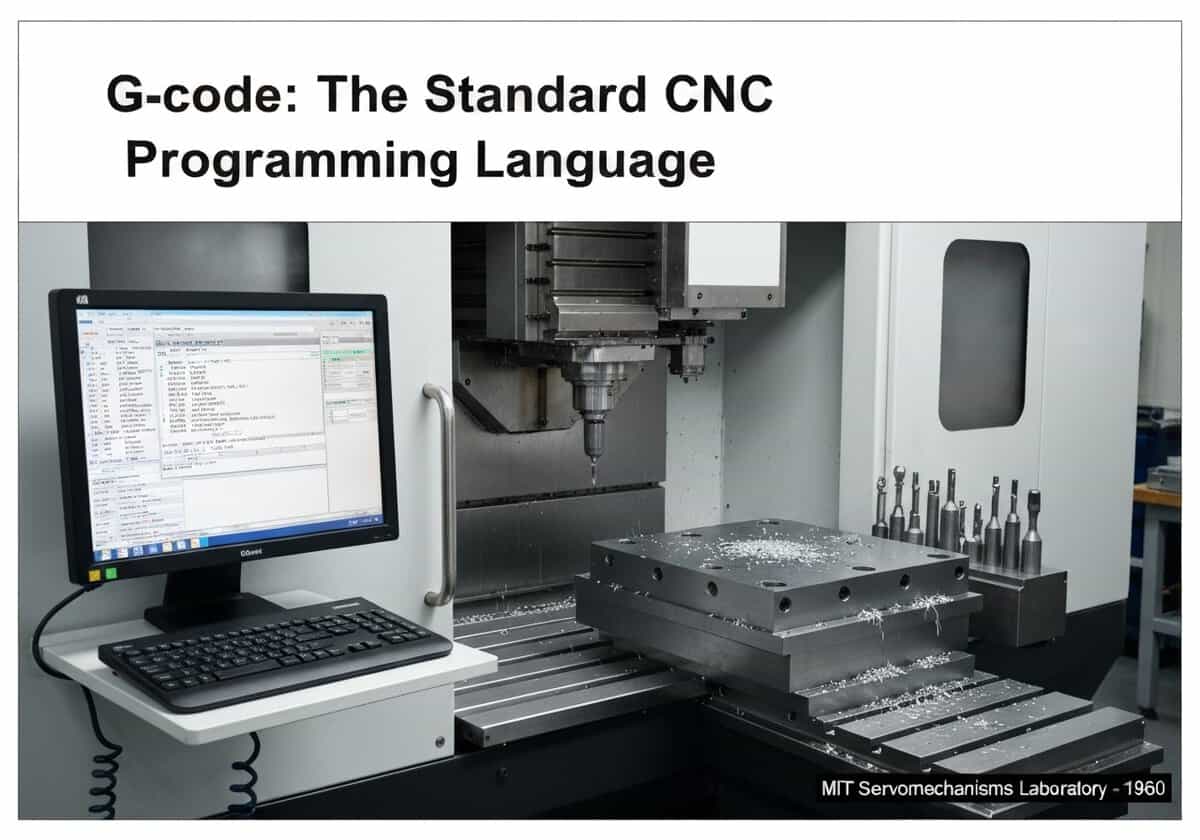
G-code, formally known as RS-274, is the most prevalent programming language for controlling CNC machines. It consists of sequential commands that instruct the machine on positioning, speed, and specific actions. Commands begin with a letter address; ‘G’ denotes preparatory commands for motion (e.g., G01 for linear feed), while ‘M’ signifies miscellaneous functions (e.g., M03 for spindle start).
G-code provides a standardized, human-readable (to a degree) method for creating a set of instructions that a CNC machine controller can interpret and execute. Each line, or ‘block’, of a G-code program typically contains one or more commands that tell the machine what to do next. The structure is based on a word-address format, where a letter (the ‘address’) is followed by a numerical value. For example, the block ‘G01 X10.0 Y5.0 F150’ instructs the controller to perform a linear feed move (G01) to the coordinate position X=10.0, Y=5.0 at a feed rate (F) of 150 units per minute.
The ‘G’ commands are the most crucial, defining the type of motion. G00 is a rapid positioning move, used for non-cutting travel. G01 is a controlled linear feed for cutting straight lines. G02 and G03 command clockwise and counter-clockwise circular/arc movements, respectively. Other G-codes handle tasks like setting coordinate systems (G54-G59), selecting units (G20/G21 for inches/mm), and activating cutter compensation (G41/G42). ‘M’ codes, or miscellaneous functions, control non-geometric actions like starting or stopping the spindle (M03/M05), turning coolant on or off (M08/M09), and initiating tool changes (M06). While RS-274 provides a standard, most machine tool manufacturers have implemented their own specific dialects or extensions of G-code, requiring post-processors in CAM software to translate a generic toolpath into the specific format required by a particular machine controller.
UNESCO Nomenclature: 1203
– Computer science
Precursors
- the concept of numerical control (NC)
- punched tape data storage formats
- early computer programming languages like fortran
- the development of machine tool controllers
Applications
- cnc milling and turning
- 3D printing (additive manufacturing)
- laser cutting and engraving
- water jet cutting
- robotic arm programming
- automated welding
- coordinate-measuring machines (CMM)
Potential Innovations Ideas
Due to scrapping bot traffic, currently more than 40k per day, this content is reserved to community members.
> Login < or > Register < (100% free) to access this, so as all other restricted content and tools.
Related to: G-code, RS-274, CNC programming, manufacturing, machining, toolpath, cam, g01, m-code, numerical control.