Product Design, Manufacturing & Innovation Resources
Home » The Fire Triangle Model

The Fire Triangle Model

1900
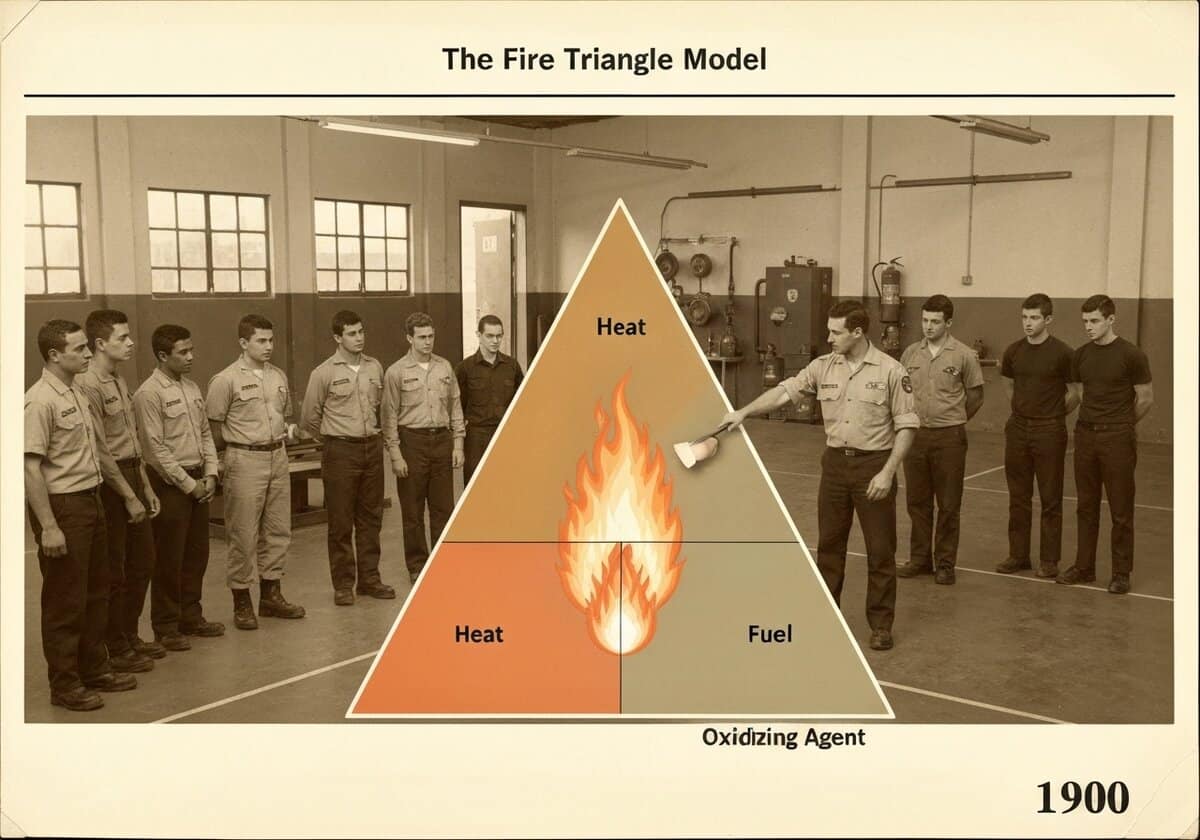
Fire Triangle Model in a fire safety training session, highlighting heat, fuel, and oxidizing agent.

(generated image for illustration only)

The fire triangle is a simple model illustrating the three essential elements required for most fires: heat, fuel, and an oxidizing agent, typically atmospheric oxygen. Removing any one of these elements prevents a fire from starting or causes an existing fire to be extinguished. It is a fundamental concept in fire safety and prevention.


The fire triangle, also known as the combustion triangle, is a foundational model in fire safety science. It visually represents the three necessary components for ignition and sustained combustion. The first side is ‘Heat’, which provides the energy required to raise the fuel to its ignition temperature and maintain the combustion process; this is the activation energy for the reaction. The second side is ‘Fuel’, which is any combustible material in a solid, liquid, or gaseous state. For combustion to occur, solid and liquid fuels must typically be vaporized or pyrolyzed into a gaseous state. The third side is the ‘Oxidizing Agent’, a substance that reacts chemically with the fuel, with the most common being oxygen from the ambient air. The model’s simplicity makes it an effective educational tool for explaining how fires start and how they can be prevented or extinguished. By understanding that fire requires all three elements simultaneously, one can devise strategies to break the triangle and stop the fire. For example, applying water removes heat, creating a firebreak removes fuel, and using a CO2 extinguisher displaces oxygen.

UNESCO Nomenclature: 3305
– Chemical engineering

Type

Abstract System

Disruption

Foundational

Usage

Widespread Use

Precursors

  • discovery of fire by early humans
  • antoine lavoisier’s work on the role of oxygen in combustion (late 18th century)
  • understanding of activation energy in chemical reactions
  • development of formal fire brigades and safety protocols

Applications

  • fire safety education
  • fire prevention strategies
  • basic firefighting training
  • design of fire suppression systems
  • building codes and regulations
  • fire risk assessment

Patents:

NA

Potential Innovations Ideas

Due to scrapping bot traffic, currently more than 40k per day, this content is reserved to community members.
> Login < or > Register < (100% free) to access this, so as all other restricted content and tools.

Related to: fire triangle, combustion, heat, fuel, oxygen, fire safety, ignition, extinguishment, fire prevention, oxidizing agent.

Historical Context

The Fire Triangle Model

1886-04-23
1890
1897
1900
1900
1903-05-10
1910
1884
1890
1890
1899-01-01
1900
1903
1906
1910

(if date is unknown or not relevant, e.g. "fluid mechanics", a rounded estimation of its notable emergence is provided)

Related Invention, Innovation & Technical Principles

Full size images and downloads are only available, 100% free, for registered members.

> Login <