Product Design, Manufacturing & Innovation Resources
Home » Fault Tree Analysis (FTA)

Fault Tree Analysis (FTA)

1962
  • H.A. Watson
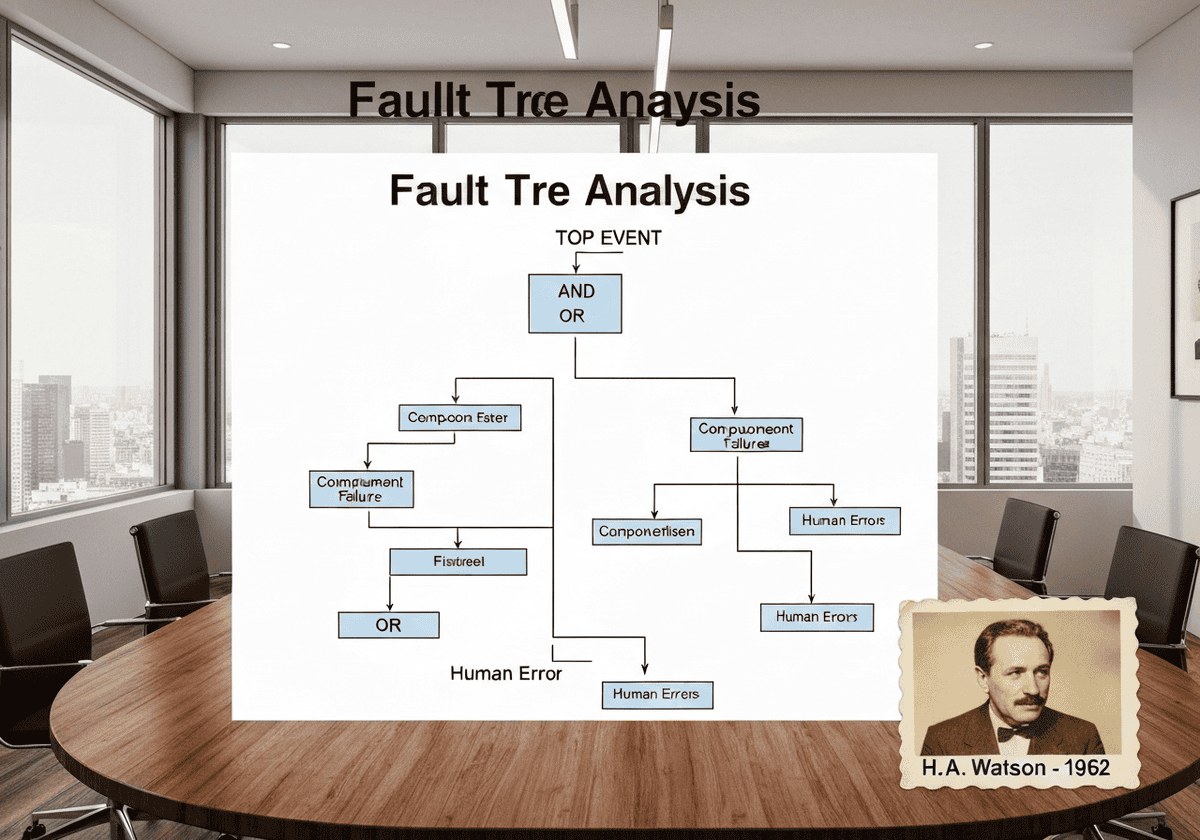
Fault tree analysis diagram for systems design and risk assessment.

(generated image for illustration only)

FTA is a top-down, deductive failure analysis technique. It starts with a potential undesired event (the “top event”) and uses Boolean logic gates (AND, OR, etc.) to determine the combinations of component failures or human errors that could cause it. It provides a graphical model for understanding and quantifying system risk, identifying critical failure paths.


Fault Tree Analysis was developed at Bell Laboratories in the early 1960s to evaluate the safety of the Minuteman I Intercontinental Ballistic Missile (ICBM) launch control system. The technique was later adopted and extensively used by Boeing and NASA.

The analysis process begins by defining the top event, which is a specific system failure or hazard. The analyst then works backward to identify all possible immediate causes. These causes are linked to the top event using logic gates. An ‘OR’ gate implies that any of the input events is sufficient to cause the output event, while an ‘AND’ gate requires all input events to occur simultaneously. The process continues downwards, breaking down events into more fundamental causes, until basic events are reached. Basic events are typically component failures or human errors for which failure probability data is available.

Once the fault tree is constructed, it can be analyzed qualitatively to identify single points of failure and minimal cut sets (the smallest combinations of basic events that will cause the top event). It can also be analyzed quantitatively by assigning probabilities to the basic events and using Boolean algebra to calculate the probability of the top event occurring. This makes FTA a powerful tool for risk assessment and for prioritizing design improvements.

UNESCO Nomenclature: 3313
– Systems design and theory

Type

Software/Algorithm

Disruption

Revolutionary

Usage

Widespread Use

Precursors

  • boolean algebra developed by George Boole
  • system safety engineering concepts from the 1950s
  • reliability block diagrams
  • event tree analysis (a forward, inductive logic approach)

Applications

  • safety analysis of nuclear power plants
  • risk assessment in the aerospace industry, including for the apollo program
  • hazard analysis in chemical processing plants
  • reliability analysis of complex railway signaling systems

Patents:

NA

Potential Innovations Ideas

Due to scrapping bot traffic, currently more than 40k per day, this content is reserved to community members.
> Login < or > Register < (100% free) to access this, so as all other restricted content and tools.

Related to: fault tree analysis, fta, risk assessment, top-down analysis, boolean logic, safety engineering, minimal cut set, system safety.

Historical Context

Fault Tree Analysis (FTA)

1960
1960
1960
1962
1964
1970
1970
1960
1960
1960
1960
1963
1965-12-21
1970
1970

(if date is unknown or not relevant, e.g. "fluid mechanics", a rounded estimation of its notable emergence is provided)

Related Invention, Innovation & Technical Principles

Full size images and downloads are only available, 100% free, for registered members.

> Login <