Product Design, Manufacturing & Innovation Resources
Home » Euclidean Distance

Euclidean Distance

1650
  • René Descartes
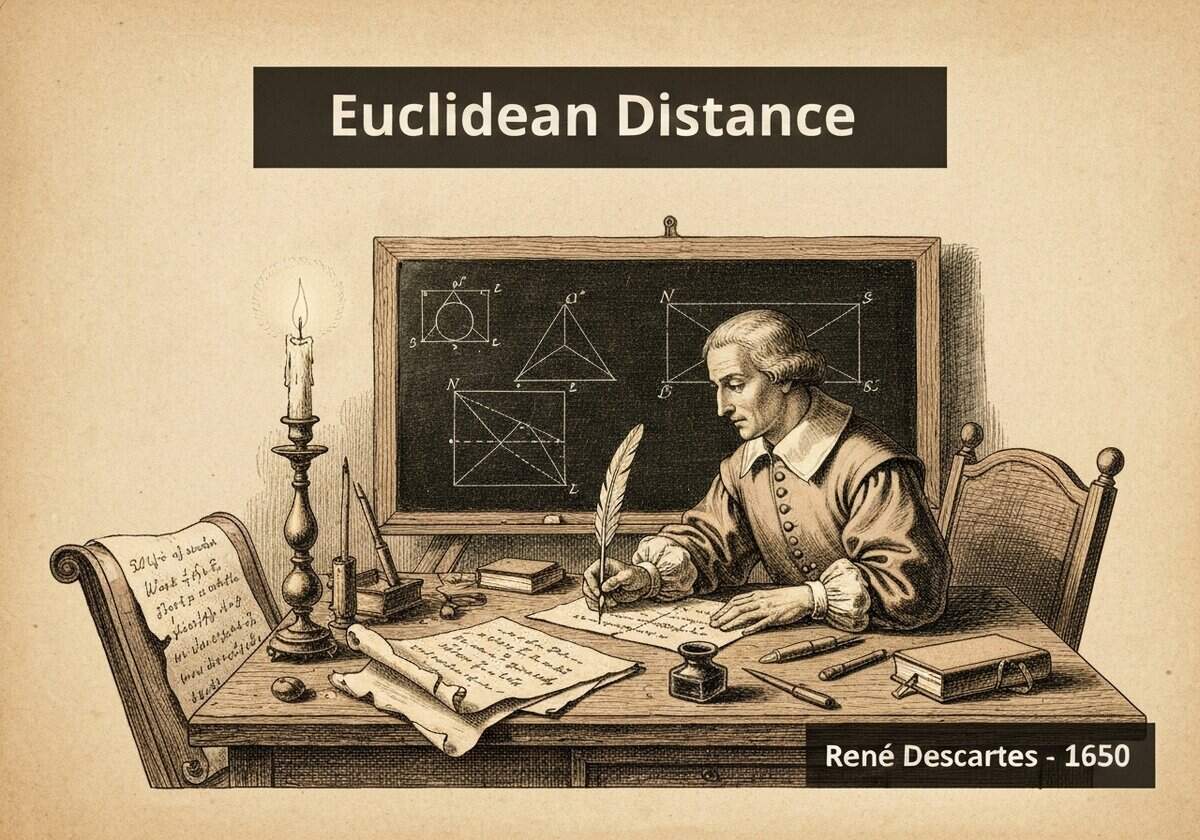
Analytic geometry workspace with Euclidean distance calculations and historical context.

(generated image for illustration only)

The Pythagorean theorem provides the basis for the distance formula in Cartesian coordinates. The distance \(d\) between two points \((x_1, y_1)\) and \((x_2, y_2)\) in a plane is given by \(d = \sqrt{(x_2 – x_1)^2 + (y_2 – y_1)^2}\). This formula is a direct application of the theorem to a right triangle whose legs are the differences in the x and y coordinates.

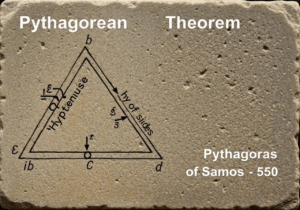
The Euclidean distance formula is a direct and powerful application of the Pythagorean theorem within the framework of a Cartesian coordinate system. It provides a simple method to calculate the straight-line distance between any two points in a plane (or in higher-dimensional space). For two points, P1 at \((x_1, y_1)\) and P2 at \((x_2, y_2)\), the formula is \(d = \sqrt{(x_2 – x_1)^2 + (y_2 – y_1)^2}\).

The derivation of this formula is visually intuitive. The two points can be seen as vertices of a right-angled triangle. The length of the horizontal leg of this triangle is the absolute difference in the x-coordinates, \(|x_2 – x_1|\). The length of the vertical leg is the absolute difference in the y-coordinates, \(|y_2 – y_1|\). The straight-line distance between P1 and P2 is the hypotenuse of this triangle. By applying the Pythagorean theorem (\(c^2 = a^2 + b^2\)), we get \(d^2 = (x_2 – x_1)^2 + (y_2 – y_1)^2\). Taking the square root of both sides yields the distance formula. The squaring operation conveniently removes the need for absolute value signs.

This concept, born from the marriage of ancient Greek geometry and 17th-century analytic geometry developed by René Descartes and Pierre de Fermat, is fundamental to nearly every scientific and technical field. It allows geometric problems to be translated into algebraic ones and solved systematically. The formula also generalizes seamlessly to three or more dimensions. For two points in 3D space, \((x_1, y_1, z_1)\) and \((x_2, y_2, z_2)\), the distance is \(d = \sqrt{(x_2 – x_1)^2 + (y_2 – y_1)^2 + (z_2 – z_1)^2}\). This generalized form, known as the Euclidean norm or L2 norm, is a cornerstone of linear algebra, computer science (especially in machine learning for ‘k-nearest neighbors’ and clustering algorithms), and physics.

UNESCO Nomenclature: 1204
– Geometry

Type

Abstract System

Disruption

Foundational

Usage

Widespread Use

Precursors

  • the Pythagorean theorem
  • development of the Cartesian coordinate system by René Descartes
  • the concept of representing geometric points with algebraic coordinates

Applications

  • computer science (e.g., k-nearest neighbors algorithm in machine learning)
  • geographic information systems (GIS)
  • robotics and autonomous navigation
  • data analysis and clustering
  • video game development (calculating distances between objects)

Patents:

NA

Potential Innovations Ideas

Due to scrapping bot traffic, currently more than 40k per day, this content is reserved to community members.
> Login < or > Register < (100% free) to access this, so as all other restricted content and tools.

Related to: distance formula, euclidean distance, cartesian coordinates, analytic geometry, pythagorean theorem, coordinate system, machine learning, gis, mathematics, geometry.

Historical Context

Euclidean Distance

-400
-550
1635
1650
1736
1750
1763-12-23
-350
-500
150
1640
1650
1747
1758
1777

(if date is unknown or not relevant, e.g. "fluid mechanics", a rounded estimation of its notable emergence is provided)

Related Invention, Innovation & Technical Principles

Full size images and downloads are only available, 100% free, for registered members.

> Login <