Product Design, Manufacturing & Innovation Resources
Home » CubeSat

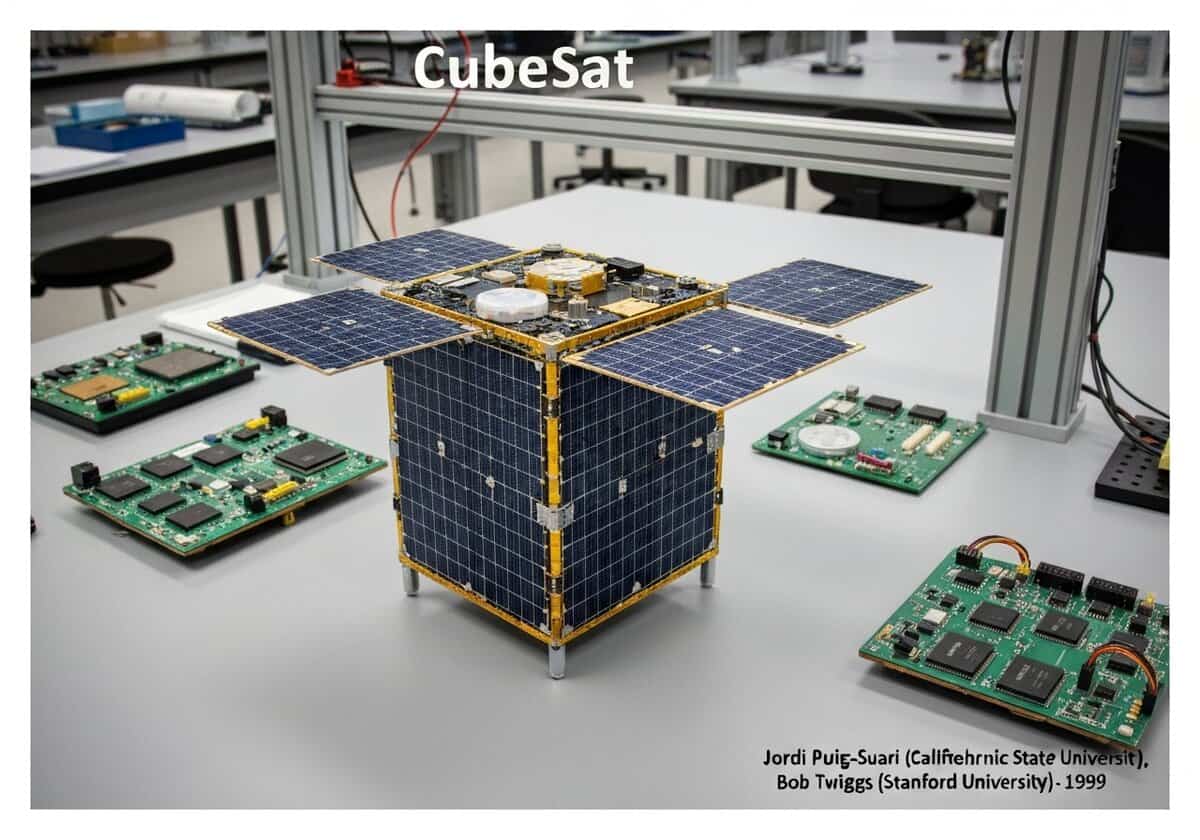
CubeSat

1999
  • Jordi Puig-Suari (California Polytechnic State University)
  • Bob Twiggs (Stanford University)
CubeSat nanosatellite design in aerospace engineering laboratory.

(generated image for illustration only)

A specification for a class of nanosatellites using a standard unit size of 10x10x10 cm, known as 1U, with a mass up to 2 kg. CubeSats can be scaled to 1.5U, 2U, 3U, 6U, or 12U+ sizes. This standardization dramatically lowered the barrier to entry for space missions by enabling shared launch dispensers and a market for off-the-shelf components.


The CubeSat standard was conceived in 1999 as an educational tool to give graduate students hands-on experience in designing, building, testing, and operating a satellite. The core innovation was not just the small size, but the standardization of the form factor and its interface with the launch vehicle. This was achieved through the Poly-Picosatellite Orbital Deployer (P-POD), a box-like mechanism that holds the CubeSats securely during launch and ejects them into orbit using a spring-loaded system.

By standardizing the external dimensions and providing a simple, reliable deployment method, the CubeSat specification decoupled the satellite’s design from the specifics of the launch vehicle. This allowed launch providers to treat CubeSats as a uniform type of secondary payload, simplifying integration and safety reviews. This predictability fueled the creation of a vibrant ecosystem of commercial-off-the-shelf (COTS) components. Companies began mass-producing CubeSat-compatible subsystems like power systems, on-board computers, radios, and attitude control systems. This COTS market drastically reduced the cost and development time for new missions, transforming the CubeSat from a purely educational tool into a viable platform for commercial ventures, government science, and even interplanetary exploration.

UNESCO Nomenclature: 3302
– Aerospace engineering

Type

Design Standard

Disruption

Revolutionary

Usage

Widespread Use

Precursors

  • earlier picosatellite projects at stanford university’s space systems development laboratory
  • the need for a standardized, low-cost platform for graduate student education
  • advances in commercial-off-the-shelf (cots) electronics
  • development of standardized launch vehicle adapters for secondary payloads like the asap ring

Applications

  • university-led space science missions
  • commercial earth observation constellations (e.g., planet labs)
  • in-orbit technology demonstration for new hardware and software
  • interplanetary missions (e.g., marcopolo-a and marcopolo-b)
  • amateur radio communication satellites

Patents:

NA

Potential Innovations Ideas

Due to scrapping bot traffic, currently more than 40k per day, this content is reserved to community members.
> Login < or > Register < (100% free) to access this, so as all other restricted content and tools.

Related to: CubeSat, nanosatellite, satellite standard, 1U, p-pod, Bob Twiggs, Jordi Puig-Suari, newspace, cots, standardized design.

Historical Context

CubeSat

1993-07-22
1996
1998
1999
2000
2000
2000
1993
1994
1997
1998
1999-05-01
2000
2000
2000

(if date is unknown or not relevant, e.g. "fluid mechanics", a rounded estimation of its notable emergence is provided)

Related Invention, Innovation & Technical Principles

Full size images and downloads are only available, 100% free, for registered members.

> Login <