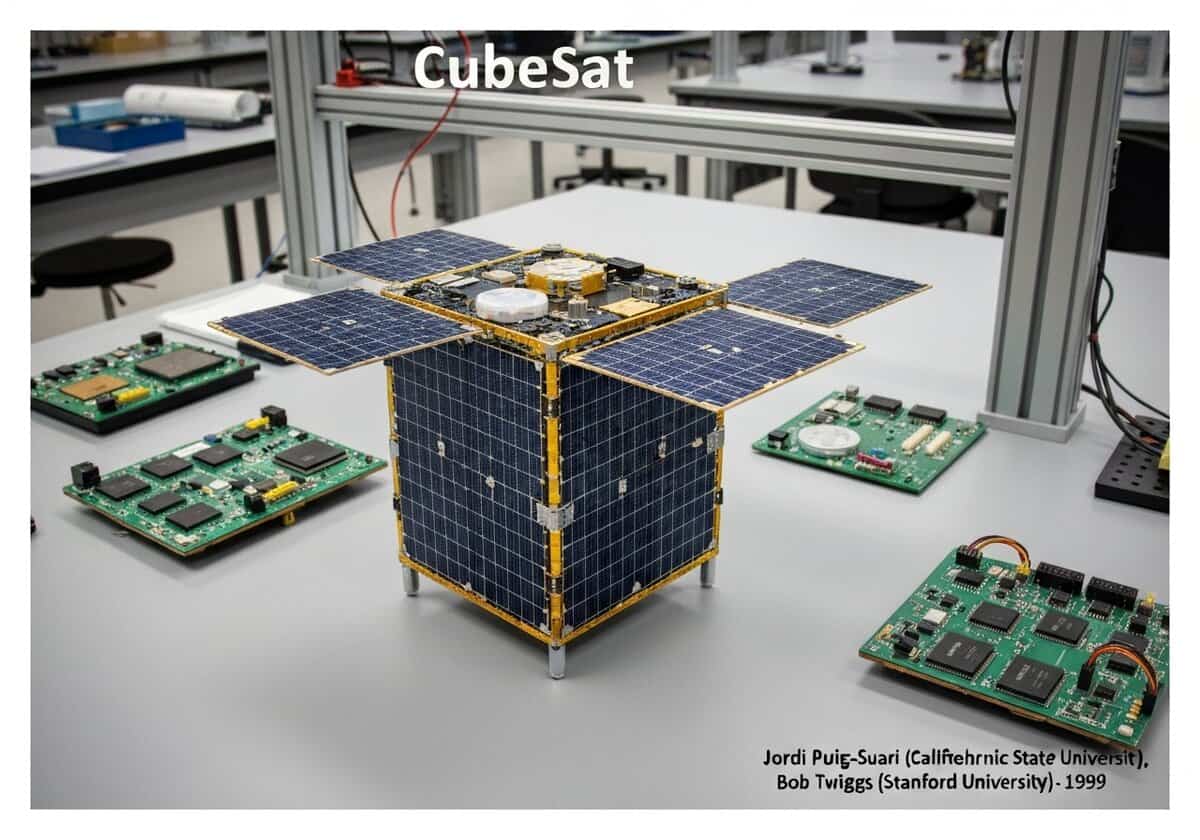
큐브샛은 표준 크기인 10x10x10cm(1U)를 사용하는 나노위성 종류에 대한 규격으로, 질량은 최대 2kg입니다. 큐브샛은 1.5U, 2U, 3U, 6U 또는 12U 이상의 크기로 확장될 수 있습니다. 이러한 표준화는 발사체 공유 및 기성 부품 시장 형성을 가능하게 함으로써 우주 임무 진입 장벽을 획기적으로 낮췄습니다.


(설명을 위한 생성된 이미지입니다)
큐브샛은 표준 크기인 10x10x10cm(1U)를 사용하는 나노위성 종류에 대한 규격으로, 질량은 최대 2kg입니다. 큐브샛은 1.5U, 2U, 3U, 6U 또는 12U 이상의 크기로 확장될 수 있습니다. 이러한 표준화는 발사체 공유 및 기성 부품 시장 형성을 가능하게 함으로써 우주 임무 진입 장벽을 획기적으로 낮췄습니다.
The CubeSat standard was conceived in 1999 as an educational tool to give graduate students hands-on experience in designing, building, testing, and operating a satellite. The core innovation was not just the small size, but the standardization of the form factor and its interface with the launch vehicle. This was achieved through the Poly-Picosatellite Orbital Deployer (P-POD), a box-like mechanism that holds the CubeSats securely during launch and ejects them into orbit using a spring-loaded system.
By standardizing the external dimensions and providing a simple, reliable deployment method, the CubeSat specification decoupled the satellite’s design from the specifics of the launch vehicle. This allowed launch providers to treat CubeSats as a uniform type of secondary payload, simplifying integration and safety reviews. This predictability fueled the creation of a vibrant ecosystem of commercial-off-the-shelf (COTS) components. Companies began mass-producing CubeSat-compatible subsystems like power systems, on-board computers, radios, and attitude control systems. This COTS market drastically reduced the cost and development time for new missions, transforming the CubeSat from a purely educational tool into a viable platform for commercial ventures, government science, and even interplanetary exploration.
현재 하루 4만 건이 넘는 봇 트래픽을 차단하기 위해 이 콘텐츠는 커뮤니티 회원만 이용할 수 있습니다.
> 로그인 < 또는 >등록 < 이 콘텐츠를 비롯한 모든 제한된 콘텐츠와 도구는 (100% 무료로) 이용할 수 있습니다.
큐브샛
(날짜를 알 수 없거나 관련이 없는 경우, 예를 들어 "유체역학"의 경우, 주목할 만한 등장 시기를 대략적으로 추정하여 제공합니다.)

고화질 이미지 및 다운로드는 등록된 회원에게만 100% 무료로 제공됩니다.
> 로그인 <