Product Design, Manufacturing & Innovation Resources
Home » C-Rate (battery)

C-Rate (battery)

1970
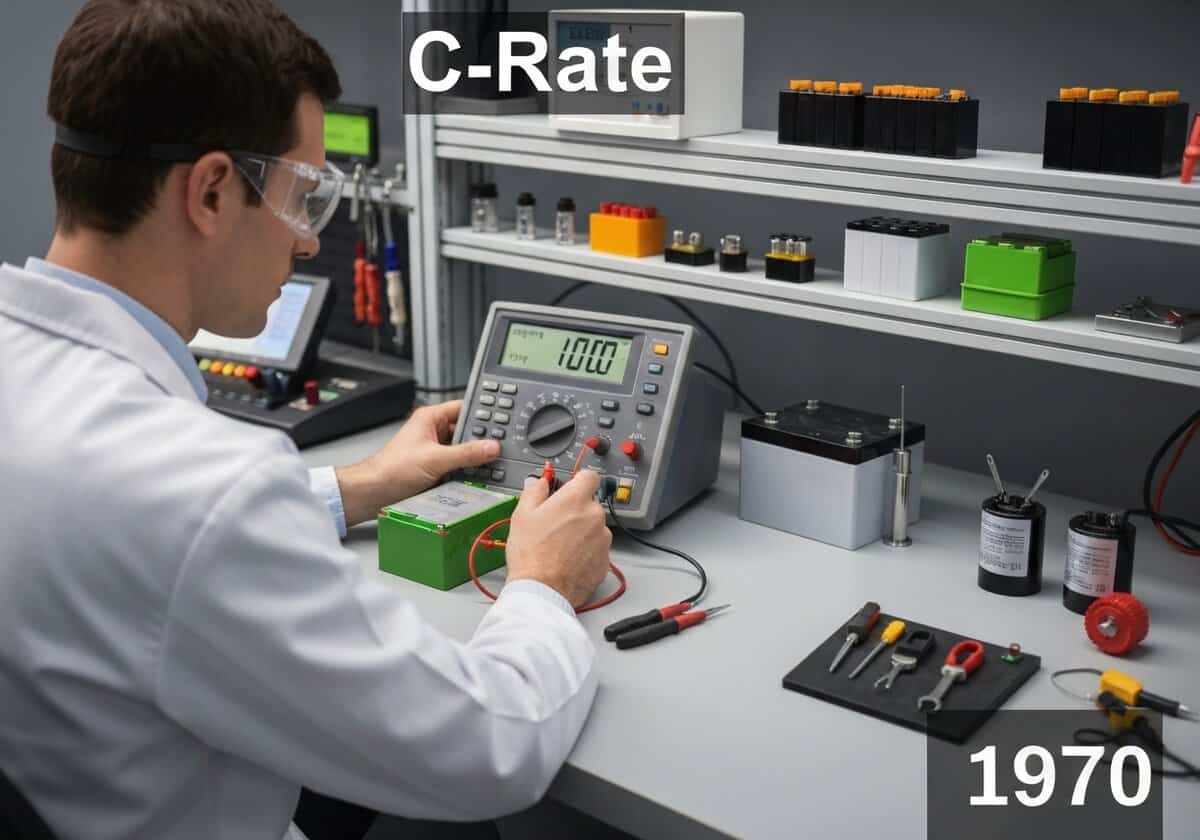
Battery performance evaluation in electrical engineering lab focusing on C-rate measurement.

(generated image for illustration only)

The C-rate is a standardized measure of the rate at which a battery is charged or discharged relative to its nominal capacity. A rate of 1C means the current will fully charge or discharge the battery in one hour. Higher C-rates (e.g., 5C) indicate faster charging/discharging (12 minutes), while lower rates (e.g., C/2) indicate slower processes (2 hours).

The C-rate provides a simple, universal way to discuss battery current without needing to know the battery’s exact capacity in ampere-hours (Ah). It normalizes the current against the battery’s size. For example, for a 2 Ah battery, a 1C discharge rate corresponds to a current of 2 A. For a 50 Ah battery, 1C corresponds to 50 A. This allows engineers to compare the performance of different batteries on an equal footing.

The C-rate is a critical parameter because a battery’s available capacity is dependent on the discharge rate. Typically, a battery will deliver less total energy if discharged at a very high C-rate compared to a low C-rate. This is known as Peukert’s law. High C-rates generate more internal heat due to the battery’s internal resistance, which can accelerate degradation and pose safety risks. Therefore, battery datasheets specify maximum continuous and peak C-rates for both charging and discharging. The development of high C-rate batteries is a major area of research, particularly for applications like electric vehicles that require rapid charging and high power acceleration.

UNESCO Nomenclature: 3305
– Electrical Engineering

Type

Abstract System

Disruption

Incremental

Usage

Widespread Use

Precursors

  • Ohm’s law defining the relationship between voltage, current, and resistance
  • the concept of ampere-hour as a unit of electric charge
  • development of commercial rechargeable batteries requiring standardized performance metrics

Applications

  • specifying fast-charging capabilities of smartphones and EVs
  • determining the power output of batteries for power tools
  • sizing battery systems for grid applications
  • evaluating battery performance in technical datasheets
  • managing battery health in battery management systems (BMS)

Patents:

NA

Potential Innovations Ideas

Due to scrapping bot traffic, currently more than 40k per day, this content is reserved to community members.
> Login < or > Register < (100% free) to access this, so as all other restricted content and tools.

Related to: C-rate, charge rate, discharge rate, battery capacity, ampere-hour, battery management, Peukert’s law, fast charging, power engineering, electrical engineering.

Historical Context

C-Rate (battery)

1964
1970
1970
1970
1970
1972
1974
1963
1965-12-21
1970
1970
1970
1970
1974
1974

(if date is unknown or not relevant, e.g. "fluid mechanics", a rounded estimation of its notable emergence is provided)

Related Invention, Innovation & Technical Principles

Full size images and downloads are only available, 100% free, for registered members.

> Login <