Product Design, Manufacturing & Innovation Resources
Home » Boolean Algebra in Digital Logic

Boolean Algebra in Digital Logic

1854
  • George Boole
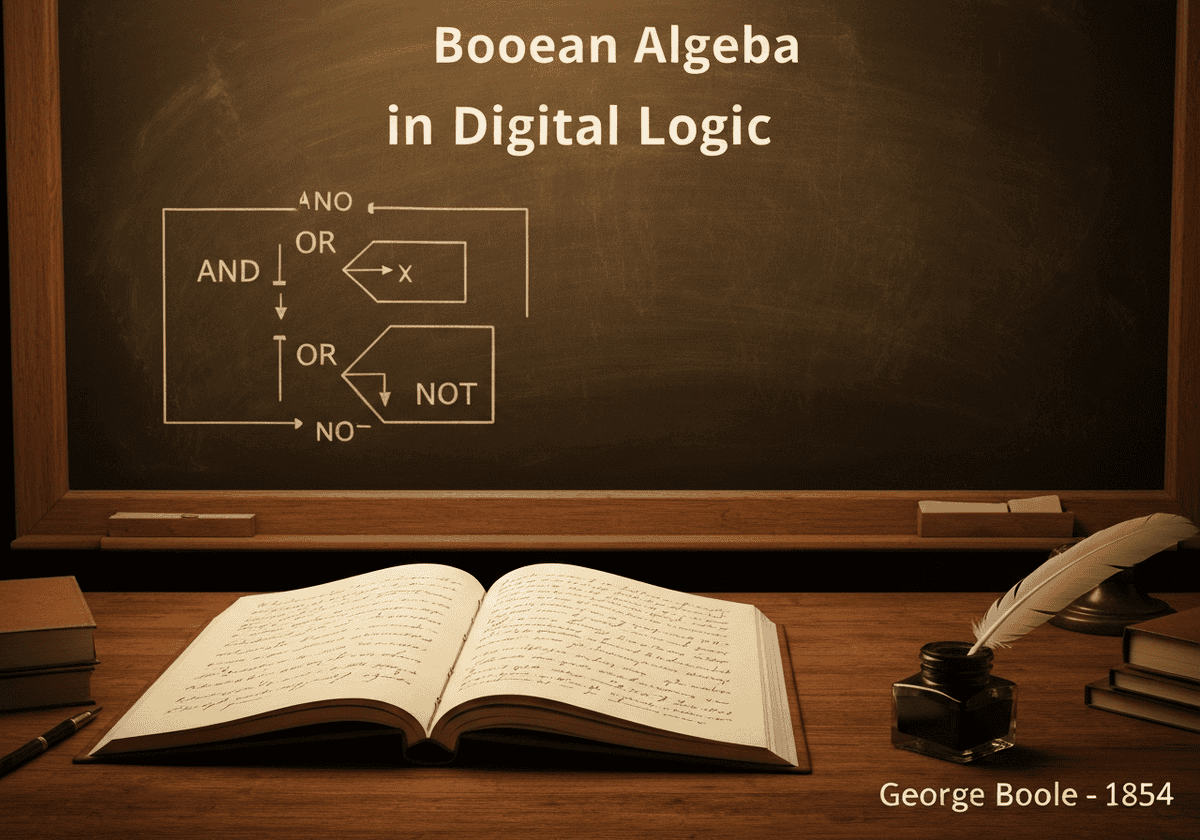
Wooden desk with ledger, quill, and chalkboard showing Boolean algebra logic gates.

(generated image for illustration only)

Digital electronics is based on Boolean algebra, a mathematical system of logic introduced by George Boole. It uses two values, typically 0 and 1 (or false and true), and three basic operations: AND (conjunction), OR (disjunction), and NOT (negation). These operations directly correspond to the logic gates that form the building blocks of all digital circuits.
Boolean algebra provides the formal framework for analyzing and designing digital circuits. In this system, variables can only take one of two values, which in electronics are represented by different voltage levels (e.g., 0V for logic ‘0’ and +5V for logic ‘1’). The AND operation is true only if all its inputs are true. The OR operation is true if at least one input is true. The NOT operation inverts the input value. These fundamental operations can be combined to create more complex functions like XOR (exclusive OR), NAND (NOT AND), and NOR (NOT OR).

Claude Shannon was the first to demonstrate in his 1937 master’s thesis that Boole’s two-valued algebra could be used to describe the operation of switching circuits, such as those using electromechanical relays. This insight connected abstract mathematics to practical engineering, laying the groundwork for modern digital circuit design. Any logical expression can be simplified using Boolean algebraic laws (e.g., commutative, associative, distributive laws, and De Morgan’s theorems), which allows engineers to reduce the number of required logic gates, thereby minimizing circuit complexity, cost, power consumption, and propagation delay.

UNESCO Nomenclature: 1202
– Computer science

Type

Abstract System

Disruption

Foundational

Usage

Widespread Use

Precursors

  • Aristotelian logic
  • Gottfried Wilhelm Leibniz’s work on binary systems
  • Symbolic logic development in the 19th century

Applications

  • design of digital logic circuits
  • computer processors (cpus)
  • memory units
  • programmable logic controllers (plcs)
  • software programming logic

Patents:

NA

Potential Innovations Ideas

Due to scrapping bot traffic, currently more than 40k per day, this content is reserved to community members.
> Login < or > Register < (100% free) to access this, so as all other restricted content and tools.

Related to: boolean algebra, logic gates, digital circuits, george boole, claude shannon, binary logic, circuit design, switching theory.

Historical Context

Boolean Algebra in Digital Logic

1829
1850
1854
1854
1895
1899
1900
1828
1848
1850
1854
1884
1896
1900
1903

(if date is unknown or not relevant, e.g. "fluid mechanics", a rounded estimation of its notable emergence is provided)

Related Invention, Innovation & Technical Principles

Full size images and downloads are only available, 100% free, for registered members.

> Login <