Biogenic Volatile Organic Compounds (BVOCs)
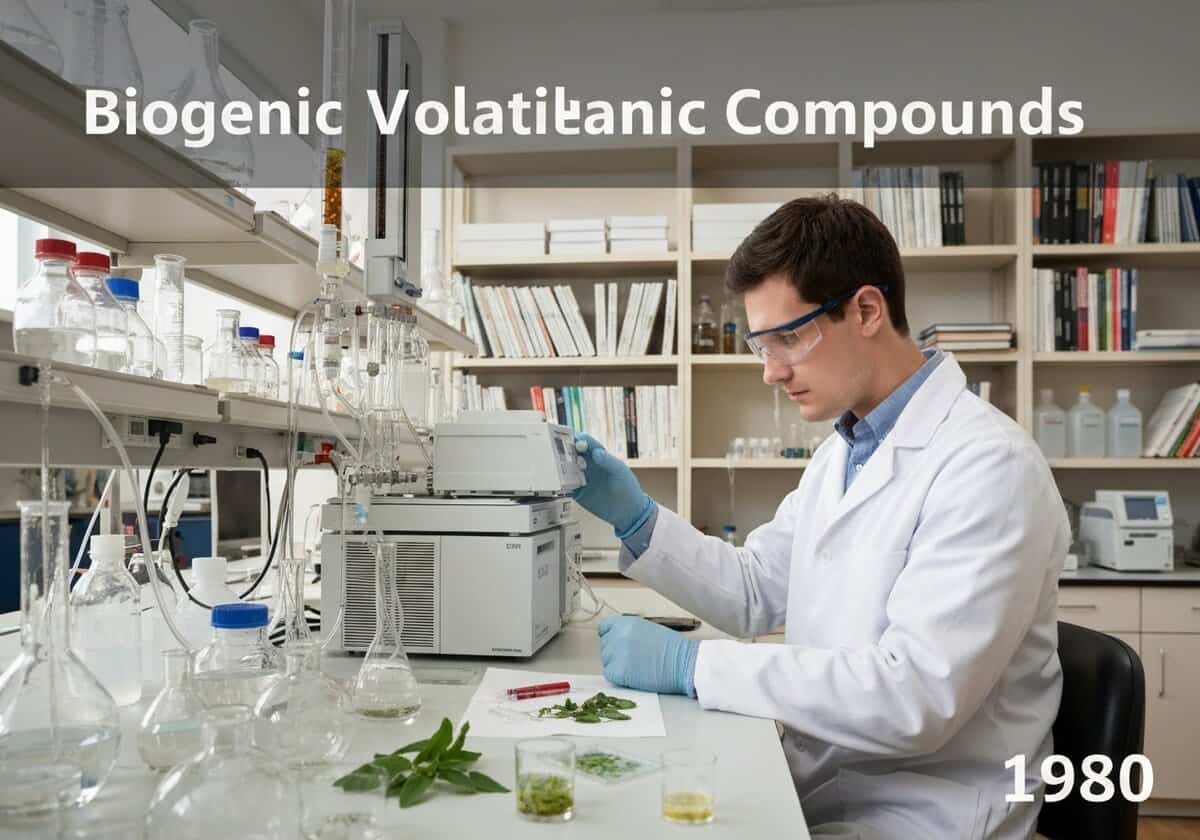
Biogenic Volatile Organic Compounds (BVOCs) are VOCs produced and emitted by living organisms, predominantly plants. Isoprene (\(C_5H_8\)) and terpenes are the most abundant BVOCs. While natural, their emissions are vast, exceeding anthropogenic VOCs globally. They play critical roles in plant defense, signaling, and are major precursors for atmospheric ozone and secondary organic aerosols, influencing air quality and climate.
Biogenic VOCs represent a massive flux of carbon from the biosphere to the atmosphere, estimated to be around 1 billion metric tons per year. Isoprene is the single most emitted non-methane organic compound, primarily from deciduous trees. Monoterpenes (\(C_{10}H_{16}\)), such as alpha-pinene and limonene, are characteristic emissions from coniferous trees. Plants produce these compounds for various ecological reasons, including deterring herbivores, attracting pollinators, protecting against thermal stress, and communicating with other plants.
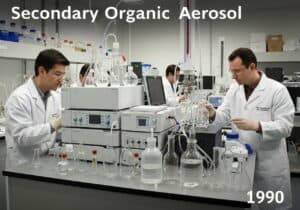
Once in the atmosphere, BVOCs are highly reactive. Their oxidation, primarily by the hydroxyl radical (\(\bullet OH\)), ozone (\(O_3\)), and the nitrate radical (\(NO_3\bullet\)), is a central process in atmospheric chemistry. This oxidation contributes significantly to the formation of secondary pollutants. In polluted, high-NOx environments, BVOC oxidation can exacerbate ozone smog formation. In cleaner environments, it leads to the formation of secondary organic aerosols (SOAs), which are tiny airborne particles that can affect cloud formation, the Earth’s radiation balance, and human health. The interplay between natural BVOC emissions and anthropogenic pollutants is a key area of research in understanding regional air quality and global climate.
UNESCO Nomenclature: 2501
– Atmospheric sciences
Type
Environmental Process
Precursors
- discovery and characterization of isoprene and terpenes
- development of gas chromatography for analyzing complex organic mixtures
- understanding of plant physiology and metabolism
- early observations of ‘blue haze’ over forested areas
Applications
- atmospheric chemistry models
- climate change research
- development of natural pesticides and fragrances
- air quality forecasting
- understanding of plant-herbivore interactions
Potential Innovations Ideas
Due to scrapping bot traffic, currently more than 40k per day, this content is reserved to community members.
> Login < or > Register < (100% free) to access this, so as all other restricted content and tools.
Related to: BVOC, biogenic, isoprene, terpenes, atmospheric chemistry, plant emissions, secondary organic aerosol, air quality, biosphere-atmosphere interaction, climate.