Superconductivity BCS Theory
1957
- John Bardeen
- Leon Cooper
- John Robert Schrieffer
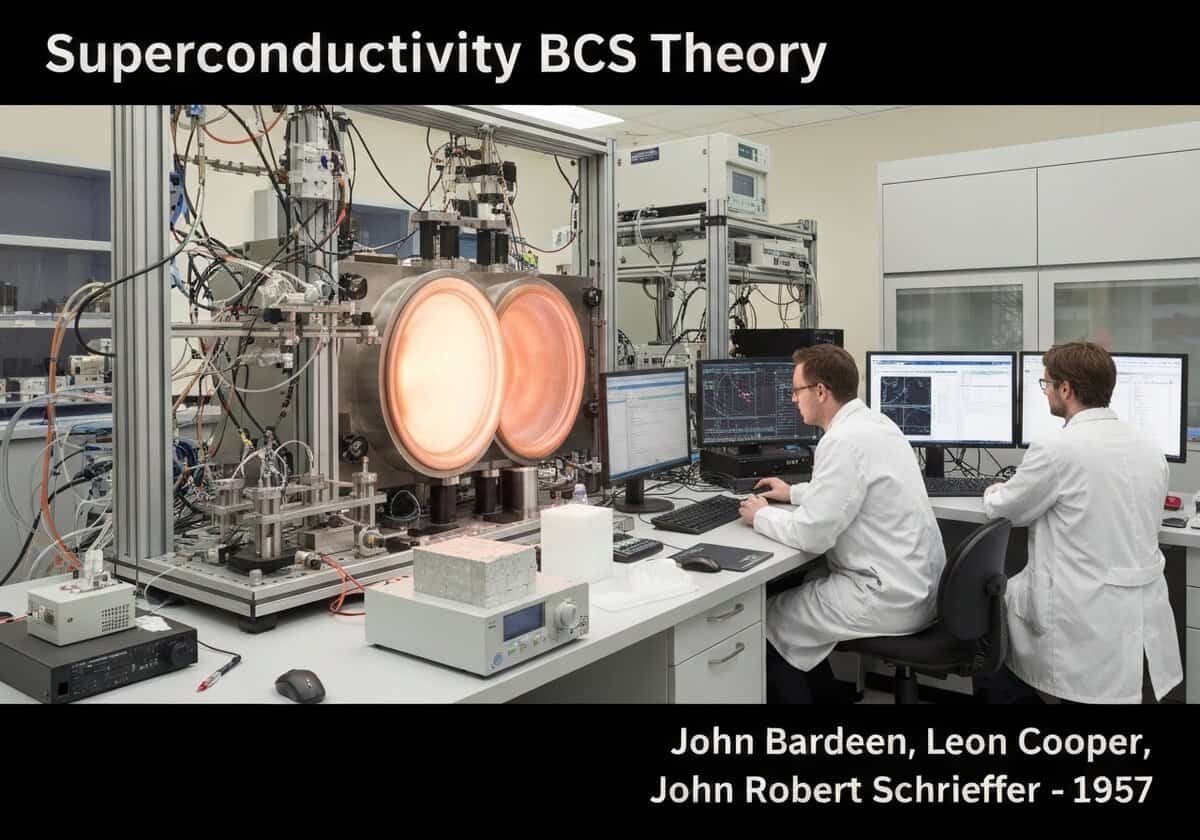
Developed in 1957 by John Bardeen, Leon Cooper, and Robert Schrieffer, the BCS theory provides a microscopic explanation for conventional superconductivity. It posits that below the critical temperature (\(T_c\)), electrons can overcome their electrostatic repulsion and form bound pairs, called Cooper pairs, through interactions with the crystal lattice (phonons). These pairs behave as bosons and can condense into a single macroscopic quantum state.
The BCS theory was a monumental achievement that solved a 46-year-old puzzle in physics. Its central concept is the Cooper pair. In a normal metal, electrons move independently and scatter off impurities and lattice vibrations (phonons), which causes electrical resistance. In the BCS model, an electron moving through the crystal lattice attracts the positive ions, creating a slight distortion or ripple in the lattice. This region of increased positive charge can then attract a second electron. This indirect, phonon-mediated attraction can overcome the direct Coulomb repulsion between the two electrons, binding them into a Cooper pair. These pairs have an integer spin (0 or 1), making them bosons, unlike individual electrons which are fermions. According to quantum statistics, bosons are not subject to the Pauli exclusion principle and can all occupy the same lowest-energy quantum state. Below \(T_c\), a significant fraction of Cooper pairs condenses into this single macroscopic ground state, described by a single wave function. This condensate of pairs can move through the lattice without scattering, as scattering a single pair would require enough energy to break it apart and excite both electrons, an energy given by the superconducting energy gap, \(\Delta\). At low temperatures, this energy is not available, leading to zero resistance. The theory successfully predicted the isotope effect, where \(T_c \propto M^{-1/2}\) (M is the isotopic mass), and provided a formula for the critical temperature: \(k_B T_c \approx 1.13 \hbar \omega_D \exp(-1/N(0)V)\), linking \(T_c\) to the Debye frequency \(\omega_D\), the density of states \(N(0)\), and the electron-phonon interaction potential \(V\).
UNESCO Nomenclature: 2211
– Solid state physics
Precursors
- discovery of superconductivity (1911)
- quantum mechanics
- London equations
- Ginzburg-Landau theory
- discovery of the isotope effect (1950)
- concept of electron-phonon interaction
Applications
- guidance for the search for new superconducting materials
- understanding of superfluidity in helium-3
- theoretical foundation for superconducting electronics
- models in nuclear physics and particle physics
Potential Innovations Ideas
Due to scrapping bot traffic, currently more than 40k per day, this content is reserved to community members.
> Login < or > Register < (100% free) to access this, so as all other restricted content and tools.
Related to: BCS theory, Cooper pairs, superconductivity, phonons, electron-phonon coupling, quantum mechanics, condensed matter theory, energy gap, macroscopic quantum state, Bardeen-Cooper-Schrieffer.