Teoria BCS da Supercondutividade
1957
- John Bardeen
- Leon Cooper
- John Robert Schrieffer
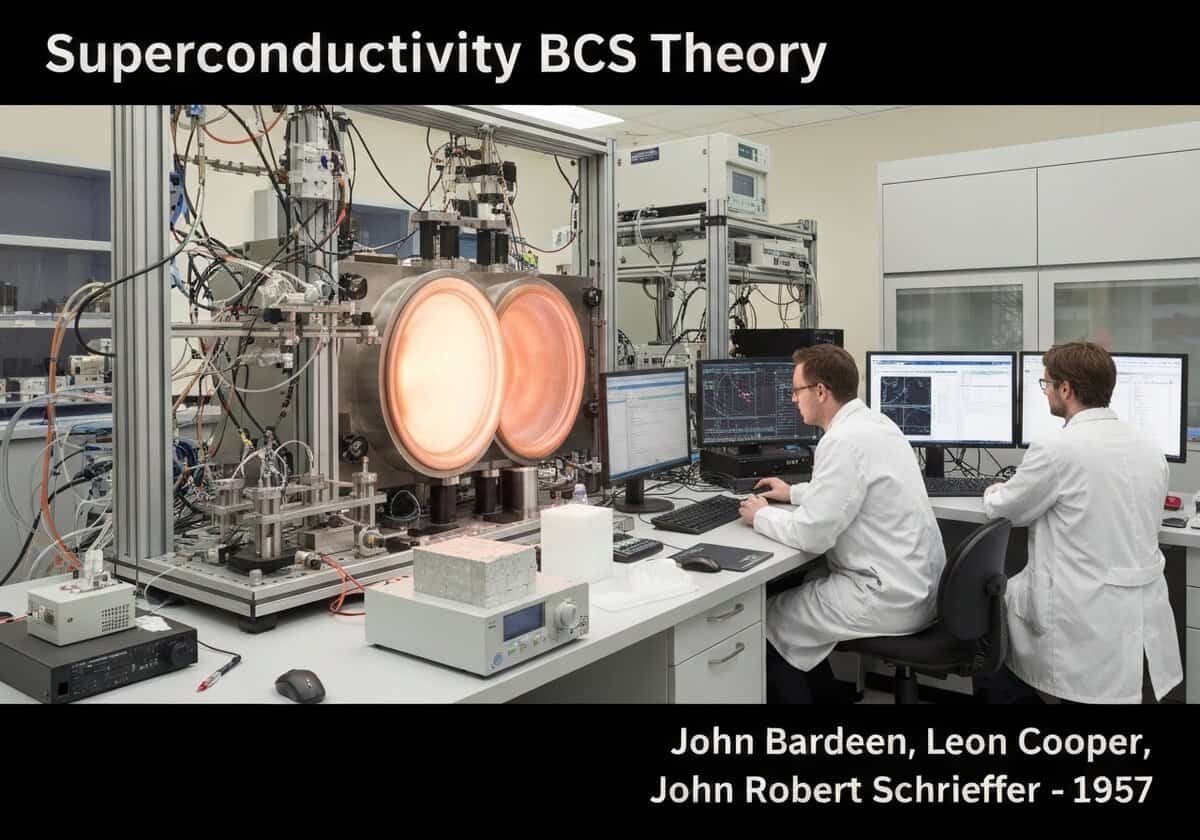
Desenvolvida em 1957 por John Bardeen, Leon Cooper e Robert Schrieffer, a teoria BCS fornece uma explicação microscópica para a supercondutividade convencional. Ela postula que, abaixo da temperatura crítica (Tc), os elétrons podem superar sua repulsão eletrostática e formar pares ligados, chamados pares de Cooper, por meio de interações com a rede cristalina (fônons). Esses pares se comportam como bósons e podem se condensar em um único estado quântico macroscópico.
The BCS theory was a monumental achievement that solved a 46-year-old puzzle in physics. Its central concept is the Cooper pair. In a normal metal, electrons move independently and scatter off impurities and lattice vibrations (phonons), which causes electrical resistance. In the BCS model, an electron moving through the crystal lattice attracts the positive ions, creating a slight distortion or ripple in the lattice. This region of increased positive charge can then attract a second electron. This indirect, phonon-mediated attraction can overcome the direct Coulomb repulsion between the two electrons, binding them into a Cooper pair. These pairs have an integer spin (0 or 1), making them bosons, unlike individual electrons which are fermions. According to quantum statistics, bosons are not subject to the Pauli exclusion principle and can all occupy the same lowest-energy quantum state. Below [latex]T_c[/latex], a significant fraction of Cooper pairs condenses into this single macroscopic ground state, described by a single wave function. This condensate of pairs can move through the lattice without scattering, as scattering a single pair would require enough energy to break it apart and excite both electrons, an energy given by the superconducting energy gap, [latex]\Delta[/latex]. At low temperatures, this energy is not available, leading to zero resistance. The theory successfully predicted the isotope effect, where [latex]T_c \propto M^{-1/2}[/latex] (M is the isotopic mass), and provided a formula for the critical temperature: [latex]k_B T_c \approx 1.13 \hbar \omega_D \exp(-1/N(0)V)[/latex], linking [latex]T_c[/latex] to the Debye frequency [latex]\omega_D[/latex], the density of states [latex]N(0)[/latex], and the electron-phonon interaction potential [latex]V[/latex].
UNESCO Nomenclature: 2211
Física do estado sólido
Interrupção
Revolucionário
Precursores
- descoberta da supercondutividade (1911)
- quantum mechanics
- Equações de Londres
- Ginzburg-Landau theory
- descoberta do efeito isotópico (1950)
- conceito de interação elétron-fônon
Aplicações
- orientações para a busca de novos materiais supercondutores
- Compreensão da superfluidez no hélio-3
- fundamentos teóricos para a eletrônica supercondutora
- modelos em física nuclear e física de partículas
Ideias de Inovação Potencial
Devido ao tráfego de bots de coleta de dados, atualmente superior a 40 mil por dia, este conteúdo é reservado aos membros da comunidade.
> Login < ou > Registrar < (100% gratuito) para acessar isso, assim como todo o restante do conteúdo e das ferramentas restritas.
Related to: BCS theory, Cooper pairs, superconductivity, phonons, electron-phonon coupling, quantum mechanics, condensed matter theory, energy gap, macroscopic quantum state, Bardeen-Cooper-Schrieffer.