Acoustic Impedance in Ultrasonic Reflection
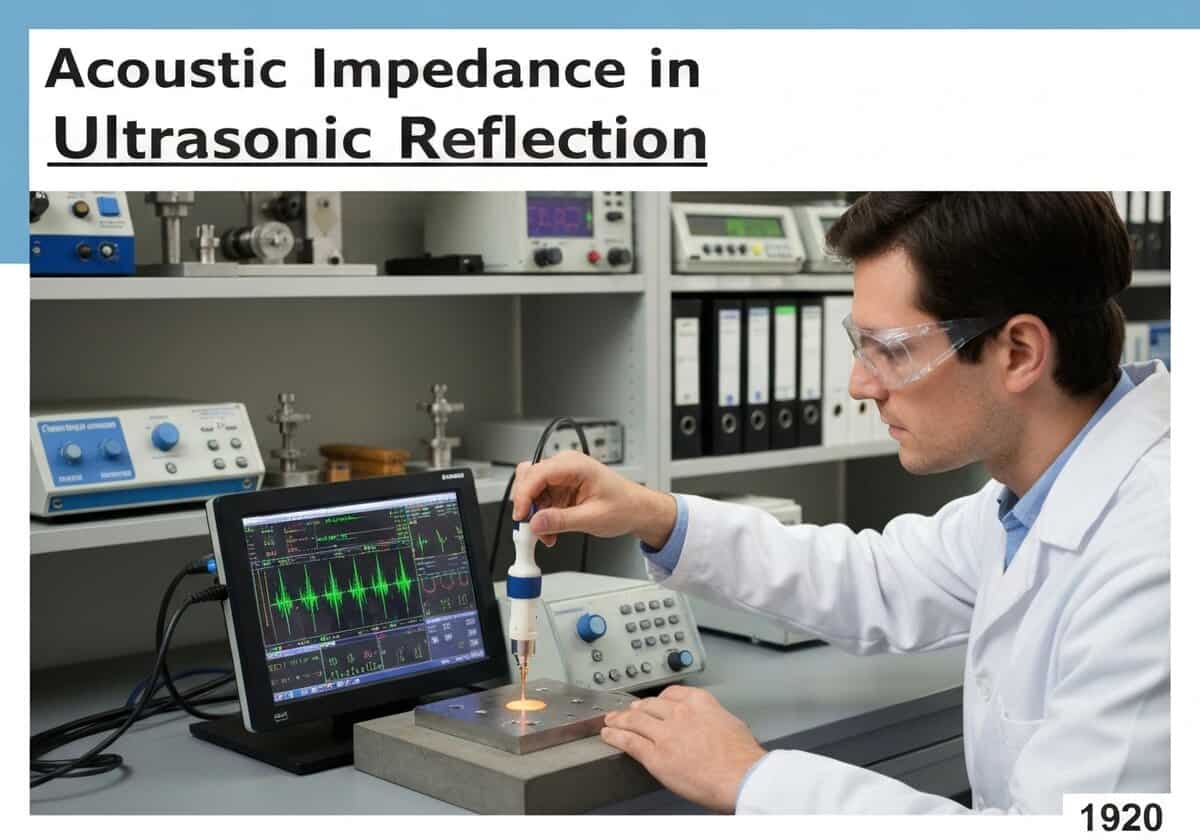
Acoustic impedance (\(Z\)) is a material’s intrinsic resistance to acoustic flow, defined as its density (\(\rho\)) multiplied by its acoustic velocity (\(c\)), so \(Z = \rho c\). The percentage of ultrasonic energy reflected at the boundary between two materials is governed by the difference, or mismatch, in their respective acoustic impedances. This principle is what makes flaw detection possible.
The concept of acoustic impedance is analogous to electrical impedance in circuits and is fundamental to understanding how ultrasonic waves interact with materials. When a wave traveling through a material (Material 1) encounters an interface with a second material (Material 2), part of the wave is reflected and part is transmitted. The amount of reflection is quantified by the reflection coefficient (\(R\)), which depends on the acoustic impedances of the two materials, \(Z_1\) and \(Z_2\).
For a wave at normal incidence, the pressure reflection coefficient is given by \(R = (Z_2 – Z_1) / (Z_2 + Z_1)\). The intensity of the reflected wave, which is what is typically measured, is proportional to the square of this value. A large mismatch in impedance, such as between steel (\(Z approx 45 times 10^6\) Pa·s/m) and air (\(Z approx 415\) Pa·s/m), results in a very high reflection coefficient (nearly 100%). This is why internal cracks and voids, which are filled with air or gas, are so easily detectable with ultrasound; they act as near-perfect reflectors.
Conversely, if two materials have very similar acoustic impedances, most of the sound energy will pass through the interface with minimal reflection. This principle is exploited in the design of ultrasonic couplants (gels or liquids used between the transducer and the test piece) and transducer matching layers, which are designed to have an impedance intermediate between the transducer element and the test material to maximize energy transmission and improve signal quality.
UNESCO Nomenclature: 3301
– Acoustics
Precursors
- Lord Rayleigh’s foundational work on wave theory and acoustics (‘The Theory of Sound’)
- studies of sound propagation in solids and fluids by 19th-century physicists
- development of continuum mechanics to describe material properties
- early sonar research which required understanding of acoustic reflection from objects
Applications
- non-destructive testing for detecting cracks (metal-air interface)
- medical imaging for distinguishing between different tissues and organs
- design of acoustic matching layers for transducers to improve energy transmission
- geophysical prospecting using seismic reflection to map subsurface geology
- ultrasonic cleaning systems design
Potential Innovations Ideas
Due to scrapping bot traffic, currently more than 40k per day, this content is reserved to community members.
> Login < or > Register < (100% free) to access this, so as all other restricted content and tools.
Related to: acoustic impedance, reflection coefficient, ultrasonic testing, NDT, material property, density, acoustic velocity, interface, mismatch, wave physics.