Acid Rain Formation Chemistry
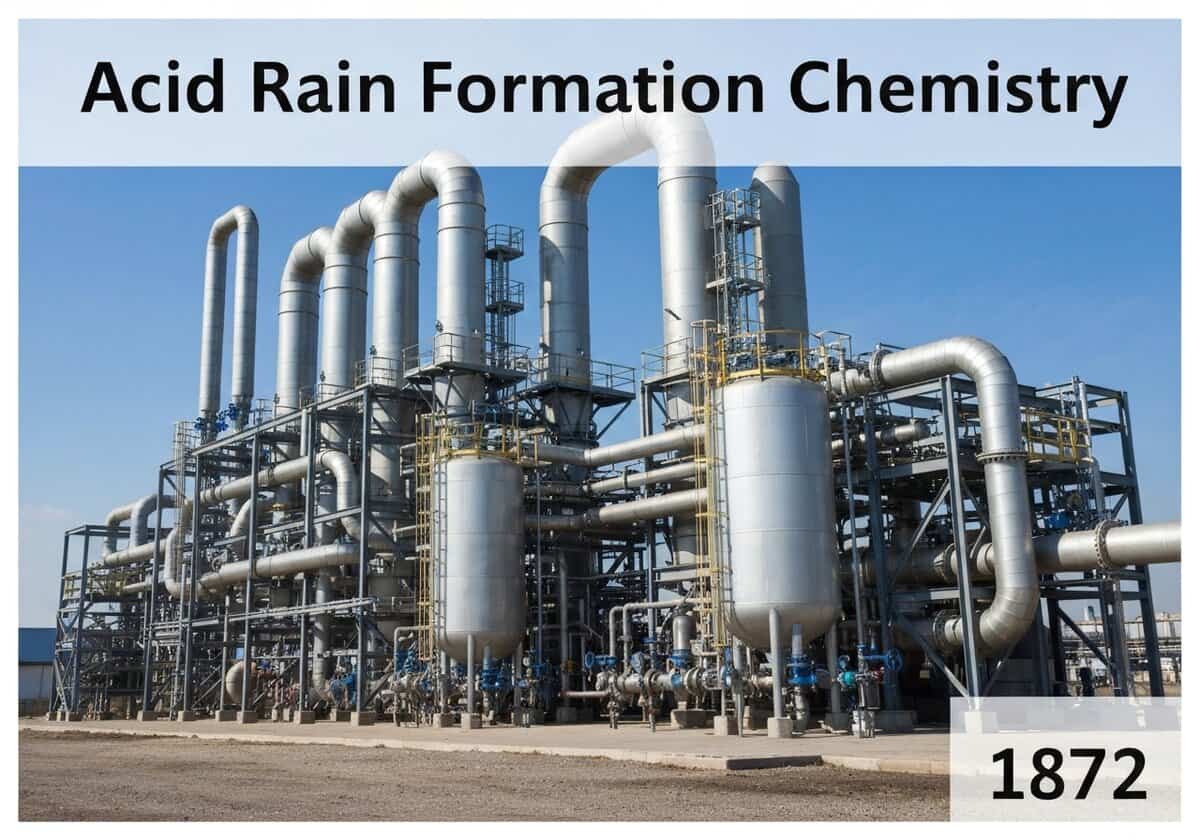
Acid rain results from atmospheric sulfur dioxide (SO2) and nitrogen oxides (NOx) reacting with water, oxygen, and other chemicals. SO2 is oxidized to sulfuric acid (\(H_2SO_4\)), and NOx forms nitric acid (\(HNO_3\)). These reactions, often catalyzed by sunlight, produce highly acidic compounds that fall to Earth as wet or dry deposition, harming ecosystems.
The primary precursors to acid rain are sulfur dioxide (SO2) and nitrogen oxides (NOx), which are released into the atmosphere primarily from the burning of fossil fuels in power plants and vehicles. Once in the atmosphere, these gases undergo complex chemical transformations. For sulfur dioxide, the process can be summarized in two main steps. First, SO2 is oxidized to sulfur trioxide (SO3): \(2SO_2(g) + O_2(g) \\rightarrow 2SO_3(g)\). This reaction can be slow in the gas phase but is significantly accelerated on the surface of atmospheric particles or in water droplets, where catalysts like iron and manganese are present. Subsequently, sulfur trioxide reacts rapidly with water to form sulfuric acid: \(SO_3(g) + H_2O(l) \\rightarrow H_2SO_4(aq)\).
Similarly, nitrogen oxides, primarily nitric oxide (NO) and nitrogen dioxide (NO2), contribute to acid rain formation. NO is typically emitted and is then oxidized in the atmosphere to NO2: \(2NO(g) + O_2(g) \\rightarrow 2NO_2(g)\). Nitrogen dioxide then reacts with hydroxyl radicals (OH) to form nitric acid: \(NO_2(g) + OH(g) \\rightarrow HNO_3(g)\). These strong acids, sulfuric and nitric, dissolve in atmospheric water droplets (clouds, fog, rain, snow) and lower the pH of the precipitation, often to levels between 4.2 and 4.4, which is significantly more acidic than natural rain (pH ~5.6). This acidified precipitation has widespread environmental impacts, including the acidification of lakes and streams, damage to forests and crops, and the corrosion of buildings and statues.
UNESCO Nomenclature: 2501
– Atmospheric sciences
Precursors
- discovery of chemical elements like sulfur, nitrogen, and oxygen
- understanding of acids, bases, and ph by chemists like svante arrhenius
- development of industrial processes during the industrial revolution that released large quantities of so2 and nox
- antoine lavoisier’s work on combustion and the role of oxygen
Applications
- development of flue-gas desulfurization (scrubber) technologies for power plants
- liming of lakes and soils to neutralize acidity
- international treaties to reduce transboundary pollution (e.g., convention on long-range transboundary air pollution)
- catalytic converters in vehicles to reduce nox emissions
Potential Innovations Ideas
Due to scrapping bot traffic, currently more than 40k per day, this content is reserved to community members.
> Login < or > Register < (100% free) to access this, so as all other restricted content and tools.
Related to: acid rain, sulfur dioxide, nitrogen oxides, sulfuric acid, nitric acid, atmospheric chemistry, wet deposition, environmental pollution, fossil fuels, pH.