Biological Sciences, Chemical Sciences, Physical Sciences
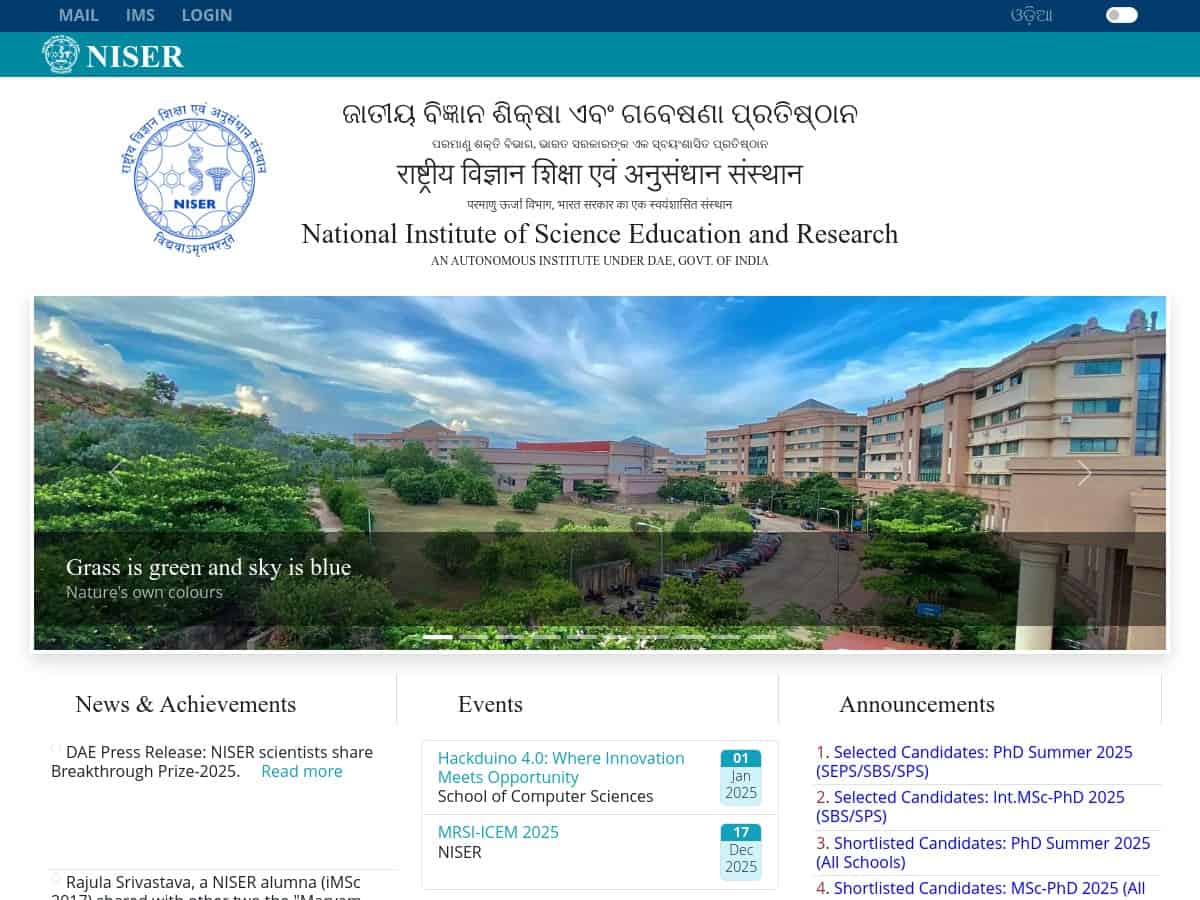
The National Institute of Science Education and Research in Bhubaneswar, known as NISER, was founded on 6 September 2007 and began teaching in September of that year. It is an autonomous institute under the Department of Atomic Energy of the Government of India. Its campus covers 300 acres at Jatni, in Odisha, a short distance from Bhubaneswar, and the move to this permanent campus took place around the 2015-16 session.
NISER is organised into schools of biological, chemical, computer, earth and planetary, humanities and social, mathematical and physical sciences, alongside centres for interdisciplinary sciences and for medical and radiation physics. The main degree route is a five-year integrated M.Sc. in basic sciences taken after school; integrated M.Sc. and Ph.D. and stand-alone Ph.D. programmes are also offered, and an M.Sc. in medical and radiological physics is available as well. Degrees are awarded through the Homi Bhabha National Institute, the deemed-to-be university for Department of Atomic Energy institutions.
Entry to the integrated M.Sc. is through the National Entrance Screening Test, known as NEST. The institute combines teaching with theoretical and experimental research in the basic sciences.
Domains taught:
AI and Machine Learning, Chemistry, Data Analytics, Geotechnics, Life Sciences, Mathematics, Physics
Diplomas*:
Bachelor, Doctor, Master
Status:
Public
Partnerships:
An autonomous institution funded by the Department of Atomic Energy, GoI. Focus on high-quality research and education in basic sciences.
Research:
Leading research in fundamental sciences including physics (particle, condensed matter), chemistry (materials, organic), biology (genetics, cell biology), and mathematics.
Famous Alumnis:
N/A
International recognition**:
Number of staff***:
300
Current students***:
1000
Foreign students***:
1%
Cumulative former students***:
N/A
Pros
Strong focus on research in basic sciences, integrated master’s and PhD programs, excellent faculty and research facilities.
Cons
Highly competitive admissions, demanding academic programs focused purely on science.
Best For
Students passionate about careers in scientific research, seeking a rigorous integrated science education at a premier DAE-funded institute.
Indian Institute of Science, a public research university in Bengaluru, pairs biological sciences with physical and mathematical sciences, as NISER does.
Public University of Hyderabad offers physics, chemistry and life sciences next to humanities and social sciences.
Indian Institute of Space Science and Technology, a public institute in Thiruvananthapuram, is another government-funded science institution, with aerospace and space sciences.
Institute of Chemical Technology Mumbai is public and gives weight to chemical technology and pharmacy.
Most Similar Schools Abroad
Italy's Scuola Internazionale Superiore di Studi Avanzati is a public graduate institution known for theoretical particle physics and condensed matter.
France's École Normale Supérieure de Lyon is a public school with physics, chemistry, mathematics and computer science.
Okinawa Institute of Science and Technology Graduate University in Japan is a private graduate university for physics, chemistry and marine science.
Gwangju Institute of Science and Technology is a public science and technology university in South Korea with engineering and physics.
*our own picks (our criteria: a mix between domains, diploma delivered, reputation and size), but obviously too many criteria for an apple-to-apple ranking.
FAQ
What kind of institution is NISER?
It is an autonomous science institute funded through the Department of Atomic Energy of India. It is dedicated to education and research in the basic sciences.
Where is the campus?
The campus is at Jatni in Odisha, a short distance from Bhubaneswar. It covers 300 acres and became the institute's home around 2015-16.
When did NISER start operating?
It was established on 6 September 2007, and the first batch of students was admitted that month.
Which schools make up the institute?
There are schools for biological, chemical, computer, earth and planetary, humanities and social, mathematical and physical sciences. Two centres, for interdisciplinary sciences and for medical and radiation physics, complement them.
What degrees are on offer?
The flagship programme is a five-year integrated M.Sc. In addition there are an integrated M.Sc. and Ph.D., and a Ph.D. route.
Who awards the degrees?
NISER is affiliated to the Homi Bhabha National Institute in Mumbai. That body is a deemed-to-be university that covers Department of Atomic Energy institutions.
How do candidates apply?
Entry to the integrated M.Sc. runs through the National Entrance Screening Test (NEST). Exact dates and seat numbers appear on the institute's admissions page each year.
*: without any judgment of the quality, readers are strongly encouraged to check the official status of the exact diploma envisioned as many universities have a mix of recognized diplomas, not recognized, “co-delivered,” “equivalent to”, “some pathways” (…), can change over time, and can be named differently from one country to another.
**: international reputation: is based on some criteria that do not mean much in some domains or specialties (number of researchers, of scientific publications, on budget ….). Our approximate 1-4 scale:
known locally
known locally and internationally
is listed in some of the world university’s classifications
is listed among the 20 firsts in some of world university’s classifications
***: estimated numbers, based on online sources and/or feedbacks. The numbers can vary greatly depending on school organisation (ex.: school is part of a group, it employs internal staff or external consultants or has public staff without employing them …). Refer to all the links provided to have accurate and updated numbers.
Innovation.world is not affiliated with this school/university. We recommend to contact them directly on their website for any special request.
To complete or correct any information here or share your opinion, please comment below or > send us a direct message <.