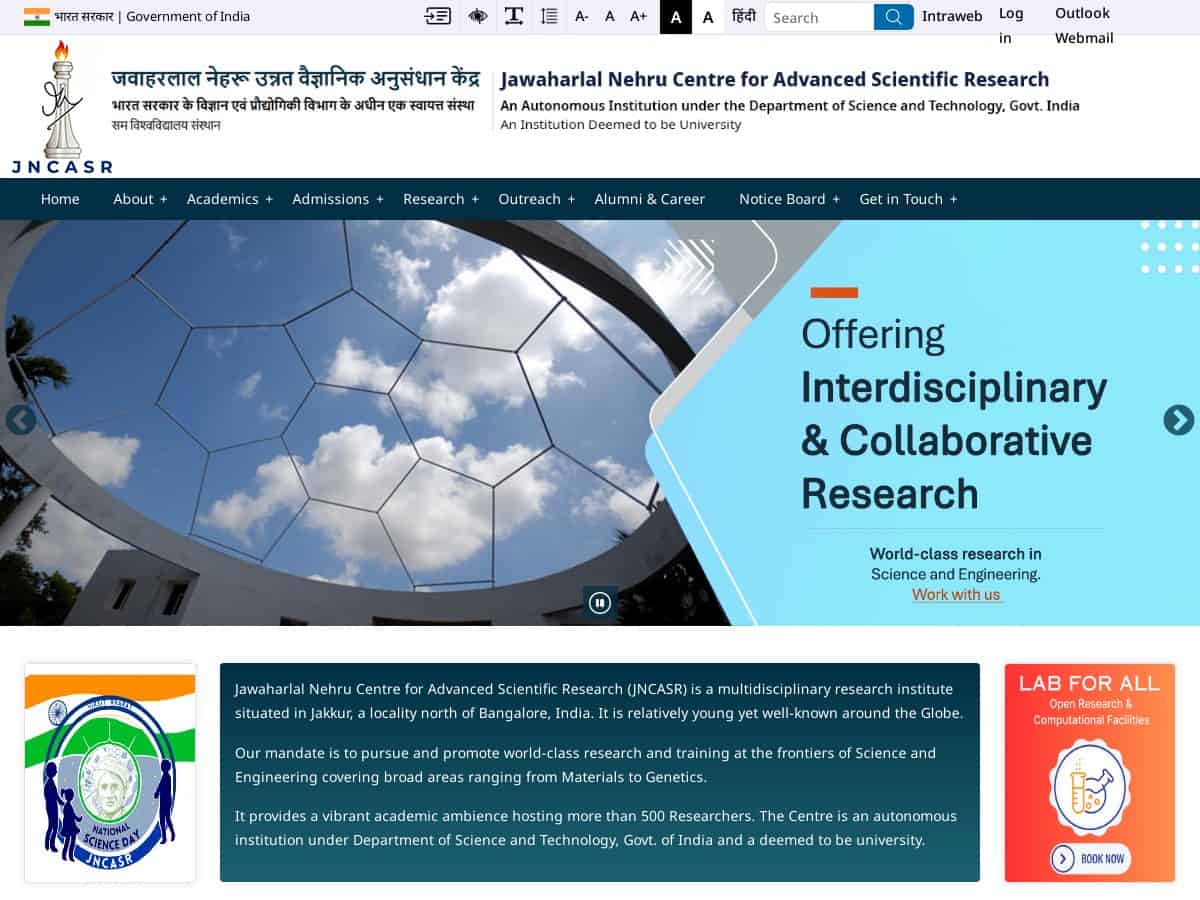
The Jawaharlal Nehru Centre for Advanced Scientific Research was created in 1989 by the Department of Science and Technology of the Government of India to mark the birth centenary of Jawaharlal Nehru. C. N. R. Rao served as its founding president. The centre is based at Jakkur, Bengaluru, the capital of Karnataka.
JNCASR is an autonomous institution that has the status of a deemed university, so it awards its own degrees; students graduate with a Ph.D. or a master’s degree. Its research is arranged in units rather than conventional departments: chemistry and physics of materials, engineering mechanics, evolutionary and organismal biology, molecular biology and genetics, theoretical sciences, new chemistry, geodynamics, and units for the study of the brain and for educational technology.
Beyond degree programmes, the centre runs a Summer Research Fellowship Programme and project-oriented education programmes in chemistry and biology.
Domains taught:
Chemistry, Fluid Dynamics, Life Sciences, Materials, Microbiology and Genetics, Nanotechnologies, Physics
Diplomas*:
Doctor, Master
Status:
Public
Partnerships:
A premier research institute funded by DST, GoI. Focus on advanced scientific research and higher education in interdisciplinary areas.
Research:
Cutting-edge research in materials science, neuroscience, molecular biology and genetics, chemical biology, condensed matter physics, and fluid dynamics.
Famous Alumnis:
C.N.R. Rao (Founder)
International recognition**:
Number of staff***:
200
Current students***:
500
Foreign students***:
1%
Cumulative former students***:
N/A
Pros
Excellent research environment for postgraduate and doctoral studies, high research output, renowned faculty.
Cons
Primarily a research institute with limited student intake, highly specialized.
Best For
Postgraduate students and researchers seeking advanced research opportunities in specialized areas of science and engineering in a premier research institute.
Indian Institute of Science in Bengaluru is a public research university with biological, physical and mathematical sciences, a close neighbour in focus and city.
Institute of Chemical Technology Mumbai is public and strong in chemical engineering and chemical technology.
Jadavpur University in Kolkata is a public university covering engineering, science and the arts.
University of Hyderabad, public, offers physics, chemistry and life sciences with humanities.
Most Similar Schools Abroad
Israel's Weizmann Institute of Science is a public research institution for mathematics, computer science, physics and chemistry.
Spain's Donostia International Physics Center is a public research centre for condensed matter physics and materials science.
ESPCI Paris - PSL in France is a public school of physics, chemistry and bioengineering.
Ulsan National Institute of Science and Technology in South Korea is public and teaches materials, engineering and nanotechnologies.
Switzerland's Paul Scherrer Institut is a public research institute with materials science and life sciences research.
*our own picks (our criteria: a mix between domains, diploma delivered, reputation and size), but obviously too many criteria for an apple-to-apple ranking.
FAQ
Why was JNCASR created?
It was set up in 1989 by India's Department of Science and Technology as a commemoration of the birth centenary of Jawaharlal Nehru. Its mission is advanced scientific research with a teaching component.
Who led the centre at the beginning?
C. N. R. Rao was the founding president.
Where is it located?
The campus is at Jakkur in Bengaluru, Karnataka. Address details are given on the centre's own contact pages.
Is JNCASR a university?
It holds the status of a deemed university, which means it can confer its own degrees. The centre is an autonomous institution rather than a conventional affiliating university.
What research areas does it cover?
Units include chemistry and physics of materials, engineering mechanics, evolutionary and organismal biology, molecular biology and genetics, theoretical sciences, new chemistry and geodynamics. Educational technology has a unit of its own.
Can undergraduates take part?
Yes, through the Summer Research Fellowship Programme and other short courses run by the centre. Dates and eligibility are announced on the official pages.
How can a student apply for graduate study?
The centre advertises its Ph.D. and master's admissions on its official website, with eligibility and deadlines set each cycle. Candidates should read the notice for the programme they want.
Advanced Product Quality Planning (APQP), Environmental Impact, Materials Science, Research and Development
*: without any judgment of the quality, readers are strongly encouraged to check the official status of the exact diploma envisioned as many universities have a mix of recognized diplomas, not recognized, “co-delivered,” “equivalent to”, “some pathways” (…), can change over time, and can be named differently from one country to another.
**: international reputation: is based on some criteria that do not mean much in some domains or specialties (number of researchers, of scientific publications, on budget ….). Our approximate 1-4 scale:
known locally
known locally and internationally
is listed in some of the world university’s classifications
is listed among the 20 firsts in some of world university’s classifications
***: estimated numbers, based on online sources and/or feedbacks. The numbers can vary greatly depending on school organisation (ex.: school is part of a group, it employs internal staff or external consultants or has public staff without employing them …). Refer to all the links provided to have accurate and updated numbers.
Innovation.world is not affiliated with this school/university. We recommend to contact them directly on their website for any special request.
To complete or correct any information here or share your opinion, please comment below or > send us a direct message <.