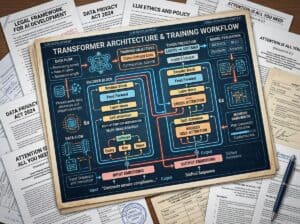
A large language model is a neuronales Netzwerk, usually a transformer, trained on very large text corpora to predict the next token. Self-attention lets it weigh context across a sequence. Pre-training on generic text is followed by fine-tuning or alignment for specific behavior. GPT-style generative models and masked language models are the two best-known training objectives.
Der Einsatz in der Produktion wirft Fragen hinsichtlich Kosten, Latenz und Zuverlässigkeit auf. Inferenzprozesse benötigen Speicherbandbreite und Quantisierung, Halluzinationen erfordern Abruf und Überprüfung, und die Evaluierung muss über Benchmarks hinausgehen. Kleinere, spezialisierte Modelle konkurrieren bei vielen Aufgaben mit den größten. Datenherkunft und Lizenzierung sind mittlerweile rechtliche Themen. Die folgenden Patente und Publikationen zeigen die Entwicklung von LLM-Architekturen, -Training und -Anwendungen.
Nach der Lektüre über LLMs tauchen zwei Fragen auf: Wie steuere ich sie, und wie klein können sie werden? Die Steuerung wird in … behandelt. schnelles Engineering und zielorientierte Nutzung in agentenbasierte KIKompakte Versionen sind verfügbar auf kleine SprachmodelleDie Grundlagen finden Sie in der Lektüre. neuronale Netze Und natürliche Sprachverarbeitung.
Dies ist unsere neueste Auswahl an weltweiten Veröffentlichungen und Patenten in englischer Sprache zum Thema Large Language Models (LLM), aus vielen wissenschaftlichen Online-Zeitschriften, klassifiziert und fokussiert auf Large Language Model, LLM, generative pre-trained transformer, pre-training, transformer architecture, gradient descent, GPT, tokenization, generative model, self-attention mechanism, masked language model und MLM.
Trip prediction system
Patent published on the 2026-11-05 in US under Ref US20260350687 by BOOKING COM B V [NL] (Pathak Pranav [nl])
Abstract: A computer-implemented method comprising reading travel booking items associated with a particular user account in a database; grouping the travel booking items specifying one or more common attributes into a digitally stored draft travel itinerary; programmatically calling a large language model (LLM) application programming interface (API) with a first prompt to determine a user intent that the booking items of the travel itinerary collectively represent and receiving a first LLM response spec[...]
Our summary: The system reads travel booking items to create a draft itinerary. It uses a large language model to determine user intent and generate additional travel recommendations. User feedback is incorporated to update satisfaction scores and refine the itinerary.
trip prediction, user intent, travel itinerary, feedback controls
Patent
Method and system of implementing an event mesh network application emulation tool
Patent published on the 2026-11-05 in US under Ref US20260349772 by JPMORGAN CHASE BANK N A [US] (Sarkar Bodhisatta [us])
Abstract: A system is presented that implements an event mesh network application emulation tool. The system may be configured to: provide a GUI that comprises a first set of GUI-generated objects that comprises at least one GUI-generated object that correlates to at least one respectively corresponding event broker database of an event mesh network; based on a first set of interactions with the first set of GUI-generated objects, perform at least one from among a first set of push operations and a first [...]
Our summary: The system implements an event mesh network application emulation tool with a configurable GUI. It allows users to interact with GUI-generated objects linked to event broker databases. The system performs push and pull operations based on user interactions and updates the GUI to reflect the results.
event mesh, application emulation, GUI, event broker
Patent
On-device large language model-driven context-aware roaming
Patent published on the 2026-11-05 in WO under Ref WO2026229155 by NOKIA TECH OY [FI] (Lee Juhyung [us], Varshney Prabodh [us], Liubogoshchev Mikhail [de], Talarico Salvatore [us], Dezfouli Behnam [us], Costa Mario [pt], Mutgan Orhan Okan [de])
Abstract: An apparatus, method, and computer program product are provided for generating a prompt based on one or more parameters; inputting the prompt to a large language model to obtain a textual output, wherein the large language model is stored locally at the apparatus; and performing at least one of roaming to a target access point indicated within the textual output, adjusting one or more roam-trigger thresholds indicated within the textual output, or determining scheduling for one or more roaming s[...]
Our summary: The system generates prompts based on parameters and inputs them into a local large language model. It produces textual outputs that guide roaming actions and adjustments. The apparatus schedules and performs roaming scans based on the generated outputs.
on-device, large language model, context-aware, roaming
Patent
Sealed api gateways and execution enforcement for third-party platform integration
Patent published on the 2026-11-05 in US under Ref US20260350611 by FARIAS JARAMILLO ADRIAN [US] (Farias Jaramillo Adrian [us])
Abstract: [0000] A sealed API gateway system that verifies third-party platform requests before allowing commercial execution. The system uses metadata, licensing tokens, and trust thresholds to filter and control access to sealed fulfillment rails. Unauthorized requests are denied, logged, and prevented from triggering execution.[...]
Our summary: A sealed API gateway verifies third-party requests before execution. It utilizes metadata, licensing tokens, and trust thresholds for access control. Unauthorized requests are denied and logged to prevent execution.
API gateway, execution enforcement, third-party integration, access control
Patent
Method and system for automated data curation and quality assessment of large language model training datasets using statistical outlier detection
Patent published on the 2026-11-05 in US under Ref US20260349978 by AVINASH KONDA [IN] (Rao Bharath R [in], Kumar Swapnil [in], Avinash Konda [in])
Abstract: [0000] In one aspect, a computer-implemented method for automated data curation with reduced human annotation, the method comprising the following steps. The processor captures a user s perception of underlying topics, labels, and classes in a hierarchical data structure. The processor then auto-classifies a plurality of text paragraphs to corresponding classes using similarity scoring. Next, the processor generates a diverse set of prompts to ensure comprehensive data coverage using divisive sa[...]
Our summary: The method automates data curation and quality assessment for training datasets. It utilizes user feedback and statistical techniques to enhance data classification and validation. The system reduces human annotation efforts while ensuring comprehensive data coverage and quality responses.
automated data curation, quality assessment, statistical outlier detection, large language models
Patent
System and method for securing software supply chains
Patent published on the 2026-11-05 in US under Ref US20260350176 by ACCENTURE GLOBAL SOLUTIONS LTD [IE] (Kaulgud Vikrant [in], Tung Teresa Sheausan [us], Burden Adam Patten [us], Dey Kuntal [in], Sikand Samarth [in], Singi Kapil [in], Sharma Vibhu Saujanya [in])
Abstract: [0000] System and method for securing software supply chains is disclosed. The method includes receiving input data associated with a software project from a plurality of data sources, generating a knowledge graph for the received input data based on a pre-stored historical data, extracting sub-graphs from the knowledge graph by parsing relationships between the plurality of nodes, transforming the extracted sub-graphs into a plurality of prompts for a Large Language Model (LLM), computing a vul[...]
Our summary: The method involves generating a knowledge graph from input data associated with a software project. It computes vulnerability scores for prompts derived from sub-graphs and extracts probabilistic vulnerable templates. Finally, it generates code snippets based on the highest vulnerability scores to improve software security.
vulnerability assessment, knowledge graph, software supply chain, large language model
Patent
A large language model-based agent system for interactive large-scale project scheduling
Published on 2026-09-14 by @OXFORD
Abstract: AbstractAdvanced optimization techniques generate highly complex schedules for large-scale engineering projects. While large language models have recently emerged as a transformative alternative for project scheduling, two primary hurdles must be overcome to realize a high-precision framework: performance degradation in large-scale projects and the functional separation between planning and analysis. To address these challenges, we propose an on-premises autonomous large language model agent sys[...]
Our summary: This paper presents an autonomous agent system utilizing large language models for interactive project scheduling. It addresses performance issues and functional separation through a LangGraph-based framework. The proposed system achieves approximately 90% accuracy in large-scale scheduling by integrating retrieval-augmented generation with analytical tools.
large language models, project scheduling, optimization techniques, knowledge graph
Publication
Provenance grounds trust in autonomous science
Published on 2026-08-20 by Robert MacKnight, Ivan M. Novitskiy, Rushik Radadiya, Gabe Gomes @NATURE
Abstract: Nature Computational Science, Published online: 20 August 2026; doi:10.1038/s43588-026-01035-4As large language models begin to plan and run experiments on their own, the reflex is to demand that they be interpretable before they are trusted. We argue that what grounds trust in autonomous science is not a view inside the model; it is provenance: a complete, re-openable record of what was reasoned, done and measured that can be audited and set right when it is wrong, making autonomy a corrective [...]
Our summary: Provenance is essential for establishing trust in autonomous scientific processes. A complete record of reasoning, actions, and measurements allows for auditing and correction. While interpretability is important, the provenance record is crucial for ensuring rigor and accountability.
provenance, trust, autonomous science, interpretability
Publication