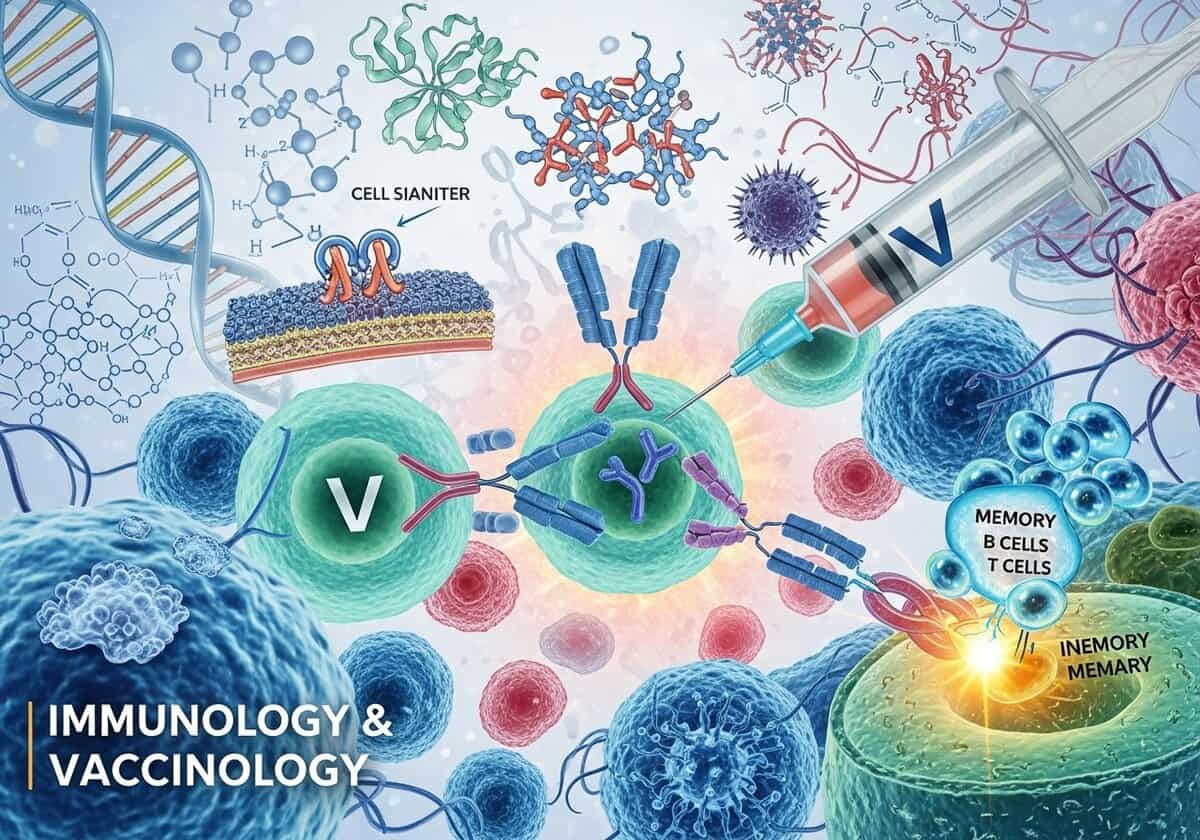

Immunologie und Vakzinologie umfassen die Mechanismen der Immunfunktion und die Entwicklung prophylaktischer und therapeutischer Impfstoffe. Dieses Gebiet integriert zelluläre und molekulare Immunologie, Antigen-Erkennung, Immungedächtnis und Wirt-Pathogen-Interaktionen, um Impfstoffformulierungen, Adjuvantien und Verabreichungssysteme zu entwickeln und zu optimieren. Die Forschung befasst sich mit Immunmodulation, Immunpathologie und Strategien zur Steigerung der Impfstoffwirksamkeit gegen Infektionskrankheiten, Krebs und Autoimmunerkrankungen. Unsere kontinuierlich aktualisierte Zusammenstellung präsentiert die neuesten, von Experten begutachteten Studien und patentierten Technologien, die das immunologische Verständnis und die Impfstoffinnovation voranbringen.
Impfstoffe wirken, indem sie das Immunsystem mit einer ungefährlichen Vorbereitung trainieren. Genetische Werkzeuge sind im Einsatz. Biotechnologie und CRISPR, Krebsimmunität auf Molekulare Onkologie, Darm-Immunsystem-Verbindungen auf Mikrobiomund Arbeiten zu risikoreichen Krankheitserregern Gain-of-Function-Forschung.
Dies ist unsere neueste Auswahl weltweiter Veröffentlichungen und Patente in englischer Sprache zum Thema Immunologie & Vakzinologie aus vielen wissenschaftlichen Online-Zeitschriften, klassifiziert und fokussiert auf Antigen, Antikörper, T-Zelle, B-Zelle, Immunogen, Epitop, Adjuvans, Immunisierung, Wirksamkeit von Impfstoffen, Immunantwort, Gedächtniszellen, Zytokine, Immunglobuline, neutralisierende Antikörper, Immuntherapie, Erregererkennungsrezeptor, Haupthistokompatibilitätskomplex, Immunol, Vaccin, Immuntoleranz, dendritische Zellen, humorale Immunität, zellvermittelte Immunität, Impfstoffformulierung, abgeschwächter Lebendimpfstoff, Untereinheitenimpfstoff, Schleimhautimmunität, immunologisches Gedächtnis, Immuncheckpoint, Impfstoffadjuvans, Immunpathologie und Immunmodulation.
Device and method for performing matrix operation
Patent published on the 2026-11-19 in US under Ref US20260369315 by TAIWAN SEMICONDUCTOR MFG [TW] (Lu Shih-Lien Linus [tw])
Abstract: A system for processing a data array, such as transposing a matrix, includes a two-dimensional array of memory cells, such as FeFETs, each having an input end, an output end and a control end. The system also includes an input interface is adapted to supply signals indicative of a subset of the data array, such as a row of a matrix, and output control signals to the input ends of a selected column of the memory cells. The system further includes an output interface adapted to receive the data st[...]
Our summary: The system processes a data array using a two-dimensional array of memory cells. It supplies input signals for a subset of the data and controls output signals from selected memory cell columns. The method involves writing data column-by-column and reading it row-by-row.
matrix operation, data array, memory cells, transposing
Patent
Antibody dimerization detected by multifaceted mass spectrometry
Patent published on the 2026-11-19 in US under Ref US20260367090 by REGENERON PHARMA [US] (Heindel Andrew J [us], Wang Shunhai [us], Yan Yuetian [us])
Abstract: Antibody cocktails are becoming an increasingly popular therapeutic class; however, antibody cocktails present analytical challenges over traditional single monoclonal antibody (mAb) formulations. One paramount concern is the formation of heteromeric species that have unknown impacts on safety and efficacy. Consequently, effective approaches for identifying and characterizing high-molecular weight (HMW) impurities are critical to the successful development of this therapeutic class. In this stud[...]
Our summary: This study uses multifaceted mass spectrometry to analyze dimerization of monoclonal antibodies under thermal stress. It identifies a unique dimer species and reveals a dimerization mechanism influenced by CDR-clipping. The findings emphasize the importance of advanced analytical techniques for understanding mAb cocktail complexities.
mass spectrometry, antibody cocktails, dimerization, analytical methods
Patent
Interleukin bispecific antibody and use thereof
Patent published on the 2026-11-19 in WO under Ref WO2026238097 by CHANGCHUN GENESCIENCE PHARMACEUTICAL CO LTD [CN] (Ren Huanhuan [cn], Liu Yanshuang [cn], Xue Weili [cn], Zhou Ling [cn], Lei Ming [cn], He Xuzhi [cn], Ma Qingjuan [cn], Xia Guliang [cn], Xu John Liuzhong [cn], Wang Siqin [cn], Jin Lei [cn])
Abstract: Provided in the present application is a bispecific antibody that specifically bind to IL-1α and IL-1β. In addition, further provided are a nucleic acid encoding the bispecific antibody, a host cell containing the same, and the related use. On this basis, further provided in the present invention is the therapeutic use of such bispecific antibodies.[...]
Our summary: The application presents a bispecific antibody targeting IL-1α and IL-1β. It includes a nucleic acid encoding the antibody and a host cell containing it. The invention focuses on the therapeutic applications of these bispecific antibodies.
bispecific antibody, interleukin, therapeutic use, nucleic acid
Patent
Anti-actrii antibody and use thereof
Patent published on the 2026-11-19 in WO under Ref WO2026237442 by CHIA TAI TIANQING PHARMACEUTICAL GROUP CO LTD [CN] (Guo Jun [cn], Lu Yamin [cn], Zhang Zhengping [cn], Zhao Kaidi [cn], Ying Shusong [cn], Xu Hongjiang [cn], Zhao Wei [cn])
Abstract: Provided is an anti-ActRII antibody and use thereof. Further provided herein is a pharmaceutical composition comprising the anti-ActRII antibody and use thereof. The provided antibody exhibits a good effect in treating a disease associated with ActRII expression or ActRII signaling.[...]
Our summary: The document describes an anti-ActRII antibody and its applications. It includes a pharmaceutical composition containing the antibody. The antibody is effective in treating diseases linked to ActRII expression or signaling.
Anti-ActRII antibody, pharmaceutical composition, ActRII expression, disease treatment
Patent
CHIMERIC ANTIGEN RECEPTORS (CARs), COMPOSITIONS AND METHODS THEREOF
Patent published on the 2026-11-19 in US under Ref US20260365726 by ICELL GENE THERAPEUTICS INC [US] (Ma Yupo [us], Pinz Kevin [us], Jiang Xun [us], Wada Masayuki [us], Chen Kevin [us])
Abstract: The present disclosure provides chimeric antigen receptors, compostions, and methods thereof. In one embodiment the present disclosure provides a method of treating autoimmune diseases, asthma, and preventing or mediating organ rejection in a subject.[...]
Our summary: The disclosure presents chimeric antigen receptors and their compositions. It outlines methods for treating autoimmune diseases and asthma. Additionally, it addresses prevention or mediation of organ rejection in subjects.
Chimeric Antigen Receptors, Autoimmune Diseases, Organ Rejection, Treatment Methods
Patent
Cgas modulator and use thereof
Patent published on the 2026-11-19 in WO under Ref WO2026238104 by CONVERGEN SUZHOU PHARMACEUTICALS CO LTD [CN] (Guo Qiang [cn], Sun Jinquan [cn])
Abstract: The present invention relates to a compound represented by formula I or a pharmaceutically acceptable stereoisomer, solvate, hydrate, prodrug, stable isotopic derivative or salt. In addition, the present application further relates to a small molecule-antibody conjugate, small molecule-polypeptide conjugate, bifunctional protein degrader and other bifunctional small molecule drugs based on the compound represented by formula I, and pharmaceutical compositions containing same and uses thereof.[...]
Our summary: The invention describes a compound represented by formula I and its derivatives. It includes applications for small molecule-antibody and small molecule-polypeptide conjugates. Additionally, it covers bifunctional protein degraders and related pharmaceutical compositions.
Cgas modulator, small molecule conjugate, pharmaceutical composition, bifunctional drug
Patent
Modulation of low-molecular-weight cellulose self-assembly using a nonionic amphiphilic block copolymer
Published on 2026-10-29 by Yuuki Hata, Karen Hisazawa, Takeshi Serizawa @NATURE
Abstract: Polymer Journal, Published online: 29 October 2026; doi:10.1038/s41428-026-01270-6The self-assembly of low-molecular-weight (LMW) cellulose was modulated using Poloxamer 407 (P407), a nonionic amphiphilic block copolymer. LMW cellulose formed nanosheets or nanoribbons in the presence of P407, with their dimensions and aggregation states varying depending on the degree of polymerization of LMW cellulose and P407 concentration. These results suggest that direct interactions between LMW cellulose a[...]
Our summary: The study investigates the modulation of low-molecular-weight cellulose self-assembly using Poloxamer 407. It finds that LMW cellulose forms nanosheets or nanoribbons influenced by P407 concentration and polymerization degree. The results indicate that interactions between LMW cellulose and P407 can control the nanomorphologies of artificial nanocelluloses.
cellulose, self-assembly, block copolymer, nanomorphologies
Publication
Gene editing using large insertions
Published on 2026-09-17 by Alexandra Despang @NATURE
Abstract: Nature Biotechnology, Published online: 17 September 2026; doi:10.1038/s41587-026-03319-6While technologies for smaller gene edits, such as base editing, have already entered clinical trials, larger gene cargoes face different challenges, including low editing efficiencies, delivery vehicle size constraints, and possible immunogenicity. Programmable genome engineering systems using recombinases; transposases, including CRISPR-associated transposases (CASTs); genome writing systems; and retrotran[...]
Our summary: The article discusses the challenges of gene editing with large insertions, highlighting issues like low editing efficiencies and delivery constraints. It reviews various programmable genome engineering systems, including recombinases and CRISPR-associated transposases. Experts share insights on strategies to enhance these technologies for therapeutic applications.
gene editing, large insertions, genome engineering, CRISPR
Publication