No Designer or مدير المنتج will forget the end customer using the product for its primary function. But providing القيمة المضافة to all actors in the product chain + in the دورة حياة المنتج is a great way to promote the product and stand over the me-too competition.
Note: should not be confused with Life-Cycle Assessment (تحليل دورة الحياة), which studies the environmental impact of a product or process.
دورة حياة المنتج
The typical product life-cycle of a manufactured product includes:
- تصنيع; which includes component sourcing (eventually their transport), assembly & control
- bulk packaging + transport
- sell/shop
- end-user normal usage. This one is obviously the one the product is primarily made for
- end-user abnormal usage (likely)
- repair & maintenance (eventually)
- إعادة التدوير
Note: if your “product” is a “service” or is not a material good as some intellectual work, it still may include some parts of the cycle above
Non-physical goods case
- ebooks: the بيع phase can be key to standing above the crowd: good title, good arguments, nice front cover; nice+ergonomic layout inside …
- software: the maintenance is not only correcting bugs but anticipating OS evolutions; your customers may pay more if you give some warranties about evolution or maintainability or open-source after some years if your company is transferred or bankrupt (very few companies offer escrow services for the software sources deposit)
- equipment installation service: your customer may value the fact that it is later easy to maintain or disassemble
Design for product life-cycle, proactively!
The first approach would be to take into account the duration of each phase -the time the product spends in each phase-, but that may lead to the wrong conclusion (not focusing on 5 minutes of production, because it’s short compared to end-user usage, but if then cost is too high, the product will never reach end-user at all; of it, it’s not easy to sell, not end-user either).
Design for Manufacturing
Manufacturing includes
- supply and eventually storage of components or materials
- assembly process
- the control process
- individual packaging + labeling
For manufacturing: depending on the production volume & specificities, putting some special features to ease the assembly (حداد …)
–> Refer to the المنهجيات, جولات المصنع، و مرن article on this site.
Design for Sell
If a product is not sold … it will never reach the next phase (or directly the recycling phase of the product life-cycle!)
The product is visible or only its packaging
In some cases, the product can be tested before purchase (think of those electronic toys where kids in the shop can activate some sound or light function through the packaging!)
— the example of corn flex–
–> Refer to تسويق articles on this site.
Design for (normal) Usage
For your end-users of course; not too many details here as this is the main target of any Product Development & core of many articles on innovation. world, but do not forget some less-obvious aspects of it as design for cleanness …
Multi-users
A product may frequently have different users:
cars: the driver & the passengers. In a taxi, who do you favor with the بيئة العمل and design, knowing that the driver spends all his working time inside but must convince the one-of potential customer walking nearby?
medical oxygen أسطوانة الغاز: the nurse manipulates it and selected the flow, and the patient breathes the oxygen coming out
Resist environmental conditions
Water, Salt (sea condition, dust …). Clean or maintaining clean in some applications is a must-have.
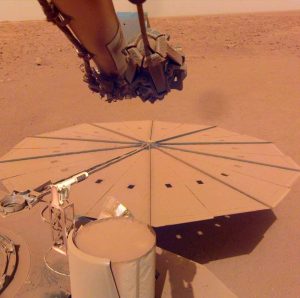
Could the InSight NASA engineers not predict that solar panels would become full of sand on the surface of Mars, thus decreasing الألواح الشمسية efficiency by 90% and that would shorten that great mission?
(design: vibrations, movement, or just a $5 brush at the end of the arm to remove the sand !?)
Design for (abnormal) Usage
Some may argue (or your risk analyses if you perform one), that abnormal usage is just an unpredicted usage that could have been predicted …
نصيحة: if the abnormal usage is frequent, this may open other تسويق opportunities (ex: some very technical طوب games have been redirected to parents and engineers rather than kids …)
Protect against stealing: either by physical means (lock of any sort, weight …) or simply by looking that your product does not have. Refer to the dedicated article for more details:

Design for Wait or Storage
Wait or Storage are often underestimated, but it is a fact, that
for most products, the unused time or storage time is much longer than the usage time
The extreme cases are emergency pieces of equipment (for example fire extinguishers) that are meant for emergencies that will hopefully never happen … but the perfect working condition in those rare cases is not an option.
But in fact, most other products are similar if the ratio usage.storage is higher: home appliances, cars (if not taxis)
24/7 counterexamples: watches, IT servers, plant production equipment, public transportation, some life support medical devices (peacemaker) …

Design for Maintenance and Serviceability
This aspect has mainly been driven by consumers or ecological associations, rarely by manufacturers in the first place.
- Remote maintenance as much as possible.
The design aspects are:
- serviceable parts for short-life components (ex: phone battery, brushed motors)
- serviceable parts for fragile components (phone front glass)
and be easily accessible:
- clearly labeled/referenced as such
- no too-specialized tool
It is a fact that an easy maintenance design may degrade other design factors:
easy maintenance <> IP index (dust/water ingress)
easy maintenance <> lean visual aspects or smallest as possible
Phone manufacturers have been legally constrained to ease the independent maintenance of their product, rather than their closed (and high price-controlled) النظام البيئي.
Design for Recycling
Depending on the country, it is more and more a legal requirement not only to be able to recycle the product but to have a solution for your customer; not only can it be a marketing argument, but you then may want that process to be very easy to perform
correct marking/labeling:
- plastic: correct plastic-type labels
- batteries: rechargeable or not, they must be easily accessible
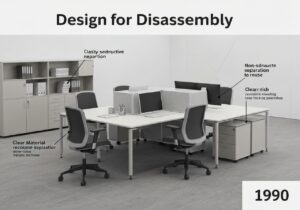
fast dismounting: that part is a tricky trade-off as you want that operation to be fast and easy, but likely not to happen by mistake earlier (your product falling into pieces) or been dismounted voluntary or not by your user (a toy dismounted by children will small parts)
Fast (involuntary) dismounting in product Life-Cycle
Include breakable points that are obvious visually; to be dismounted during recycling by a pneumatic hammer
TIP: this is currently hand-operated… it could be improved by standardizing the design and the location or the markings so that it could be AI operated.
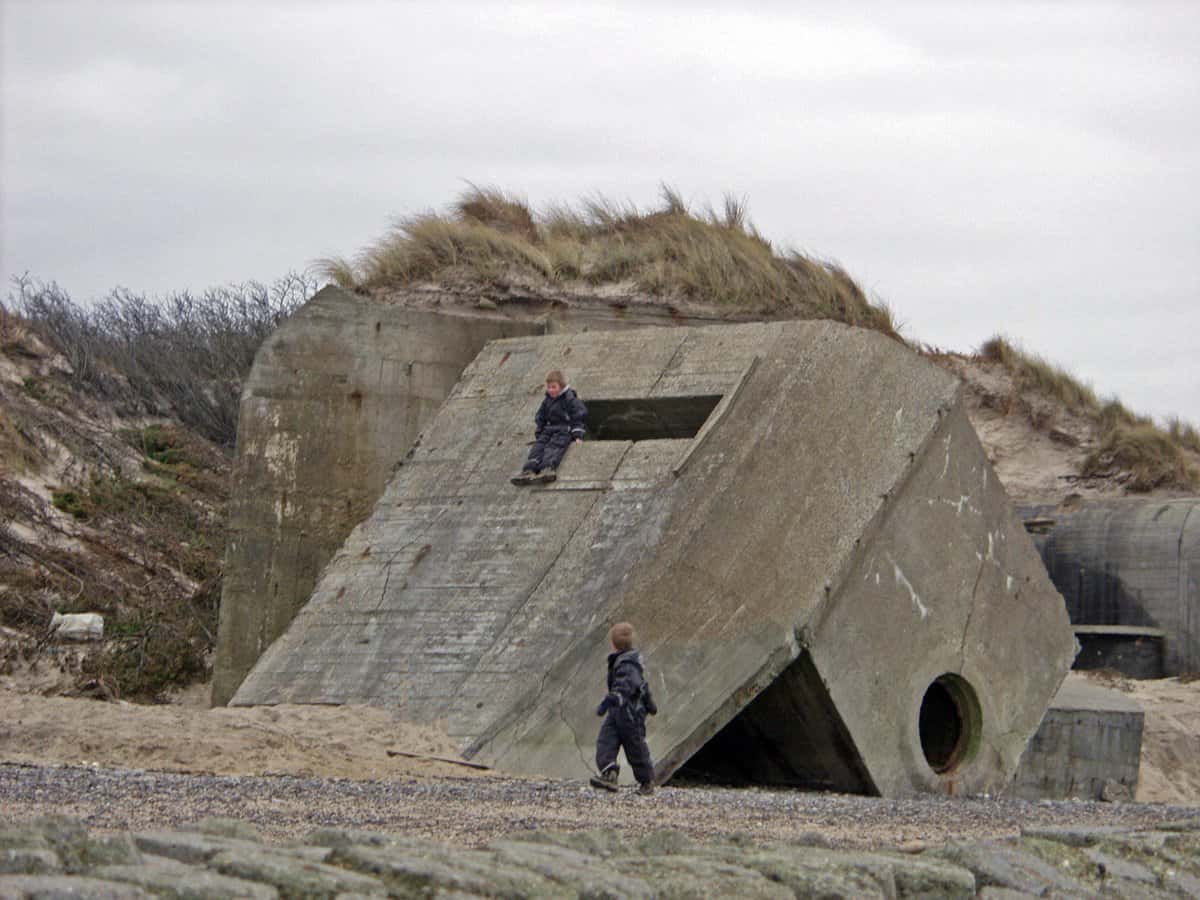
Imagine the cost of dismounting a nuclear plant with concrete walls like the bunkers of WW2.
The rest of this article is reserved for members
To limit scraping bots (currently 40,000 hits per day!),
we had to restrict access to full articles and tools to registered members only.
to access all the rest.