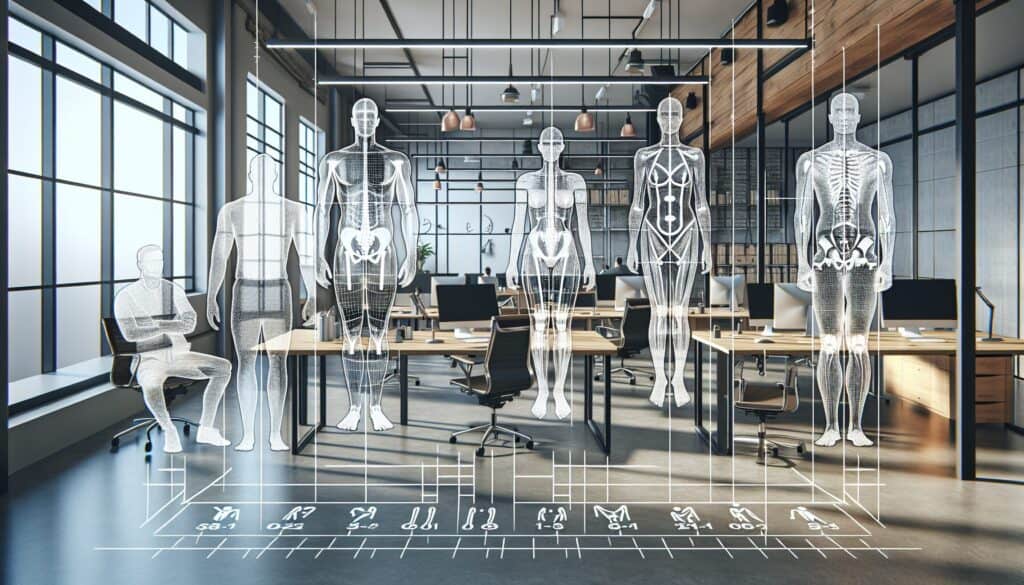
Involves using 人体测量学 data (e.g., height, reach, limb lengths) of the target user population to ensure that designs are dimensionally compatible with their physical characteristics.
Anthropometric Analysis applies extensively across various industries, including ergonomics, industrial design, and healthcare, facilitating the creation of tools, equipment, and workspaces that are inherently user-centric. This methodology is often employed during the early stages of product development, typically in user research and concept design phases, where understanding the physical characteristics of the target user population is pivotal. Participants in this process include product designers, engineers, ergonomists, and market researchers, who collaborate to gather and analyze anthropometric data relevant to their specific demographic. Industries such as automotive and aerospace rely heavily on this analysis, ensuring that vehicle interiors and control interfaces accommodate diverse user heights and body shapes, thereby enhancing safety and comfort. Similarly, in healthcare, ergonomic design of medical instruments and patient handling equipment is informed by anthropometric data, directly impacting healthcare outcomes through improved usability. The application extends to consumer products like furniture, where knowledge of human dimensions informs the ergonomic design of chairs and tables, ensuring that they can be used comfortably across a broad range of body sizes. This attention to anthropometric details not only reduces physical strain but also minimizes the risk of injury and errors during use, thereby enhancing operational efficiency and user satisfaction in multiple contexts.
该方法的关键步骤
确定目标用户群及其代表性人体测量数据。
根据设计所需的具体任务或交互来选择相关维度。
分析所选数据的分布,确定设计极限(最小值和最大值)。
根据用户的不同身材和体型,设计出适合的包络面。
根据人体工程学原理和用户界面交互,反复推敲设计概念。
在目标人群中抽样进行可用性测试,对设计进行原型设计和评估。
根据反馈和性能观察结果改进设计,以提高贴合度和舒适度。
专业提示
纳入分段数据以完善人体工程学评估,重点关注不同人口的身体比例分布。
Utilize dynamic anthropometry by assessing movement patterns and workspace interactions to create adaptable designs that accommodate varying user scenarios.