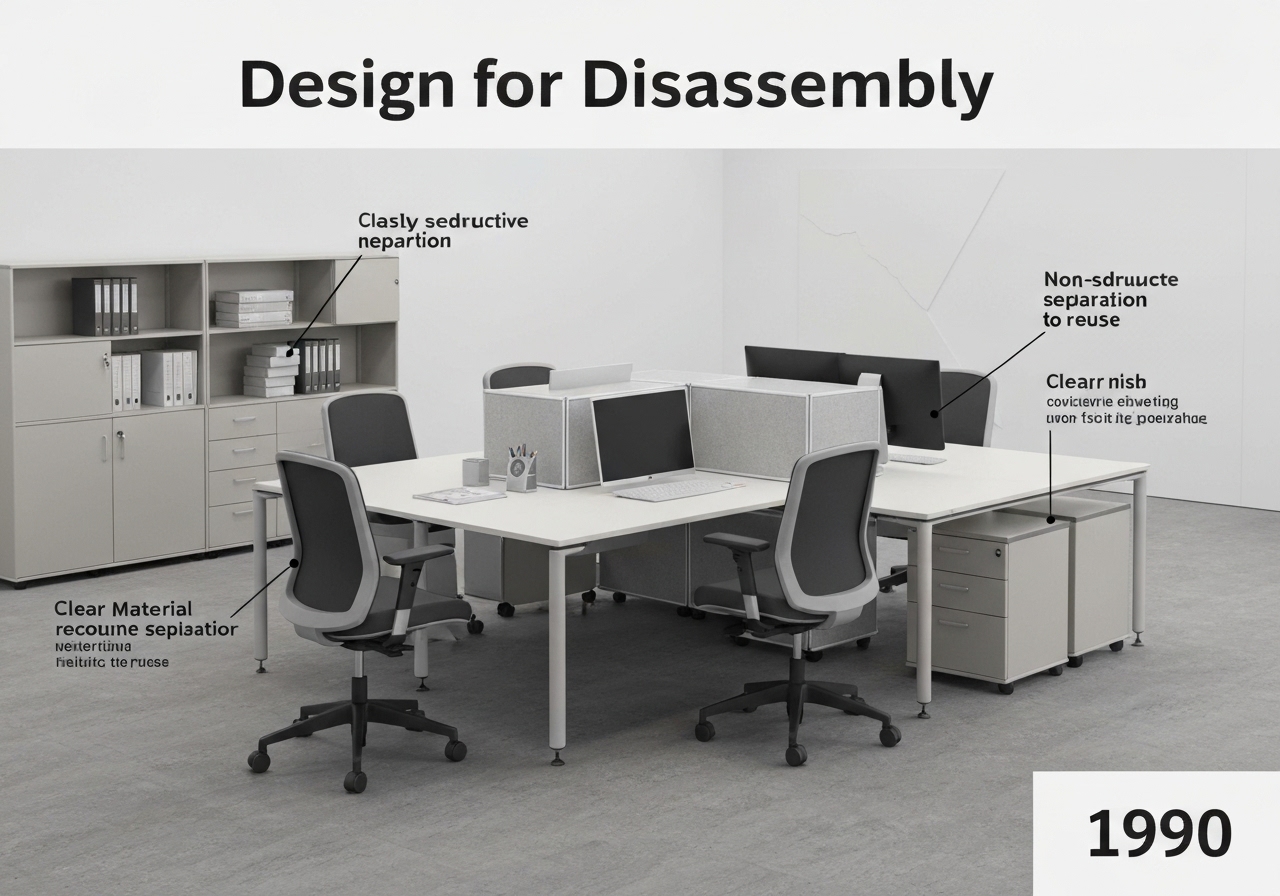
Design for Disassembly is a practical application of circular economy principles. Its technical execution involves a deliberate choice of product architecture and joining methods. Designers employing DfD minimize the variety and quantity of fasteners, opting for common types like screws instead of permanent bonds like glue or ultrasonic welds. Products are often designed with a clear hierarchy, allowing major modules to be removed without disturbing the entire assembly. Materials are selected not only for performance but also for their compatibility in recycling streams, and are clearly marked with international recycling codes to aid in sorting. This approach stands in contrast to conventional Design for Assembly (DfA), which often prioritizes initial production speed and can lead to integrated, inseparable designs that are destined for landfill. The novelty of DfD was its explicit consideration of the end-of-life phase as a critical design constraint, shifting the perspective from a linear ‘take-make-dispose’ model to a circular one where components and materials retain their value through multiple life cycles.
Related to: design for disassembly, dfd, circular economy, repairability, recycling, modular design, product end-of-life, sustainable engineering, right to repair, e-waste.