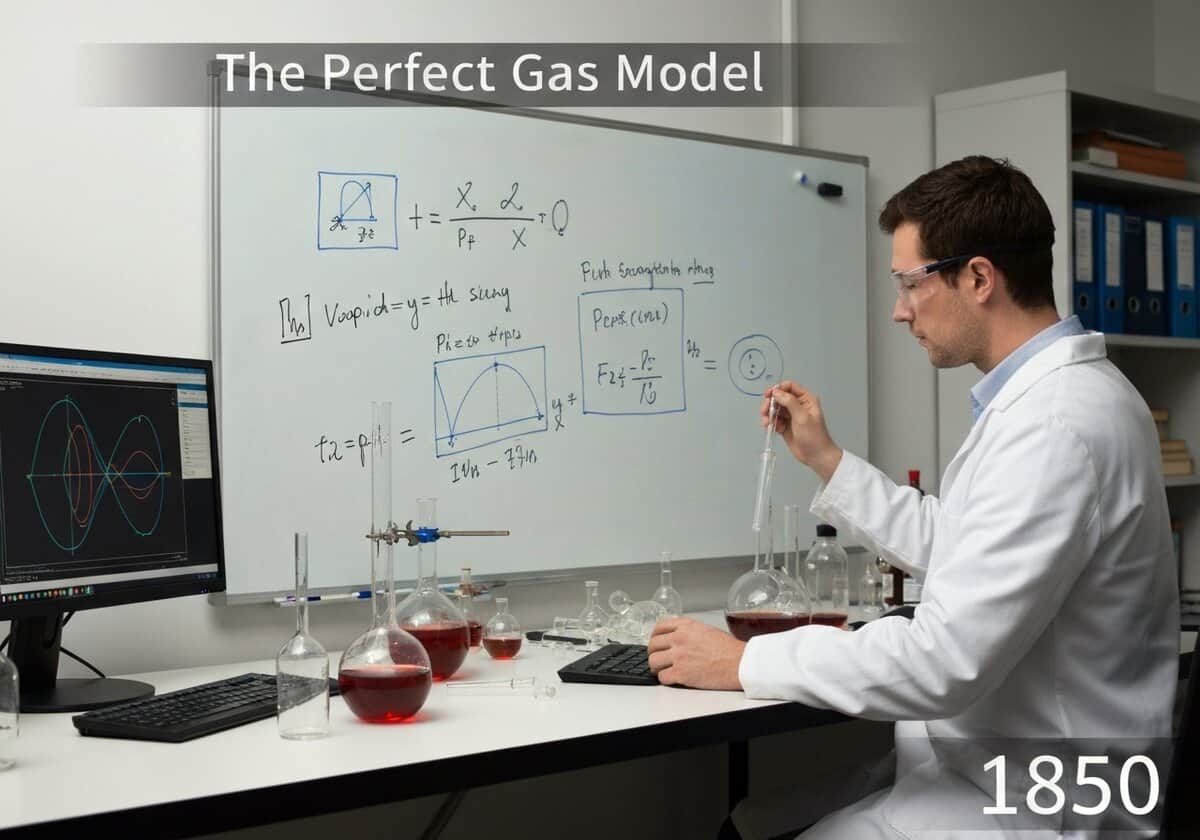
The perfect gas model is a refinement and simplification used extensively in thermodynamics and 流体力学. While the 理想气体定律, [latex]PV=nRT[/latex], only assumes negligible intermolecular forces and molecular volume, the perfect gas model adds the constraint that the specific heats at constant pressure ([latex]C_P[/latex]) and constant volume ([latex]C_V[/latex]) are constant. This additional assumption is crucial because it implies that the internal energy ([latex]U[/latex]) and enthalpy ([latex]H[/latex]) are solely linear functions of temperature. Specifically, [latex]dU = C_V dT[/latex] and [latex]dH = C_P dT[/latex].
This simplification is reasonably accurate for monatomic gases (like helium, argon) and diatomic gases (like nitrogen, oxygen) over a moderate range of temperatures where vibrational modes are not significantly excited. However, for polyatomic gases or over wide temperature ranges, the specific heats do change, and the more general semi-perfect (or thermally perfect) gas model is required. The perfect gas model is foundational in education for introducing 热力学 concepts and provides a first-order approximation for many real-world engineering problems, especially in gas dynamics and propulsion systems analysis.