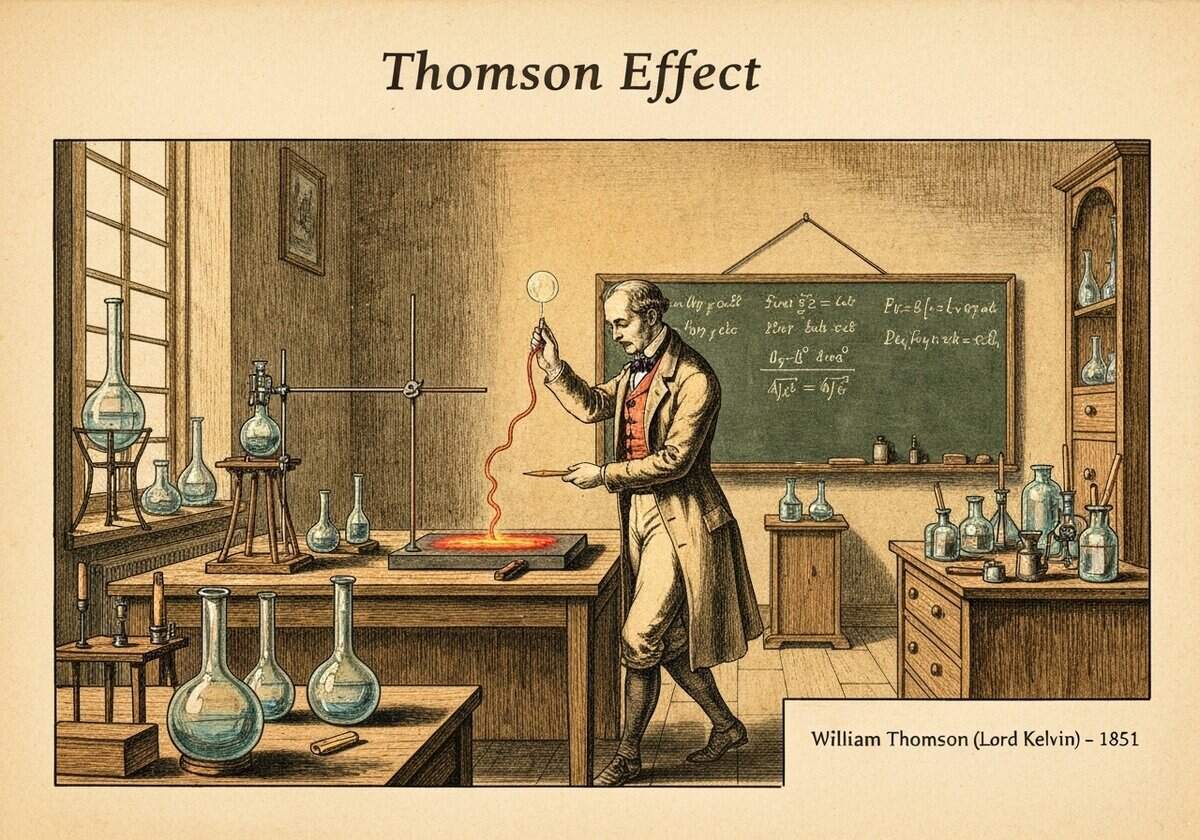
If the current flows in the same direction as the heat flow (from hot to cold), heat may be absorbed or released depending on the sign of the Thomson coefficient ([latex]mathcal{K}[/latex]) for that material. This heating or cooling is distinct from and superimposed upon the irreversible Joule heating ([latex]I^2R[/latex]) that always occurs. The Thomson effect is crucial for a complete 热力学 description of thermoelectric phenomena and is linked to the Seebeck and 佩尔蒂埃 通过开尔文关系产生影响,而开尔文关系是该领域的基础。