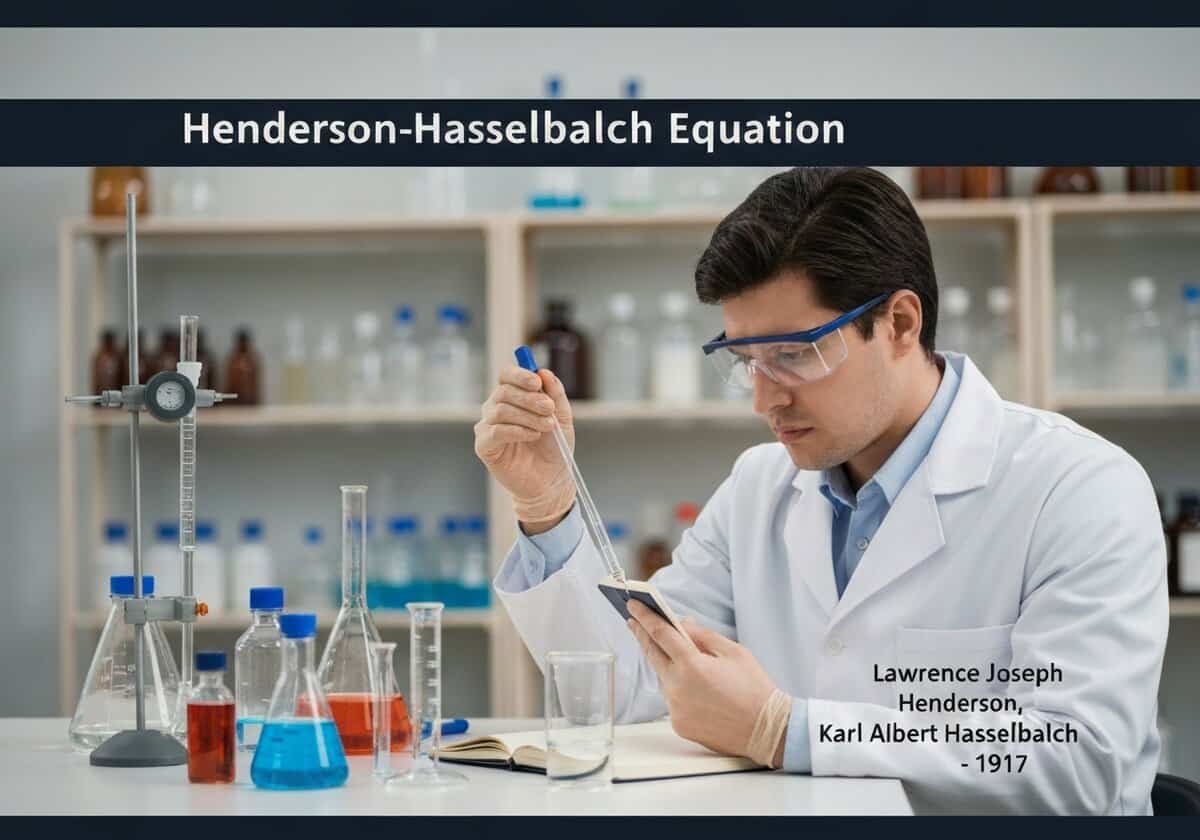
亨德森-哈塞尔巴赫方程将弱酸溶液的 pH 值与其酸解离常数([latex]pK_a[/latex])和去质子化物种(共轭碱,[latex][A^-][/latex])与质子化物种(酸,[latex][HA][/latex])的浓度之比联系起来。等式为 [latex]pH = pK_a + \log_{10}\left(\frac{[A^-]}{[HA]}}\right)[/latex].它是理解和制备缓冲溶液的基础。.
(图片仅供参考)
亨德森-哈塞尔巴赫方程将弱酸溶液的 pH 值与其酸解离常数([latex]pK_a[/latex])和去质子化物种(共轭碱,[latex][A^-][/latex])与质子化物种(酸,[latex][HA][/latex])的浓度之比联系起来。等式为 [latex]pH = pK_a + \log_{10}\left(\frac{[A^-]}{[HA]}}\right)[/latex].它是理解和制备缓冲溶液的基础。.
该方程源自酸解离常数表达式 [latex]K_a = frac{[H^+][A^-]}{[HA]}[/latex]。通过对等式两边取负对数并重新排列,即可得到最终形式。该方程的主要用途是配制所需 pH 值的缓冲溶液以及计算酸碱反应的平衡 pH 值。该方程的一个关键含义是,当酸及其共轭碱的浓度相等时([latex][HA] = [A^-][/latex]),对数项为零,溶液的 pH 值恰好等于该酸的 [latex]pK_a[/latex]。这一点代表了体系的最大缓冲能力,此时体系能够最有效地抵抗 pH 值的变化。
The equation relies on several assumptions, primarily that the acid is weak and that the autoionization of water is negligible. It uses concentrations instead of activities, making it an approximation that works best for dilute solutions. Despite these limitations, it provides an excellent framework for understanding how buffers function and is widely used in biological and chemical sciences.
亨德森-哈塞尔巴尔赫方程
(如果日期未知或不相关,例如“流体力学”,则提供其显著出现的近似估计)

只有注册会员才能免费获取完整尺寸的图片和下载内容。
> 登录 <