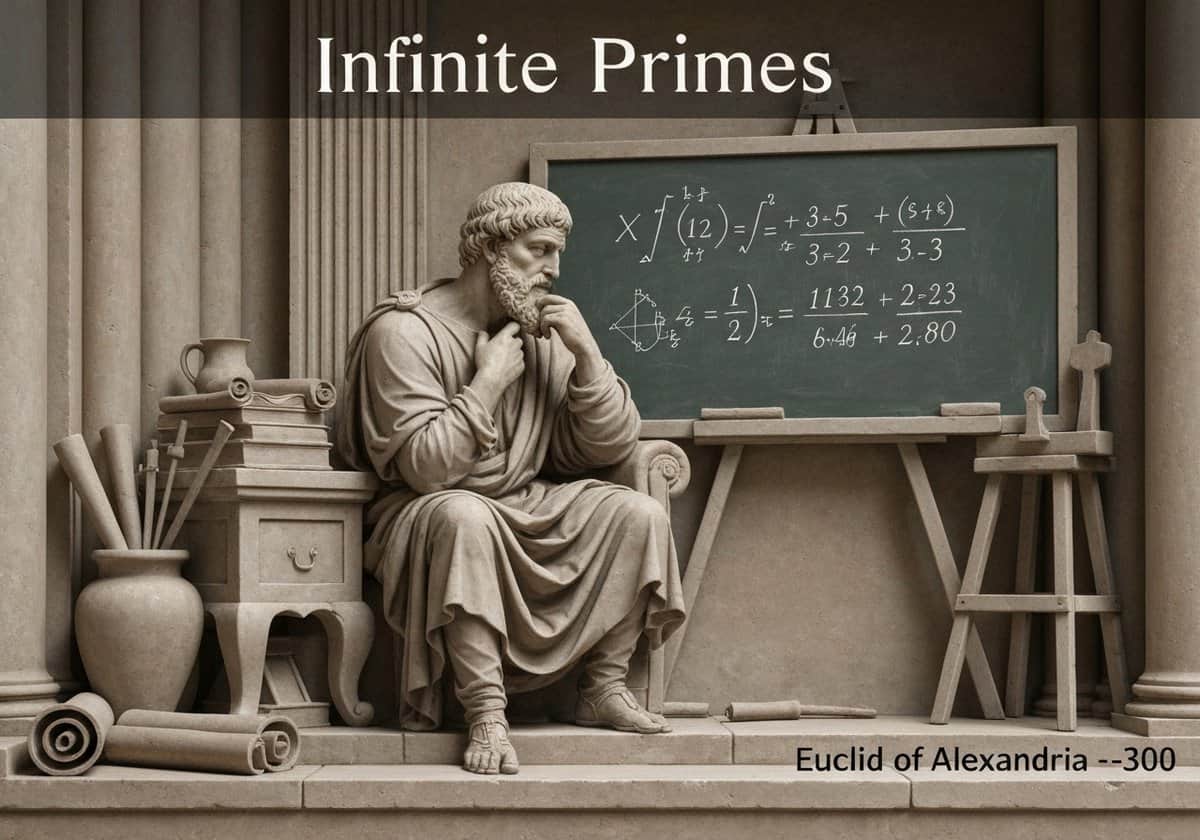
The proof continues: if [latex]P[/latex] is not prime, it must be divisible by some prime, say [latex]q[/latex]. This prime [latex]q[/latex] must be on our assumed complete list of primes. However, if we divide [latex]P[/latex] by any of the primes [latex]p_i[/latex] from our list, the remainder is always 1. Therefore, none of the primes on our list can be the factor [latex]q[/latex]. This means [latex]q[/latex] must be a prime number that was not on our original list. In either case—whether [latex]P[/latex] is prime or composite—there exists at least one more prime than is contained in any finite list. This contradicts the initial assumption that the set of all primes is finite. Therefore, the set of prime numbers must be infinite. This elegant argument is considered a masterpiece of mathematical reasoning and is often one of the first examples of proof by contradiction taught to students. It appears in Book IX, Proposition 20 of Euclid’s *Elements*.