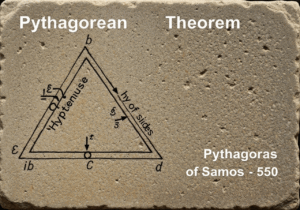
A classic application of this principle is to find the volume of a sphere. Consider a hemisphere of radius [latex]r[/latex]. Its cross-sectional area at a height [latex]h[/latex] from the base is a circle with area [latex]A = \pi(r’)^2[/latex]. By the Pythagorean theorem, [latex]h^2 + (r’)^2 = r^2[/latex], so [latex](r’)^2 = r^2 – h^2[/latex]. Thus, the area is [latex]A = \pi(r^2 – h^2)[/latex]. Now, consider a cylinder of radius [latex]r[/latex] and height [latex]r[/latex], with an inverted cone of the same radius and height removed from its center. The cross-sectional area of this shape at height [latex]h[/latex] is the area of the larger circle (from the cylinder) minus the area of the smaller circle (from the cone). This gives [latex]A = \pi r^2 – \pi h^2 = \pi(r^2 – h^2)[/latex].