Product Design, Manufacturing & Innovation Resources
家 » 数学归纳法证明

数学归纳法证明

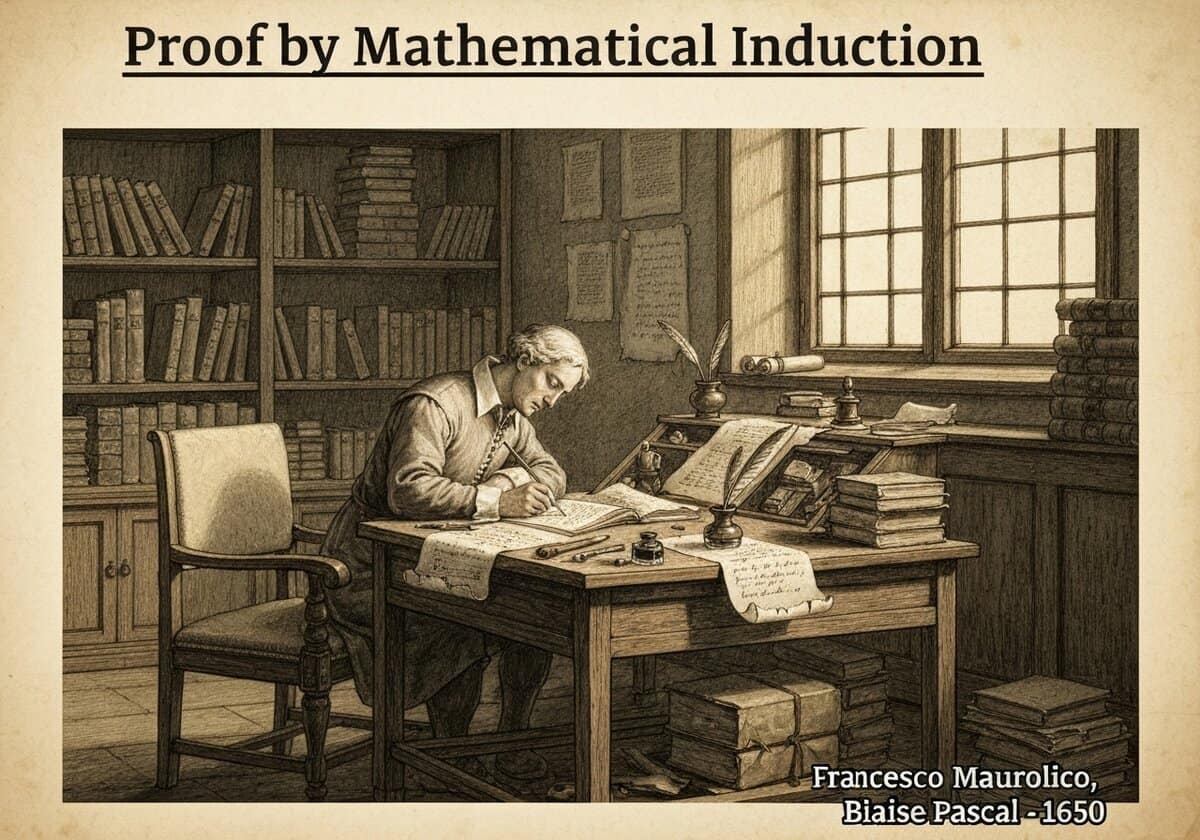
1650
  • Francesco Maurolico
  • Blaise Pascal
Study room with mathematician proving properties using mathematical induction.

(图片仅供参考)

Mathematical induction is a technique used to prove that a property [latex]P(n)[/latex] holds for every natural number [latex]n[/latex]. It involves two steps: the base case, proving [latex]P(0)[/latex] or [latex]P(1)[/latex] is true, and the inductive step, proving that if [latex]P(k)[/latex] is true for some natural number [latex]k[/latex] (the induction hypothesis), then [latex]P(k+1)[/latex] is also true.
Proof by mathematical induction is analogous to the domino effect. If you can prove the first domino will fall (the base case) and that any falling domino will knock over the next one (the inductive step), you can conclude that all dominoes will fall. The base case establishes the truth of the statement for the initial value, typically [latex]n=0[/latex] or [latex]n=1[/latex]. The inductive step is the core of the proof. It assumes the statement holds for an arbitrary case [latex]n=k[/latex], an assumption known as the induction hypothesis. Then, using this assumption, it must be shown that the statement also holds for the next case, [latex]n=k+1[/latex]. For example, to prove the formula for the sum of the first n integers, [latex]\sum_{i=1}^{n} i = \frac{n(n+1)}{2}[/latex]. Base case (n=1): [latex]1 = \frac{1(1+1)}{2}[/latex], which is true. Inductive step: Assume [latex]\sum_{i=1}^{k} i = \frac{k(k+1)}{2}[/latex]. We need to show [latex]\sum_{i=1}^{k+1} i = \frac{(k+1)(k+2)}{2}[/latex]. We start with the left side: [latex]\sum_{i=1}^{k+1} i = (\sum_{i=1}^{k} i) + (k+1)[/latex]. By the induction hypothesis, this is [latex]\frac{k(k+1)}{2} + (k+1)[/latex]. Factoring out [latex](k+1)[/latex] gives [latex](k+1)(\frac{k}{2} + 1) = (k+1)(\frac{k+2}{2}) = \frac{(k+1)(k+2)}{2}[/latex], which completes the proof. This powerful method is indispensable in discrete mathematics and computer science.

UNESCO Nomenclature: 1202
– Algebra

类型

抽象系统

中断

重大的

用法

广泛使用

前体

  • 欧几里得对素数无穷性的证明(带有归纳法的色彩)
  • 费马的无限下降法
  • 代数符号的发展

应用程序

  • 证明计算机算法(尤其是递归算法)的正确性
  • 涉及顺序步骤的财务模型分析
  • 组合数学和数论中的公式证明
  • 建立计算机科学中数据结构的属性

专利:

NA

潜在创新理念

  • formal verification of loop invariants in software engineering
  • 为编译器开发递归下降解析器
  • proof-of-stake consensus algorithms in 区块链 technology
  • 分形几何的生成模型
  • 用于归纳性质的自动定理证明器
  • 递归算法的计算复杂度分析
  • 在离散时间步长内模拟人口增长
  • 具有顺序状态恢复的容错系统设计
  • 证明计算机程序终止
  • 复杂数据类型的结构归纳开发
相关内容:数学归纳法、递归、基本情况、归纳步骤、数论、离散数学、算法正确性、级数、求和、皮亚诺公理。

历史背景

数学归纳法证明

-500
150
1640
1650
1747
1758
1777
-400
-550
1635
1650
1736
1750
1763-12-23
1780

(如果日期未知或不相关,例如“流体力学”,则提供其显著出现的近似估计)

第十年 周年纪念日

只有注册会员才能免费获取完整尺寸的图片和下载内容。

> 登录 <