Product Design, Manufacturing & Innovation Resources
بيت » The Cavalieri’s Principle

The Cavalieri’s Principle

1635
  • Bonaventura Cavalieri
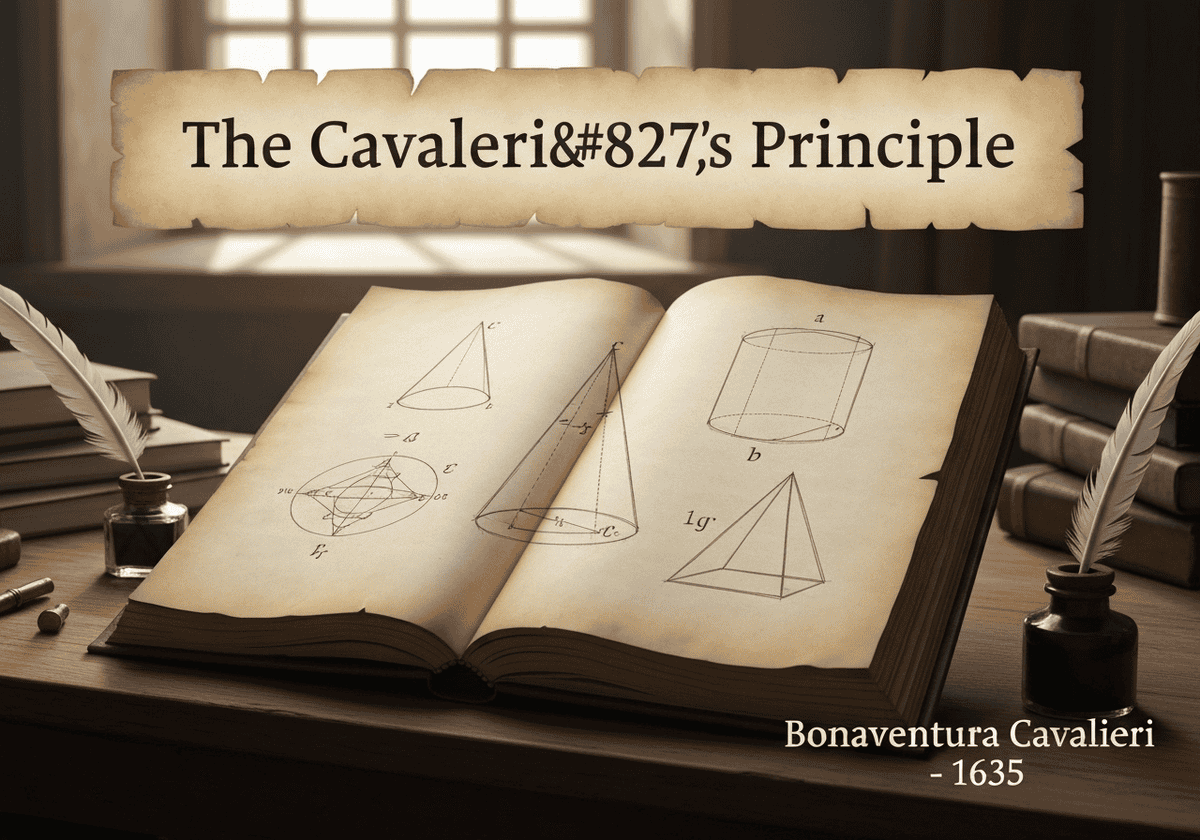
Mathematical derivation of Cavalieri's Principle with geometric shapes in a historical study setting.

(صورة توضيحية فقط)

Also known as the method of indivisibles, this principle states that if two solids lying between two parallel planes have the property that every plane parallel to the two given planes intersects them in cross-sections of equal area, then the two solids have equal volumes. It provides a powerful method for calculating volumes of complex shapes without calculus.


Cavalieri’s principle offers an elegant and intuitive way to determine the volume of three-dimensional objects. It formalizes the idea of slicing a solid into an infinite number of infinitesimally thin cross-sections, or “indivisibles.” The core idea is that if you have two solids, and for every possible height, the cross-sectional area of the first solid is equal to the cross-sectional area of the second solid, then their total volumes must be the same. It’s like comparing two stacks of coins; if each coin in one stack has the same area as the corresponding coin in the other stack, the total volume of metal is the same, regardless of how the stacks are skewed or arranged.

A classic application of this principle is to find the volume of a sphere. Consider a hemisphere of radius [latex]r[/latex]. Its cross-sectional area at a height [latex]h[/latex] from the base is a circle with area [latex]A = \pi(r’)^2[/latex]. By the Pythagorean theorem, [latex]h^2 + (r’)^2 = r^2[/latex], so [latex](r’)^2 = r^2 – h^2[/latex]. Thus, the area is [latex]A = \pi(r^2 – h^2)[/latex]. Now, consider a cylinder of radius [latex]r[/latex] and height [latex]r[/latex], with an inverted cone of the same radius and height removed from its center. The cross-sectional area of this shape at height [latex]h[/latex] is the area of the larger circle (from the cylinder) minus the area of the smaller circle (from the cone). This gives [latex]A = \pi r^2 – \pi h^2 = \pi(r^2 – h^2)[/latex].

بما أن مساحات المقاطع العرضية متطابقة عند كل ارتفاع h، فإن مبدأ كافالييري ينص على أن حجم نصف الكرة يساوي حجم الأسطوانة مطروحًا منها حجم المخروط. حجم الأسطوانة هو πr² ⋅ r = πr³، وحجم المخروط هو ¾πr² ⋅ r = ¾πr³. بالتالي، فإن حجم نصف الكرة هو ¾πr³ = ¾πr³. حجم الكرة الكاملة يساوي ضعف هذا، أو 4/3 πr³. وقد مثّلت هذه الطريقة، التي طوّرها بونافنتورا كافالييري في القرن السابع عشر، خطوةً مهمةً نحو تطوير حساب التكامل. Newton ولايبنيز.

UNESCO Nomenclature: 1204
– Geometry

يكتب

نظام مجرد

خلل

Substantial

الاستخدام

استخدام واسع النطاق

مقدمات

  • Archimedes’ method of exhaustion
  • Work of Zu Gengzhi in 5th-century China on calculating the volume of a sphere
  • The concept of infinitesimals in early mathematics

التطبيقات

  • calculating the volume of a sphere
  • deriving the volume formula for cones and pyramids
  • integral calculus (as a precursor concept)
  • computer tomography (ct) scan analysis for volume measurement
  • geotechnical engineering for estimating earthwork volumes

براءات الاختراع:

NA

أفكار ابتكارية محتملة

  • الطباعة رباعية الأبعاد techniques where object volume is controlled by layering cross-sections of varying material density
  • algorithms for optimizing material usage in additive manufacturing by ensuring constant cross-sectional stress distribution
  • medical imaging software that reconstructs 3d organ volumes from 2d slices with greater accuracy
  • geological modeling software to estimate mineral deposits by comparing seismic cross-section data
  • ai-driven architectural design that generates complex forms with predefined volumes
  • fluid dynamics simulations that calculate flow rates through irregular channels
  • haptic feedback systems that simulate the ‘feel’ of an object’s volume based on cross-sectional data
  • non-destructive testing methods for industrial parts that calculate internal void volumes
Related to: cavalieri’s principle, method of indivisibles, volume calculation, integral calculus, cross-section, sphere volume, solid geometry, cylinder.

السياق التاريخي

The Cavalieri’s Principle

-300
-400
-550
1635
1650
1736
1750
-300
-350
-500
150
1640
1650
1747
1758

(إذا كان التاريخ غير معروف أو غير ذي صلة، على سبيل المثال "ميكانيكا الموائع"، يتم توفير تقدير تقريبي لظهوره الملحوظ)

أحدث الإضافات

أهم المنشورات والمقالات

أفضل الأدوات الأصلية

السنة العاشرة عيد

الصور والتنزيلات بالحجم الكامل متاحة فقط، ومجانية تمامًا، للأعضاء المسجلين.