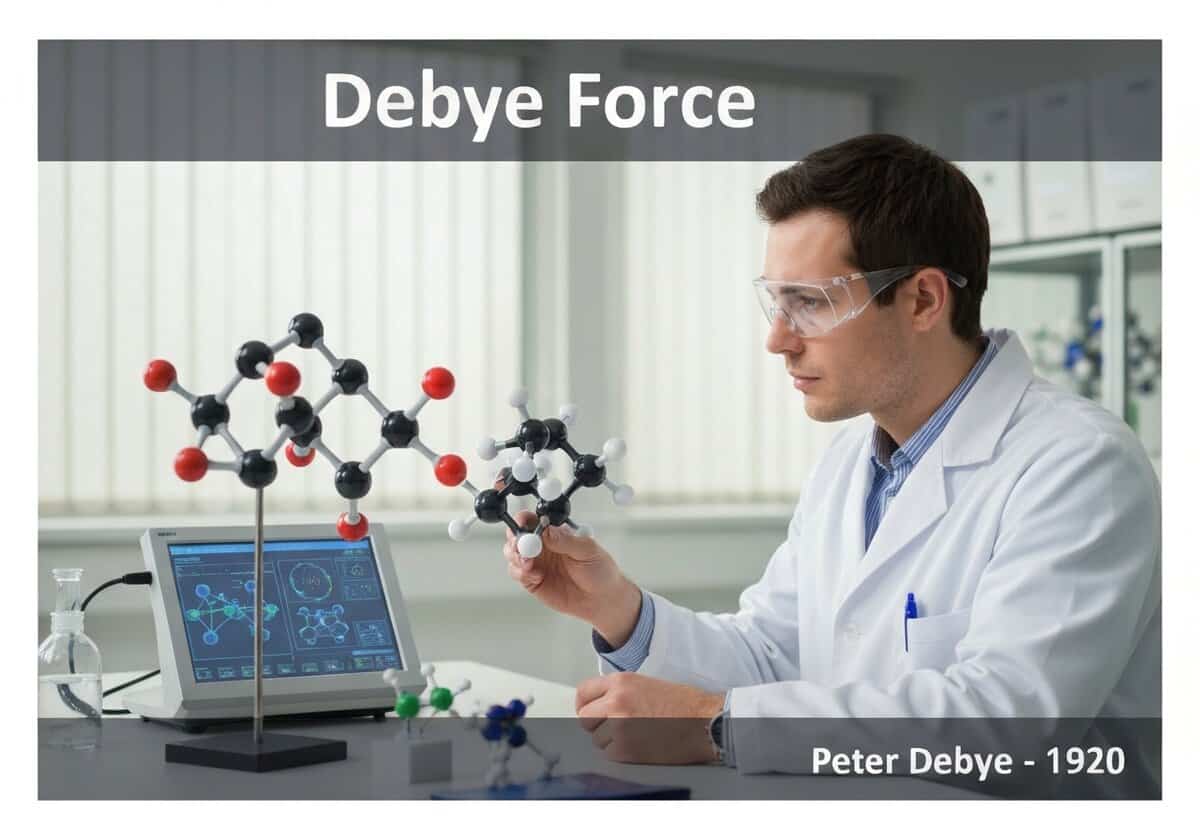
极性分子(具有永久电势)之间的一种吸引力分子间作用力。 偶极子)和一个非极性分子。永久偶极子产生的电场会使非极性分子的电子云发生畸变,从而在其中感应出一个瞬态偶极子。这两个偶极子相互吸引。相互作用势能为 [latex]V propto -frac{alpha mu^2}{r^6}[/latex],其中 [latex]alpha[/latex] 为极化率,[latex]mu[/latex] 为永久偶极矩。 偶极矩.

(图片仅供参考)
极性分子(具有永久电势)之间的一种吸引力分子间作用力。 偶极子)和一个非极性分子。永久偶极子产生的电场会使非极性分子的电子云发生畸变,从而在其中感应出一个瞬态偶极子。这两个偶极子相互吸引。相互作用势能为 [latex]V propto -frac{alpha mu^2}{r^6}[/latex],其中 [latex]alpha[/latex] 为极化率,[latex]mu[/latex] 为永久偶极矩。 偶极矩.
The Debye force, also known as the induction force, explains how a polar molecule can attract a nonpolar one. A polar molecule possesses a permanent electric 偶极子, which creates an electric field in its vicinity. When a nonpolar molecule enters this field, its electron cloud is distorted—electrons are pushed away from the negative end of the dipole and pulled toward the positive end. This separation of charge creates a temporary, ‘induced’ dipole in the nonpolar molecule. The interaction is always attractive because the induced dipole is always oriented favorably with respect to the permanent dipole that created it.
与此不同的是 基索姆力量德拜力与温度无关。这是因为诱导偶极子是由永久偶极子产生的,并瞬间跟随其取向,因此永久偶极子的热翻滚不会抵消这种吸引力。德拜力的强度取决于两个因素:极性分子的永久偶极矩 (μ) 和非极性分子的极化率 (α)。虽然德拜力通常弱于偶极-偶极相互作用力,但它对于理解含有极性和非极性组分的混合物的行为至关重要。
德拜力(偶极子诱导偶极子相互作用)
(如果日期未知或不相关,例如“流体力学”,则提供其显著出现的近似估计)

只有注册会员才能免费获得 100% 的全尺寸图片和下载。.
> 登录 <