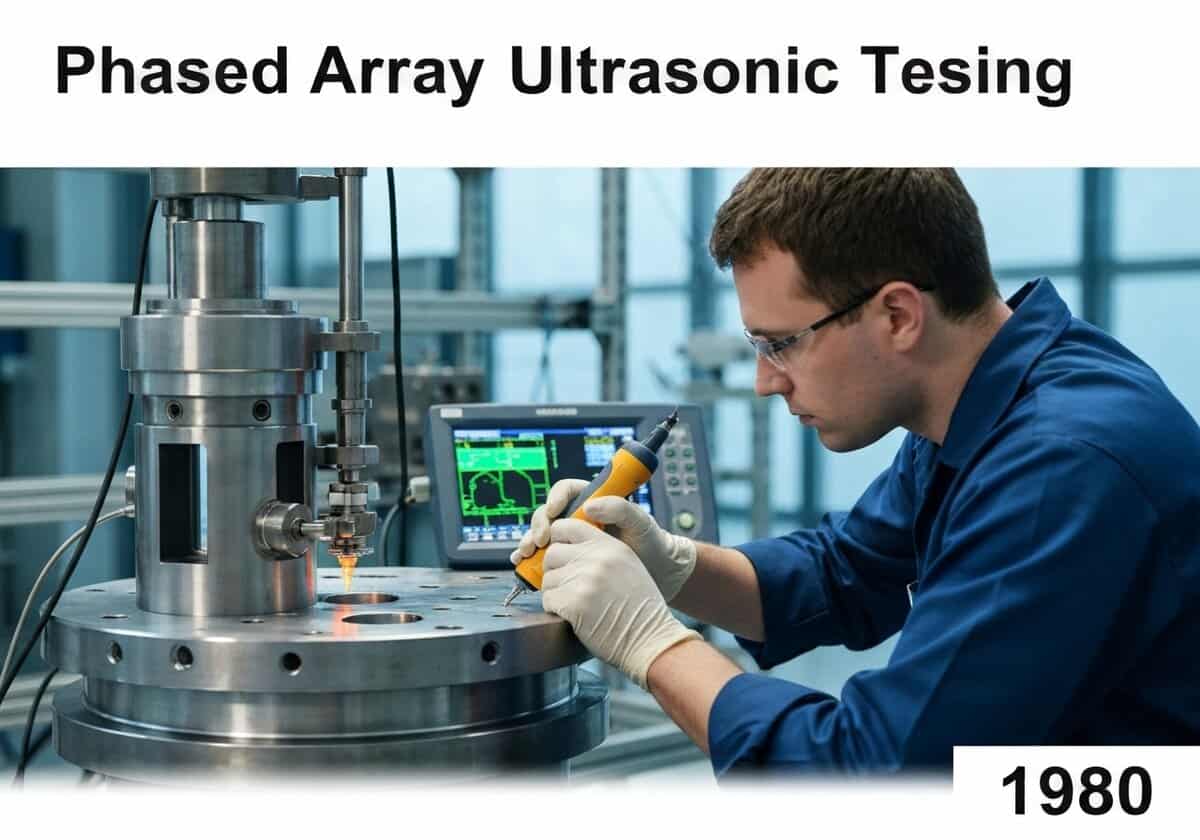
相控阵超声检测(PAUT)
创新世界 Ultrasonic Testing (PAUT) employs a multi-element transducer where each element is pulsed independently with precise, computer-calculated time delays. By controlling this phasing, the resulting ultrasonic beam can be electronically steered, focused, and scanned without physically moving the probe. This provides rapid, detailed imaging of flaws, especially in complex geometries, surpassing conventional single-element techniques.
The core principle behind PAUT is the constructive and destructive interference of wavelets, as described by Huygens’ principle. A PAUT probe consists of an array of small, individual transducer elements (from 16 to 256 or more). A computer-controlled instrument sends out precisely timed electrical pulses to each element. If all elements are pulsed simultaneously, they produce a standard, straight ultrasonic beam. However, by introducing minute time delays between the firing of adjacent elements, a phase shift is created across the probe’s aperture.
This phase shift causes the individual wavelets to interfere in such a way that the combined wavefront is steered at an angle or focused to a specific depth. For example, by progressively delaying the pulses from one end of the array to the other, the beam can be swept through a range of angles, creating a ‘sectorial scan’ or S-scan. This allows a large volume of material to be inspected from a single probe position. Similarly, by applying a parabolic timing pattern, the beam can be focused, increasing its intensity and improving resolution at a specific depth.
This electronic control offers immense flexibility and speed. An entire weld can be inspected rapidly by combining electronic scanning along the array’s length with the angular sweep. The data is often presented in easy-to-interpret 2D or 3D color-coded images (S-scans, C-scans), which provide a more intuitive representation of flaw location and size compared to the simple A-scan of conventional UT.
UNESCO Nomenclature: 3322
- 材料科学
前体
- 为雷达和声纳开发的相控阵天线技术
- 微电子和数字信号处理技术的进步,用于控制多个通道
- 常规单元素超声检测方法
- Huygens’ principle of wave propagation
应用程序
- 核电站和管道的焊缝检测
- 航空航天工业用于检查复合结构和摩擦搅拌焊缝
- 医学成像,特别是超声心动图和产科
- 石化储罐和管道腐蚀测绘
- 检查涡轮叶片等复杂几何形状的部件
潜在创新理念
由于机器人流量被拦截(目前每天超过 4 万),此内容仅限社区成员查看。
> 登录 > 或者 > 注册 < (100% 免费)即可访问此内容,以及所有其他受限内容和工具。
Related to: phased array, PAUT, beam steering, beamforming, NDT, ultrasonic imaging, transducer array, weld inspection, non-destructive testing, electronic scanning.