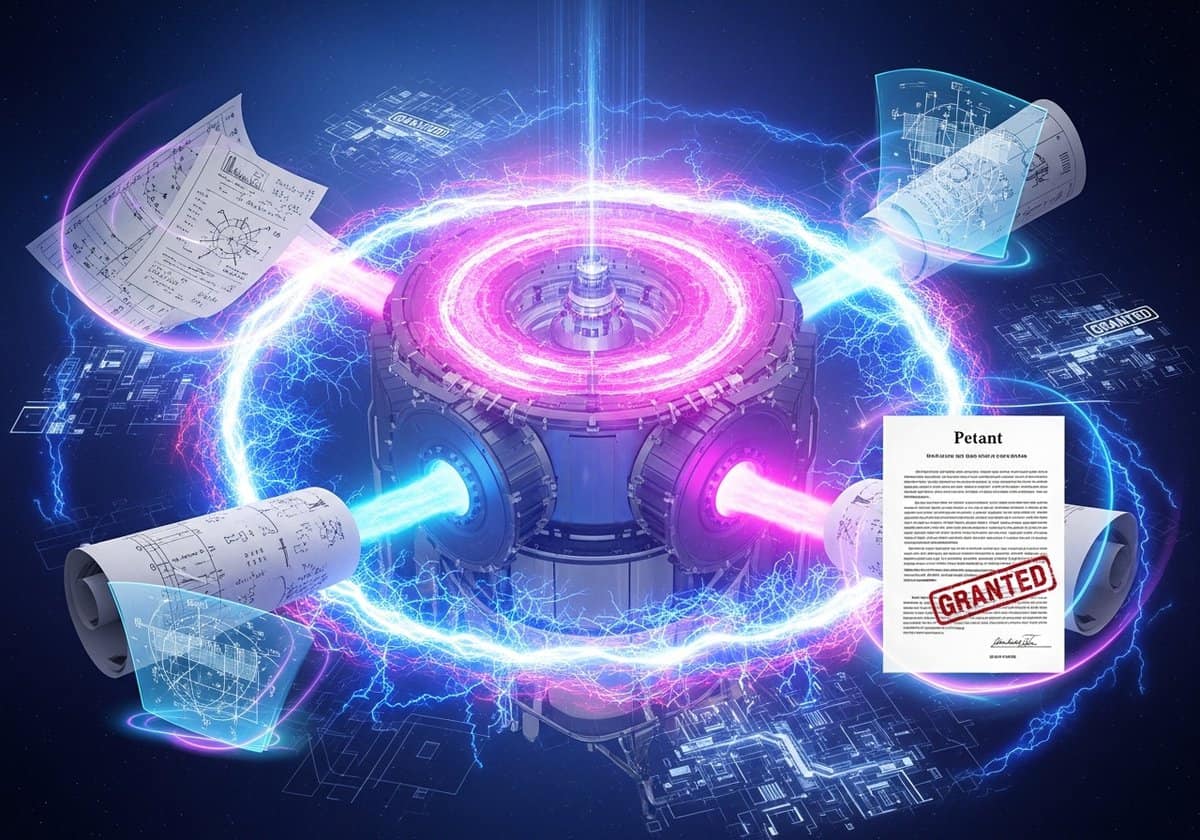

核聚变是指将较轻的原子核(主要是氢的同位素,例如氘和氚)结合起来,在极高温度下通过等离子体约束释放大量能量的过程。 压力 条件方面,磁约束装置(如托卡马克和仿星器)以及使用高功率激光的惯性约束方法是实现聚变点火和维持等离子体稳定性的主要途径。研究重点在于优化等离子体加热、控制磁流体动力学不稳定性、提高聚变反应速率以及开发能够承受强中子通量的材料。我们更新的合集汇集了最新的科学出版物和专利,内容涵盖反应堆设计、等离子体诊断、燃料循环管理以及对推进实用聚变发电至关重要的能量提取技术。
这是我们最新精选的有关核聚变的全球出版物和专利(英文),这些出版物和专利在众多科学在线期刊中进行了分类,主要涉及核聚变、托卡马克、恒星器、磁约束、惯性约束、等离子体物理、聚变反应堆、氘氚、聚变等离子体、聚变能、等离子体加热、核聚变点火、核聚变盈亏平衡、磁流体动力学、核聚变燃料、核聚变诊断、核聚变材料、等离子体约束、核聚变发电厂、核聚变中子、核聚变反应堆设计、核聚变稳定性、激光核聚变、核聚变磁场、核聚变反应堆毯、等离子体湍流、核聚变反应速率、核聚变能量增益和核聚变颗粒注入。.
Optimizing heat flux deposition of diverted plasma configurations using controller neural networks
Patent published on the 2026-05-28 in WO under Ref WO2026112323 by GDM HOLDING LLC [US] (Pfau David Benjamin [gb], De Vylder Bart [gb], Tracey Brendan Daniel [gb], Felici Federico Alberto Alfredo [gb], Norman Tamara Catherine [gb], Donner Craig Steven [gb], Jackson Tyler [ca])
Abstract: Methods, systems, and apparatus, including computer programs encoded on a computer storage medium, for controlling magnetic confinement devices using a controller neural network trained via reinforcement learning. Examples of control systems for magnetic confinement devices are described herein that utilize the controller neural network for optimizing heat and particle flux deposition of diverted plasma configurations. The controller neural network is trained on a model of the magnetic confineme[...]
Our summary: The content discusses optimizing heat flux deposition in plasma configurations using neural networks. It details methods for controlling magnetic confinement devices through a reinforcement learning-trained controller. Applications include controlled thermonuclear fusion and advanced plasma research.
neural networks, magnetic confinement, plasma configurations, reinforcement learning
Patent
Training device and control device
Patent published on the 2026-05-28 in WO under Ref WO2026110235 by NTT INC [JP] (Yoneda Ryouta [jp], Kojima Tomihiko [jp], Shirasawa Yuita [jp], Takahashi Madoka [jp])
Abstract: This training device comprises: an input unit that inputs training data, which is experimental data or a numerical calculation result regarding control of nuclear fusion plasma; and a training unit that trains, by means of offline reinforcement learning using the training data, a control model which outputs a control instruction.[...]
Our summary: The training device includes an input unit for experimental data or numerical results related to nuclear fusion plasma control. It features a training unit that employs offline reinforcement learning to develop a control model. The control model generates control instructions based on the trained data.
training device, control device, reinforcement learning, nuclear fusion
Patent
Superconducting magnet, plasma device, nuclear fusion apparatus, and coil guide for superconducting magnet
Patent published on the 2026-05-21 in WO under Ref WO2026105811 by HELICAL FUSION CO LTD [JP] (Tamura Hitoshi [jp], Goto Takuya [jp], Miyazawa Junichi [jp])
Abstract: Disclosed are a superconducting magnet, a plasma device, a nuclear fusion apparatus, and a coil guide for the superconducting magnet, which make it possible to maintain two or more coils in a pre-designed positional relationship. The present disclosure is a superconducting magnet comprising: a first coil and a second coil which each include a superconducting material; a first coil guide which has a first housing part in which the first coil is housed; and a second coil guide which has a second h[...]
Our summary: The disclosure involves a superconducting magnet with two coils made of superconducting material. It includes a first and second coil guide, each with helical housing shapes. These guides maintain a pre-designed positional relationship between the coils for optimal performance.
superconducting magnet, plasma device, nuclear fusion, coil guide
Patent
Optimised architecture of a civil engineering tyre
Patent published on the 2026-05-14 in AU under Ref AU2024392625 by CIE GENERALE DES ETABLISSEMENTS MICHELIN (Royer Thierry, Pujol Gilles, Attome Elodie)
Abstract: The invention relates to a tyre for a civil engineering vehicle, comprising a tread intended to come into contact with the ground via a tread surface having an axial end E1, the distance between the axial end E1 of the tread surface and the internal cavity in a meridian plane being at least equal to 120 mm. The tread comprises two rubber compounds (23, 24): a first material intended to come into contact with the ground, and a second so-called diffusion material, which is radially inward with res[...]
Our summary: The invention describes a tyre for civil engineering vehicles with a tread designed for optimal ground contact. It features two rubber compounds: one for ground contact and a diffusion material for internal support. The diffusion material has a thermal conductivity of at least 0.35 W/mK.
tyre design, civil engineering, rubber compounds, thermal conductivity
Patent
Modular vessel assembly
Patent published on the 2026-05-13 in EP under Ref EP4742271 by UK FUSION ENERGY LTD [GB] (Verhoeven Roel [gb])
Abstract: A modular vessel assembly defining an internal chamber suitable to maintain a vacuum within the chamber to support a magnetically confined plasma. The present modular assembly is formed from a plurality of annular modular sections arranged in abutting contact as a stack of annular rings extending around a central axis of the chamber. A sealing arrangement is provided at the interface between the modules of the stack to create a fluid seal configured to maintain at least a partial vacuum within t[...]
Our summary: The modular vessel assembly is designed to maintain a vacuum for magnetically confined plasma. It consists of annular modular sections stacked around a central axis. The assembly is suitable for use in fusion reactors like tokamaks.
modular assembly, vacuum chamber, plasma confinement, fusion reactor
Patent
Fluid sealing device for a modular vessel assembly
Patent published on the 2026-05-13 in EP under Ref EP4742272 by UK FUSION ENERGY LTD [GB] (Verhoeven Roel [gb])
Abstract: [0001] A modular vessel assembly and sealing arrangement defining an internal chamber suitable to maintain a vacuum within the chamber to support a magnetically confined plasma. The present vessel and sealing arrangement is formed from a plurality of annular modular sections arranged in fluid sealed abutting contact as a stack of sealed annular rings extending around a central axis of the chamber. A sealing arrangement is provided at the interface between the modules of the stack to create a flu[...]
Our summary: The content describes a modular vessel assembly designed to maintain a vacuum for magnetically confined plasma. It consists of annular sections arranged in sealed contact to form a chamber. The sealing arrangement ensures a fluid seal, making it suitable for fusion reactor applications like tokamaks.
fluid sealing, modular vessel, vacuum chamber, plasma confinement
Patent
The Role of the Magnetic Field Orientation and Strength on the Electrodeposition of Ni-Fe Bifunctional Electrocatalyst for Hydrogen Evolution Reaction and Oxygen Evolution Reaction
Published on 2026-02-03 by Safya Elsharkawy, Mateusz M. Marzec, Piotr ?abi?ski @MDPI
Abstract: Ni–Fe alloys were prepared via electrodeposition from a citrate electrolyte under different magnetic field (MF) strengths (0.1 T, 0.3 T, and 0.5 T) and configurations parallel (B‖) and perpendicular (B⊥) to the electrode surface. The magnetohydrodynamics (MHD) induced by the magnetic field influences their structural, compositional, and electrocatalytic properties. The application of an external homogeneous magnetic field significantly altered the alloy m[...]
Our summary: The study investigates how magnetic field orientation and strength affect the electrodeposition of Ni-Fe alloys. Results show that moderate magnetic field intensity improves film quality and electrocatalytic performance for hydrogen and oxygen evolution reactions. The findings highlight the potential to optimize bifunctional electrocatalysts through controlled magnetic field conditions.
Electrodeposition, Magnetic Field, Ni-Fe Alloys, Electrocatalysis
Publication
Fusion and Evaluation of Multi-Source Satellite Remote Sensing Precipitation Products Based on Transformer Machine Learning
Published on 2026-01-30 by Qingyuan Luo, Dongzhi Wang, Lina Liu, Caihong Hu, Chengshuai Liu @MDPI
Abstract: Satellite precipitation products offer great potential for acquiring reliable precipitation data in data-sparse areas, yet they have inherent uncertainties and errors as indirect observations. This study evaluated the accuracy of multi-source satellite precipitation products from daily and precipitation magnitude perspectives and discussed the spatiotemporal variation in their inversion errors. Based on ground rainfall observations, satellite products, and environmental factors, a Transformer-ba[...]
Our summary: This study evaluates the accuracy of multi-source satellite precipitation products and their spatiotemporal error variations. A Transformer-based fusion method was proposed, demonstrating improved correlation with ground observations. The GSMaP_Gauge product showed the best performance, while the proposed method enhanced estimation accuracy by incorporating environmental factors.
Satellite Remote Sensing, Precipitation Products, Transformer Machine Learning, Data Fusion
Publication