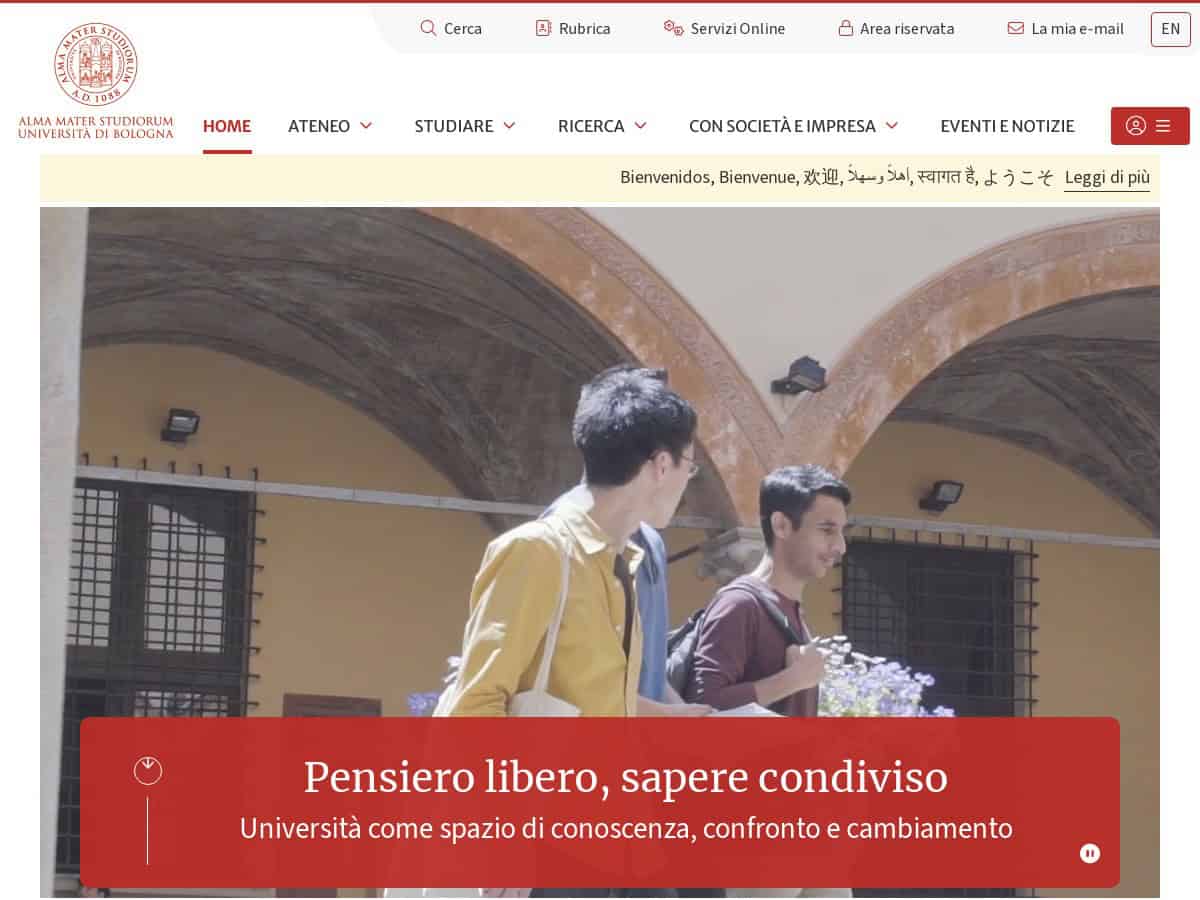
Address: Via Zamboni 33, 40126 Bologna, Emilia-Romagna, Italy
Engineering & Technology, Natural Sciences, Data Science & AI
Founded in 1088, the University of Bologna is the oldest university in continuous operation in the Western world. It is a comprehensive university with strong faculties in engineering, sciences, and humanities.
The Università di Bologna, Alma Mater Studiorum, is generally regarded as the oldest university in continuous operation in the Western world, with a founding date of 1088. It has about 90,000 students and 9,000 staff, and roughly one student in ten comes from abroad. The historic seat is in the university quarter around Via Zamboni, in the porticoed old town of Bologna, and further campuses are located in Cesena, Forlì, Ravenna and Rimini, with a centre in Buenos Aires.
The university grew from groups of students who hired teachers of law and organised themselves into associations, so that students rather than professors held the early power. Dante, Petrarch and Copernicus are among those linked to the school, and the physician Marcello Malpighi and the physicist Luigi Galvani worked in Bologna. Umberto Eco taught semiotics here for decades, and the Magna Charta Universitatum, a declaration of university autonomy, was signed in the city in 1988 to mark the 900th anniversary.
Bologna lends its name to the Bologna Process, the European reform that created comparable bachelor’s, master’s and doctoral cycles in 1999. The university covers almost all disciplines, from law, medicine and engineering to agriculture, arts and sciences, and its multicampus structure gives students a choice of city. Research strengths include physics, chemistry, engineering, agricultural sciences, humanities and law.
Italian public universities charge fees that depend on family income and are lower than in many other countries. Amounts range from a few hundred euros to a few thousand a year, with special rules for students from outside the EU. Check the current tariff. Many courses accept all applicants, but medicine and some other subjects use national or local tests and limited places. Bachelor’s programmes are mostly taught in Italian, while a growing set of master’s programmes are in English.
Bologna is a lively student city with relatively cheap restaurants, though rooms are hard to find. Early applications for regional housing support are advisable.
Domains taught:
Aerospace, Agriculture, AI and Machine Learning, Astroscience, Automation, Bioengineering, Bioinformatics, Chemistry, Civil Engineering, Computer Vision, Data Analytics, Ecology and Sustainability, Electrical and Electronics, Engineering, Food Science, Geotechnics, Industrial Design, Life Sciences, Materials, Mathematics, Mechanical Engineering, Microbiology and Genetics, Nanotechnologies, Physics, Process Control, Robotics, Software Engineering, Statistics, Structural Engineering, Telecommunications, Thermodynamics
Diplomas*:
Bachelor, Doctor, Master
Status:
Public
Partnerships:
Coimbra Group, The Guild, Utrecht Network, Una Europa. Extensive global partnerships.
Research:
Climate change and sustainability, AI and big data, Health and life sciences, Cultural heritage, Advanced materials.
Famous Alumnis:
Dante Alighieri (tradition), Nicolaus Copernicus, Umberto Eco, Romano Prodi
International recognition**:
Number of staff***:
9000
Current students***:
90000
Foreign students***:
10%
Cumulative former students***:
600000
Pros
World-renowned historic university, very broad range of programs, large international student community, vibrant city.
Cons
Very large and sometimes bureaucratic, housing in Bologna is expensive and difficult to find, can be crowded.
Best For
Comprehensive and historic university offering strong engineering and science programs.
Università degli Studi di Padova shares the core fields of this university, namely astroscience, aerospace and agriculture; it is slightly smaller, at about 65,000 students against roughly 90,000 here, and is also a public institution.
Among national alternatives, Università degli Studi di Firenze stands out for its focus on astroscience, aerospace and agriculture, and it is smaller, enrolling about 55,000 students against roughly 90,000 here, and is also a public institution.
Anyone who wants a second school in the same country with a similar spread of astroscience, aerospace and bioinformatics can consider Università degli Studi di Roma La Sapienza, and it runs the same bachelor's, master's and doctoral programmes, and covers optics and fluid dynamics as well.
Università degli Studi di Napoli Federico II follows much the same lines as this institution, with astroscience, aerospace and agriculture as common ground, and it is also a public institution, and runs the same bachelor's, master's and doctoral programmes.
Università degli Studi di Roma Tre sits close to this institution on aerospace, bioinformatics and geotechnics; it runs the same bachelor's, master's and doctoral programmes, and covers optics and fluid dynamics as well.
Most Similar Schools Abroad
Sorbonne Université brings a France setting to the same core fields, astroscience, aerospace and bioinformatics, and it runs the same bachelor's, master's and doctoral programmes, and covers sound engineering and marine science as well.
Université de Lille, in France, takes a similar route through astroscience, aerospace and food science; it is slightly smaller, at about 74,000 students against roughly 90,000 here, and is also a public institution.
Zhejiang University brings a China setting to the same core fields, astroscience, aerospace and agriculture, and it covers marine science and transportations as well, and is smaller, enrolling about 60,000 students against roughly 90,000 here.
A foreign alternative with a similar emphasis on astroscience, aerospace and food science is Universität Hamburg in Germany, and it teaches at the same levels, namely bachelor's, master's and doctoral, and covers sound engineering and marine science as well.
Technische Universität München, in Germany, takes a similar route through aerospace, food science and bioinformatics; it is smaller, enrolling about 48,000 students against roughly 90,000 here, and is also a public institution.
*our own picks (our criteria: a mix between domains, diploma delivered, reputation and size), but obviously too many criteria for an apple-to-apple ranking.
FAQ
Where is the University of Bologna?
The historic seat is on Via Zamboni 33 in Bologna, Italy. Other campuses are in Cesena, Forlì, Ravenna and Rimini.
When was it founded?
In 1088, which makes it the oldest university in continuous operation in the Western world.
How large is it?
About 90,000 students and 9,000 staff.
What is the Bologna Process?
A European reform of 1999 that created comparable bachelor's, master's and doctoral cycles.
What is the Magna Charta Universitatum?
A declaration of university autonomy signed in Bologna in 1988.
Who taught or studied there?
Dante, Petrarch and Copernicus are linked to it, and Umberto Eco taught semiotics.
What does it cost to study there?
Fees depend on family income and range from a few hundred euros to a few thousand a year. Special rules apply to students from outside the EU. Check the current tariff.
In which language are courses taught?
Mostly Italian at bachelor level, with a growing number of master's programmes in English.
Is admission open?
Many courses accept all applicants, but medicine and some other subjects use tests and limited places.
Is housing easy to find?
No. Rooms are hard to find, so apply early for regional housing support.
Artificial Intelligence (AI), Climate Change, Engineering, Environmental Engineering, Sustainable Development
*: without any judgment of the quality, readers are strongly encouraged to check the official status of the exact diploma envisioned as many universities have a mix of recognized diplomas, not recognized, “co-delivered,” “equivalent to”, “some pathways” (…), can change over time, and can be named differently from one country to another.
**: international reputation: is based on some criteria that do not mean much in some domains or specialties (number of researchers, of scientific publications, on budget ….). Our approximate 1-4 scale:
known locally
known locally and internationally
is listed in some of the world university’s classifications
is listed among the 20 firsts in some of world university’s classifications
***: estimated numbers, based on online sources and/or feedbacks. The numbers can vary greatly depending on school organisation (ex.: school is part of a group, it employs internal staff or external consultants or has public staff without employing them …). Refer to all the links provided to have accurate and updated numbers.
Innovation.world is not affiliated with this school/university. We recommend to contact them directly on their website for any special request.
To complete or correct any information here or share your opinion, please comment below or > send us a direct message <.