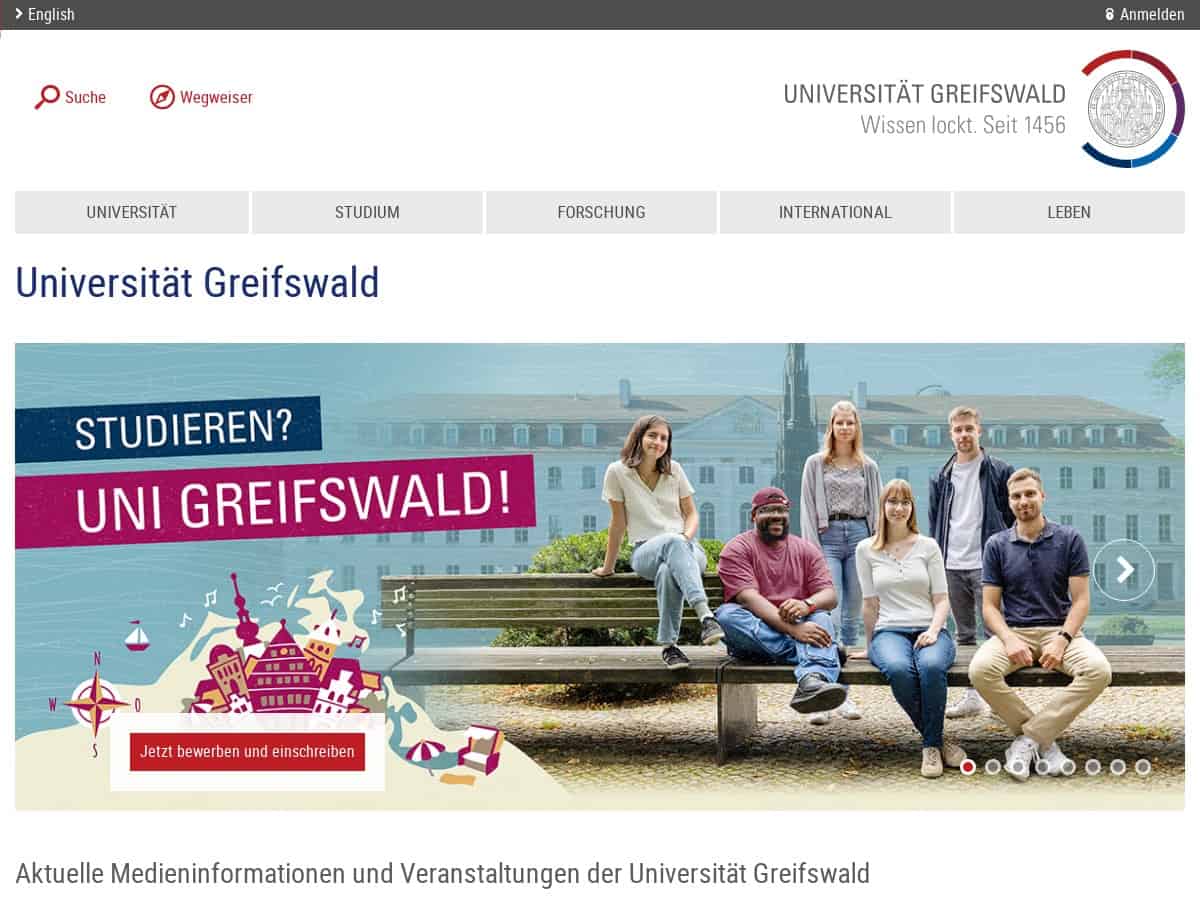
On the Baltic Sea coast of Mecklenburg-Vorpommern, the Universität Greifswald dates its beginnings to 1456. Its position on the Baltic coast gives its research domain of the Baltic Sea region a natural geographic base.
The city of Greifswald passed to Sweden in 1648 and to Prussia in 1815, and the university lived through both changes of rule. Among the scientists who worked there, Gerhard Domagk taught at the university in 1924-25 before moving to Münster, and he later received the Nobel Prize in Physiology or Medicine for 1939.
The Baltic Sea region is one of the university\’s research domains. Prospective students can find faculty pages, programme details and application rules on the official site, and should check it for current deadlines and fees.
Domains taught:
AI and Machine Learning, Astroscience, Bioengineering, Bioinformatics, Chemistry, Computer Vision, Data Analytics, Ecology and Sustainability, Engineering, Life Sciences, Marine Science, Materials, Mathematics, Mechanical Engineering, Microbiology and Genetics, Nanotechnologies, Optics, Physics, Software Engineering, Statistics, Thermodynamics
Diplomas*:
Bachelor, Doctor, Master
Status:
Public
Partnerships:
Historic university with a strong tradition in sciences. Collaborations with Max Planck Institute for Plasma Physics (Greifswald branch).
Research:
Plasma physics and fusion research, Molecular medicine and proteomics, Environmental science and landscape ecology, Pharmaceutical biology.
Famous Alumnis:
Johannes Stark (Nobel laureate), Gerhard Domagk (Nobel laureate)
International recognition**:
Number of staff***:
1500
Current students***:
10000
Foreign students***:
N/A%
Cumulative former students***:
N/A
Pros
Old and prestigious university, strong in specific research areas like plasma physics and life sciences.
Cons
Located in Greifswald (smaller coastal town), engineering options are very limited.
Best For
Historic university with strong programs in physics, chemistry, biochemistry, and environmental sciences.
Universität Rostock in Rostock is another institution in Mecklenburg-Vorpommern, listed for maritime systems and ocean technology, life sciences and biotechnology.
Christian-Albrechts-Universität zu Kiel in Kiel is listed for marine sciences, nanoscience and materials science, and life sciences.
Universität Potsdam in Potsdam covers earth and environmental sciences, cognitive sciences and data science.
Friedrich-Schiller-Universität Jena in Jena is listed for optics, photonics, physics and materials science.
Martin-Luther-Universität Halle-Wittenberg lists biosciences, pharmaceutical sciences and materials science and chemistry.
Most Similar Schools Abroad
Maritime science and forestry feature at Linnaeus University in Sweden.
Maria Curie-Skłodowska University in Lublin, Poland, covers chemistry, physics, computer science, biology and biotechnology.
Gdańsk University of Technology in Poland works in naval architecture, ocean engineering and civil and environmental engineering.
Université de Fribourg in Switzerland is listed for materials science, biology, chemistry and computer science.
University of Exeter in the United Kingdom is listed for environmental science, business and humanities.
*our own picks (our criteria: a mix between domains, diploma delivered, reputation and size), but obviously too many criteria for an apple-to-apple ranking.
FAQ
In which year was the university founded?
Its beginnings are dated to 1456.
Where is Greifswald located?
It is a town on the Baltic Sea coast in Mecklenburg-Vorpommern.
What changes of rule did the town go through?
It passed to Sweden in 1648 and to Prussia in 1815, according to Britannica. The university existed throughout both periods.
Which research domain does the university emphasise?
The Baltic Sea region is named as a research domain on its website, and Baltic Sea languages and cultures are part of its research emphasis.
Is a Nobel laureate connected with the university?
Gerhard Domagk, the 1939 Nobel laureate in Physiology or Medicine, taught at Greifswald in 1924-25 before joining the faculty at Münster.
Where do applicants find official information?
The university\'s official website covers programmes and application procedures. Fees and deadlines should always be checked there for the current year.
Biomedical Sensors, Chemistry, Life Cycle Assessment (LCA), Physics
*: without any judgment of the quality, readers are strongly encouraged to check the official status of the exact diploma envisioned as many universities have a mix of recognized diplomas, not recognized, “co-delivered,” “equivalent to”, “some pathways” (…), can change over time, and can be named differently from one country to another.
**: international reputation: is based on some criteria that do not mean much in some domains or specialties (number of researchers, of scientific publications, on budget ….). Our approximate 1-4 scale:
known locally
known locally and internationally
is listed in some of the world university’s classifications
is listed among the 20 firsts in some of world university’s classifications
***: estimated numbers, based on online sources and/or feedbacks. The numbers can vary greatly depending on school organisation (ex.: school is part of a group, it employs internal staff or external consultants or has public staff without employing them …). Refer to all the links provided to have accurate and updated numbers.
Innovation.world is not affiliated with this school/university. We recommend to contact them directly on their website for any special request.
To complete or correct any information here or share your opinion, please comment below or > send us a direct message <.