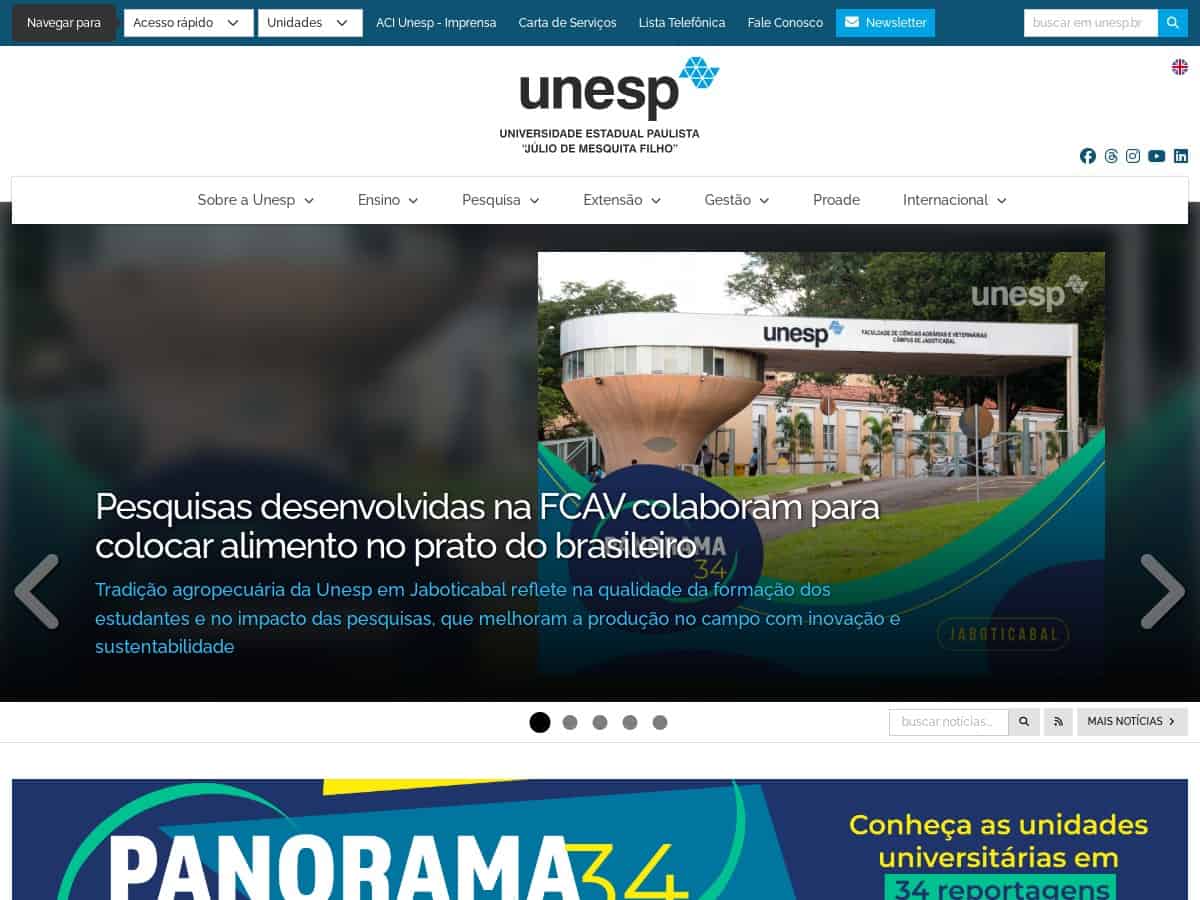
UNESP, founded in 1976, is a multi-campus university focusing on applied sciences and agricultural research with various technological programs.
UNESP was created in 1976 by merging scattered institutes of higher education across the state of São Paulo, and that origin explains its structure: it has units in more than twenty cities instead of one central campus. About 30,000 students and 11,000 staff are spread across these sites. The headquarters are in São Paulo city, while the engineering campus in Bauru and the other units run their own faculties and laboratories.
Agricultural and biological sciences are the strongest identity, with units in Jaboticabal and Botucatu, while engineering is taught in Ilha Solteira, Guaratinguetá, Bauru and other cities. The unit in São José dos Campos sits near the aerospace cluster around Embraer and the national space research institutes, and Rio Claro is known for geosciences. A student choosing UNESP is therefore choosing a city as much as a university.
Research covers agriculture, bioengineering, mechanical systems and environmental sciences, and it benefits from the same state funding mechanism as USP and UNICAMP, including the research foundation FAPESP. International collaboration includes Wageningen University in the Netherlands, and cooperation with Embrapa and agribusiness companies supports applied work in crops, livestock and food technology.
Tuition is free, because the university is financed by the state of São Paulo. Admission is competitive and based on an entrance exam, with additional seats reserved for public school graduates and quota groups. Teaching is in Portuguese. Housing and living costs vary a lot from one unit to another, and smaller cities such as Ilha Solteira are far cheaper than São Paulo.
The multi-campus model lets the university reach regions that would otherwise have no public higher education, and about 100,000 people have graduated from it. Graduates are well placed in agribusiness, energy and manufacturing companies of the interior of the state.
Where this institution leans on bioengineering, State University of Campinas does the same, and it is also a public institution, and runs the same bachelor's, master's and doctoral programmes.
Think of University of São Paulo when paulo, engineering and biotechnology is the priority: it covers computer vision and life sciences as well, and is far larger, with about 90,000 students against roughly 30,000 here.
Among national alternatives, North Fluminense State University Darcy Ribeiro stands out for its focus on agriculture and bioengineering, and it is far smaller, with about 7,000 students against roughly 30,000 here, and is also a public institution.
University of Brasília works in much the same fields, chiefly engineering, and it is also a public institution, and runs the same bachelor's, master's and doctoral programmes.
Also strong in agriculture, Federal University of Goiás makes a sensible second look at home; it teaches at the same levels, namely bachelor's, master's and doctoral, and covers life sciences and engineering as well.
Most Similar Schools Abroad
The closest overseas parallel on agriculture, bioengineering and mechanical engineering is National University of Life and Environmental Sciences of Ukraine, located in Ukraine; it is slightly smaller, at about 26,000 students against roughly 30,000 here, and is also a public institution.
Kyungpook National University in South Korea pursues a similar profile in mechanical engineering, and it teaches at the same levels, namely bachelor's, master's and doctoral, and covers life sciences and engineering as well.
Seen from abroad, Aarhus University (Denmark) is a close relative on subject matter, since agriculture and bioengineering are central to both, and it covers astroscience and nanotechnologies as well, and is slightly larger, at about 38,000 students against roughly 30,000 here.
University of Tehran brings a Iran setting to the same core fields, agriculture and mechanical engineering, and it teaches at the same levels, namely bachelor's, master's and doctoral, and covers civil engineering and chemistry as well.
Yangzhou University brings a China setting to the same core fields, agriculture and mechanical engineering, and it is also a public institution, and runs the same bachelor's, master's and doctoral programmes.
*our own picks (our criteria: a mix between domains, diploma delivered, reputation and size), but obviously too many criteria for an apple-to-apple ranking.
FAQ
Where is UNESP?
It has units in many cities of the state of São Paulo, with its headquarters in São Paulo city. The listed engineering campus is in Bauru.
How large is UNESP?
About 30,000 students and 11,000 staff across its campuses.
When was UNESP created?
In 1976, by merging institutes of higher education that already existed in the interior of the state.
Is UNESP free?
Yes. It is a state university funded by São Paulo, and undergraduate study is free of tuition.
How do you get in?
Through a competitive entrance exam, with additional seats for public school graduates and quota groups.
What language is used for teaching?
Portuguese.
Which fields are strongest?
Agriculture, biotechnology, mechanical engineering, environmental sciences and geosciences, among others.
Where is engineering taught?
In several units, among them Bauru, Ilha Solteira and Guaratinguetá, and in São José dos Campos near the aerospace industry.
Does UNESP have international partners?
Yes, including Wageningen University in the Netherlands, and it cooperates with Embrapa on agricultural research.
How different are the campuses?
Each unit has its own faculties, city and cost of living, so applicants should choose the unit as carefully as the course.
Agriculture, Bioengineering, Environmental Impact, Innovation, Mechanical Engineering, Research and Development, Sustainable Development, Sustainable Practices
*: without any judgment of the quality, readers are strongly encouraged to check the official status of the exact diploma envisioned as many universities have a mix of recognized diplomas, not recognized, “co-delivered,” “equivalent to”, “some pathways” (…), can change over time, and can be named differently from one country to another.
**: international reputation: is based on some criteria that do not mean much in some domains or specialties (number of researchers, of scientific publications, on budget ….). Our approximate 1-4 scale:
known locally
known locally and internationally
is listed in some of the world university’s classifications
is listed among the 20 firsts in some of world university’s classifications
***: estimated numbers, based on online sources and/or feedbacks. The numbers can vary greatly depending on school organisation (ex.: school is part of a group, it employs internal staff or external consultants or has public staff without employing them …). Refer to all the links provided to have accurate and updated numbers.
Innovation.world is not affiliated with this school/university. We recommend to contact them directly on their website for any special request.
To complete or correct any information here or share your opinion, please comment below or > send us a direct message <.