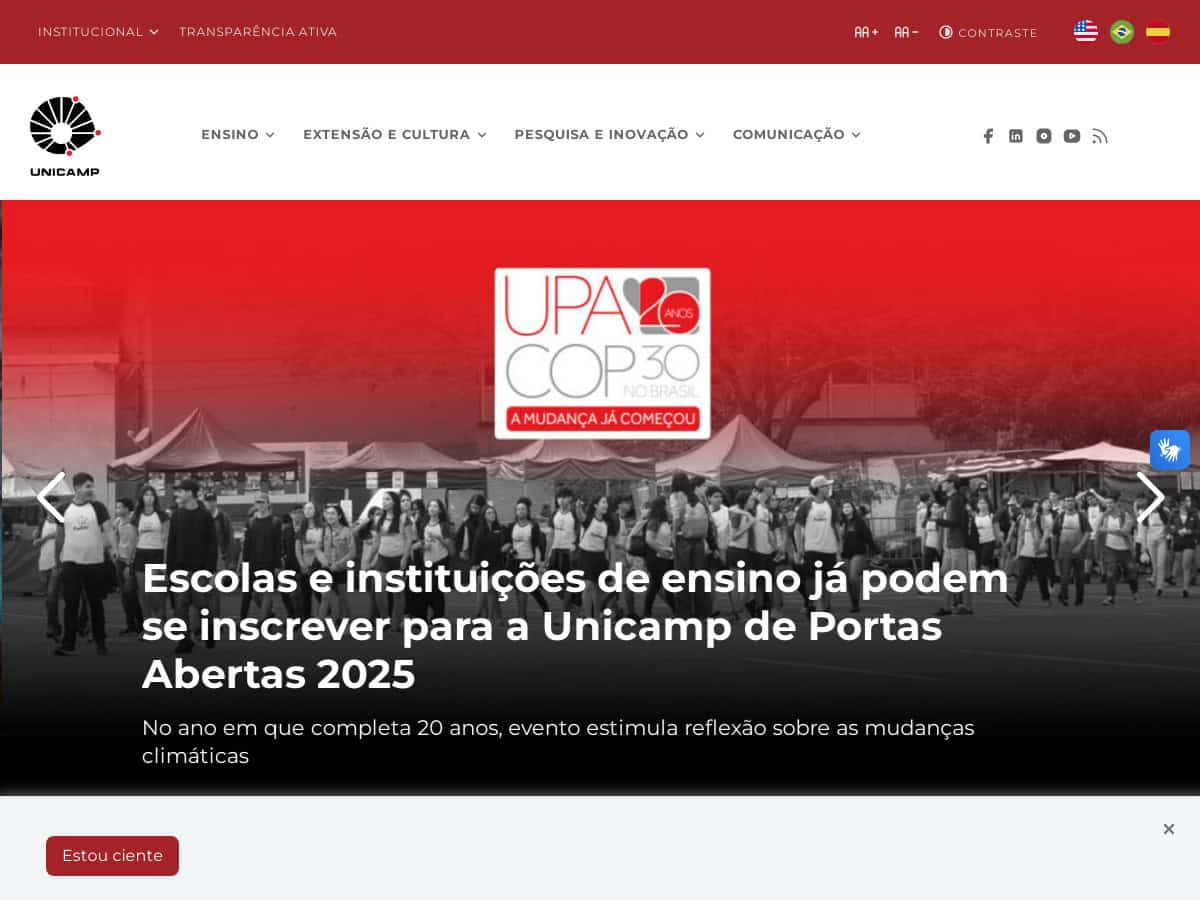
Established in 1966, UNICAMP is a prestigious research university focusing on technological and biomedical fields with a strong emphasis on innovation.
UNICAMP, the State University of Campinas, was designed from the start as a research university. It teaches about 30,000 students with 8,000 staff, and the Zeferino Vaz university city in the Barão Geraldo district of Campinas has the feel of a campus built around laboratories. Its founder, the physician Zeferino Vaz, recruited researchers from abroad to build departments quickly in the 1960s, and the habit of working with companies has remained.
Engineering is one of the main schools, with electrical and computer, mechanical, chemical and food engineering as the largest faculties, and a separate Faculty of Technology in Limeira. The Institute of Computing is among the best known in Brazil. Through its innovation agency, the university files more patents than almost any other Brazilian university, and it has spun off companies in telecommunications, software and biotechnology.
The research environment is helped by the neighbours. Campinas hosts the Brazilian Centre for Research in Energy and Materials, which operates the Sirius synchrotron light source, the telecommunications institute CPqD and several units of Embrapa, the national agricultural research agency. UNICAMP collaborates with IBM and with Embrapa, and its main fields are biotechnology, computer science and materials science.
Tuition is free, since the university is funded by the state of São Paulo. Admission is through the Vestibular Unicamp, a competitive exam run by the university, with additional paths for students from public schools and quota groups. Teaching is in Portuguese, and foreign students usually enter through exchange or graduate programmes with a language requirement.
Campinas is a large industrial city about 100 km north-west of São Paulo, and several multinational technology companies run research units there, which creates internships for engineering and computing students. About 120,000 people have graduated from UNICAMP since its creation.
Domains taught:
Bioengineering, Computer Vision, Engineering
Diplomas*:
Bachelor, Doctor, Master
Status:
Public
Partnerships:
Collaborates with IBM, Embrapa, and international institutions
Research:
Leading research in biotechnology, computer science, and materials science
Famous Alumnis:
Miguel Nicolelis
International recognition**:
Number of staff***:
8000
Current students***:
30000
Foreign students***:
15%
Cumulative former students***:
120000
Pros
High research activity, active industry partnerships
University of São Paulo works in much the same fields, chiefly computer vision and engineering, and it covers life sciences as well, and is far larger, with about 90,000 students against roughly 30,000 here.
Federal University of Minas Gerais is the closest domestic counterpart for computer vision and engineering; it is also a public institution, and runs the same bachelor's, master's and doctoral programmes.
Federal University of Santa Catarina works in much the same fields, chiefly computer vision and engineering, and it teaches at the same levels, namely bachelor's, master's and doctoral, and covers ecology and sustainability as well.
Among national alternatives, Pontifical Catholic University of Campinas stands out for its focus on computer vision and engineering, and it runs the same bachelor's, master's and doctoral programmes, and covers project management as well.
Federal University of São Carlos sits close to this institution on computer vision and engineering; it is smaller, enrolling about 14,000 students against roughly 30,000 here, and is also a public institution.
Most Similar Schools Abroad
Looking internationally, Hanyang University in South Korea is where computer vision and engineering get a comparable treatment; it is slightly smaller, at about 25,000 students against roughly 30,000 here, and is private, whereas this university is public.
A foreign alternative with a similar emphasis on computer vision and engineering is Incheon National University in South Korea, and it is smaller, enrolling about 12,000 students against roughly 30,000 here, and is also a public institution.
Autonomous University of Barcelona (Spain) works on the same fields as this institution, chiefly computer vision and engineering; it covers microbiology and genetics and chemistry as well, and is slightly larger, at about 37,166 students against roughly 30,000 here.
Beyond national borders, University of Science and Technology Beijing stands out as a comparable school for engineering; it has almost the same size, at about 27,311 students, and is also a public institution.
In China, Guangzhou Medical University teaches much the same core subjects, bioengineering, and it covers microbiology and genetics and life sciences as well, and is slightly smaller, at about 23,300 students against roughly 30,000 here.
*our own picks (our criteria: a mix between domains, diploma delivered, reputation and size), but obviously too many criteria for an apple-to-apple ranking.
FAQ
Where is UNICAMP?
The main campus, the Zeferino Vaz university city, is in the Barão Geraldo district of Campinas, in the state of São Paulo.
How large is UNICAMP?
About 30,000 students and 8,000 staff.
Is it public?
Yes. UNICAMP is a state university funded by the government of São Paulo, and undergraduate study is free of tuition.
How do you enter UNICAMP?
Through the Vestibular Unicamp, a competitive entrance exam run by the university, with additional paths for public school graduates and quota groups.
What language is used for teaching?
Portuguese.
What are the main fields?
Engineering, computing, bioengineering, biotechnology, materials science and physics.
What is UNICAMP known for in innovation?
Its innovation agency manages one of the largest patent portfolios among Brazilian universities and supports spin-off companies.
Which research partners are nearby?
CNPEM with the Sirius synchrotron, the CPqD telecommunications centre and several Embrapa units are all located in Campinas.
Does UNICAMP have industry partners?
Yes, including IBM and Embrapa, as well as other technology and industrial companies in the Campinas region.
How far is Campinas from São Paulo?
About 100 km, roughly an hour and a half by road depending on traffic.
Bioengineering, Engineering, Innovation, Materials Science, Research and Development, Sustainable Development
*: without any judgment of the quality, readers are strongly encouraged to check the official status of the exact diploma envisioned as many universities have a mix of recognized diplomas, not recognized, “co-delivered,” “equivalent to”, “some pathways” (…), can change over time, and can be named differently from one country to another.
**: international reputation: is based on some criteria that do not mean much in some domains or specialties (number of researchers, of scientific publications, on budget ….). Our approximate 1-4 scale:
known locally
known locally and internationally
is listed in some of the world university’s classifications
is listed among the 20 firsts in some of world university’s classifications
***: estimated numbers, based on online sources and/or feedbacks. The numbers can vary greatly depending on school organisation (ex.: school is part of a group, it employs internal staff or external consultants or has public staff without employing them …). Refer to all the links provided to have accurate and updated numbers.
Innovation.world is not affiliated with this school/university. We recommend to contact them directly on their website for any special request.
To complete or correct any information here or share your opinion, please comment below or > send us a direct message <.