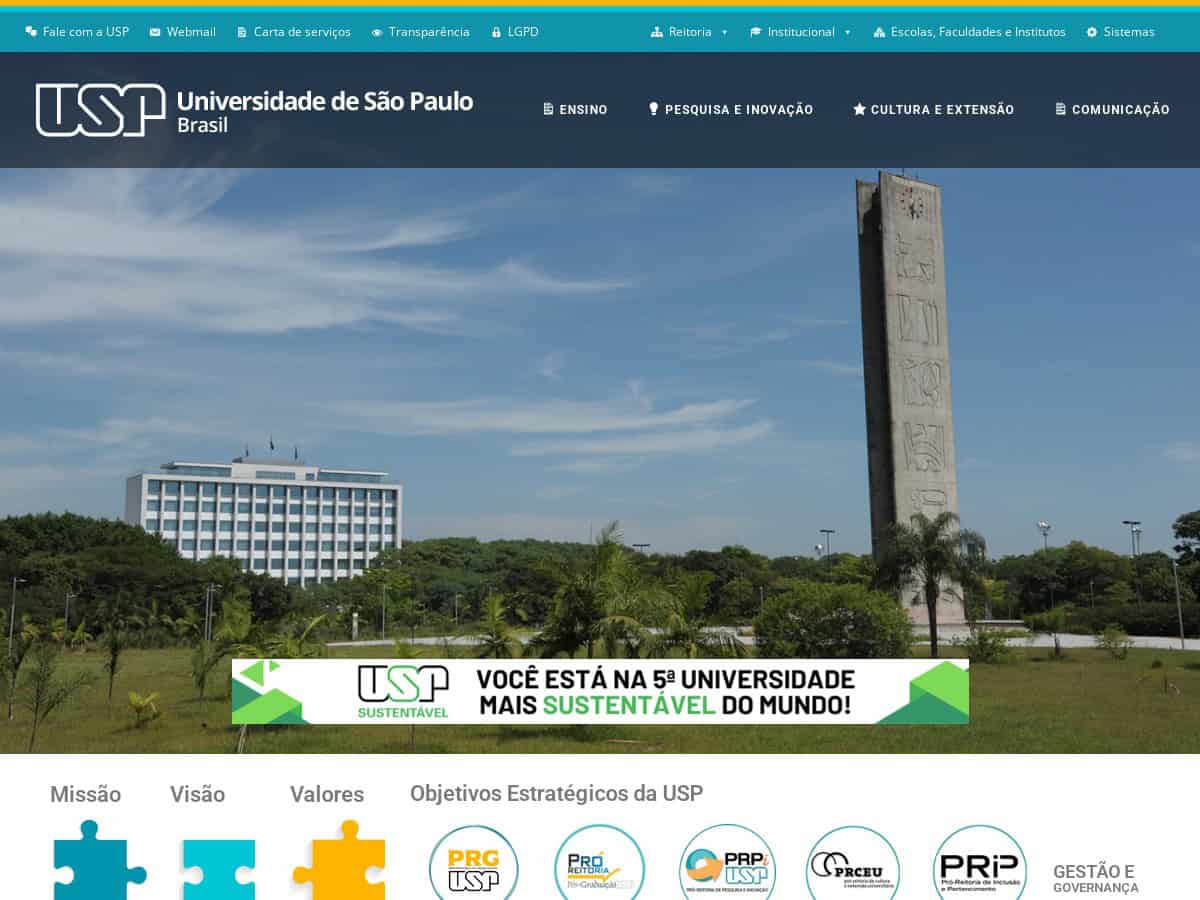
Address: Travessa do Paço, 23, 05508-010 São Paulo, São Paulo, Brazil
Engineering, Life Sciences, Computer Vision
Founded in 1934, USP is the largest Brazilian public university, renowned for its comprehensive education and research across diverse fields covering sciences, arts, and technology.
The University of São Paulo is the largest public university in Brazil and the source of a large share of the country’s scientific publications. It enrols about 90,000 students and employs roughly 35,000 staff, a figure that includes teaching hospitals, museums and technical personnel. The main campus lies in the Butantã district of São Paulo, and further campuses spread across the state, among them Ribeirão Preto, São Carlos, Piracicaba, Bauru, Lorena and Pirassununga.
Engineering is taught at the Polytechnic School in São Paulo, whose roots go back to 1893, and at the São Carlos School of Engineering, which sits beside the Institute of Mathematical and Computer Sciences. The Luiz de Queiroz agricultural college in Piracicaba, founded in 1901, covers agricultural and environmental sciences. Fernando Henrique Cardoso, president of Brazil from 1995 to 2002, studied and taught sociology at USP before entering politics.
Research is funded largely through the São Paulo state research foundation FAPESP, which gives USP groups a stable budget compared with many other Latin American universities. Strong areas are biotechnology, computer science, environmental studies and materials. Partnerships include agreements with institutions such as MIT, Stanford and numerous European universities, and joint laboratories with industry exist in several campuses.
Tuition is free, since the university is financed by a share of the state sales tax. Most undergraduate places are filled through the FUVEST entrance exam, with a growing share allocated through national ENEM results and quota policies. Teaching is in Portuguese, so foreign students need a solid working level before arrival. Student housing on the main campus, known as CRUSP, is limited and allocated according to need.
São Paulo is a city of more than 12 million people, with long commuting distances and high rents in the districts near the campus. About 400,000 people have graduated from USP, which gives its alumni a visible presence in Brazilian industry, banking and politics.
Domains taught:
Computer Vision, Engineering, Life Sciences
Diplomas*:
Bachelor, Doctor, Master
Status:
Public
Partnerships:
International partnerships including MIT, Stanford University, and European universities
Research:
Advanced research in biotechnology, computer science, and environmental studies
Famous Alumnis:
Sérgio Buarque de Holanda, Oscar Niemeyer, Dilma Rousseff
International recognition**:
Number of staff***:
35000
Current students***:
90000
Foreign students***:
20%
Cumulative former students***:
400000
Pros
Strong research output, broad course offerings, high reputation
Cons
Large campus may be overwhelming, competitive admission
Another national school that puts computer vision, life sciences and engineering at the centre is Federal University of Minas Gerais, and it is also a public institution, and runs the same bachelor's, master's and doctoral programmes.
Federal University of São Carlos takes a similar route through computer vision, life sciences and engineering, and it is far smaller, with about 14,000 students against roughly 90,000 here, and is also a public institution.
Fluminense Federal University works in much the same fields, chiefly computer vision, life sciences and engineering, and it is far smaller, with about 21,000 students against roughly 90,000 here, and is also a public institution.
Federal University of Ceará is the closest domestic counterpart for computer vision, life sciences and engineering; it is also a public institution, and teaches at the same levels, namely bachelor's, master's and doctoral.
Federal University of Uberlândia sits close to this institution on computer vision, life sciences and engineering; it is also a public institution, and teaches at the same levels, namely bachelor's, master's and doctoral.
Most Similar Schools Abroad
The closest overseas parallel on computer vision, life sciences and engineering is National University of La Plata, located in Argentina; it teaches at the same levels, namely bachelor's, master's and doctoral, and covers astroscience and chemistry as well.
A foreign alternative with a similar emphasis on computer vision, life sciences and engineering is Konkuk University in South Korea, and it is private, whereas this university is public, and teaches at the same levels, namely bachelor's, master's and doctoral.
Hanyang University brings a South Korea setting to the same core fields, computer vision and engineering, and it is far smaller, with about 25,000 students against roughly 90,000 here, and is private, whereas this institution is public.
Autonomous University of Barcelona in Spain pursues a similar profile in computer vision, life sciences and engineering, and it covers microbiology and genetics and chemistry as well, and is smaller, enrolling about 37,166 students against roughly 90,000 here.
Looking internationally, University of Belgrade in Serbia is where life sciences and engineering get a comparable treatment; it has almost the same size, at about 94,425 students, and is also a public institution.
*our own picks (our criteria: a mix between domains, diploma delivered, reputation and size), but obviously too many criteria for an apple-to-apple ranking.
FAQ
Where is the University of São Paulo?
The main campus is in the Butantã district of São Paulo. Other campuses are in Ribeirão Preto, São Carlos, Piracicaba, Bauru and other cities of the state.
How large is USP?
It has about 90,000 students and 35,000 staff, including hospital and technical personnel.
Is USP free?
Yes. Undergraduate education is free of tuition because the university is funded by the state of São Paulo.
How do you get in?
Most places are filled through the FUVEST entrance exam, with additional places allocated through ENEM results and quota policies.
What language is used for teaching?
Portuguese. Some graduate courses and exchange activities are available in English.
Where is engineering taught?
At the Polytechnic School in São Paulo and at the São Carlos School of Engineering in São Carlos.
What are the main research areas?
Biotechnology, computer science, environmental studies, materials science, medicine and agricultural sciences.
Does USP have international partnerships?
Yes, with universities including MIT, Stanford and many in Europe, through exchange and joint research agreements.
Who are famous alumni?
Fernando Henrique Cardoso, former president of Brazil, studied and taught at USP, which also counts many scientists, writers and business leaders among its graduates.
Is there student housing?
The CRUSP residence on the main campus offers rooms to students in need, but places are limited and allocated through a selection process.
Artificial Intelligence (AI), Engineering, Environmental Engineering, Innovation, Life Cycle Assessment (LCA), Research and Development
*: without any judgment of the quality, readers are strongly encouraged to check the official status of the exact diploma envisioned as many universities have a mix of recognized diplomas, not recognized, “co-delivered,” “equivalent to”, “some pathways” (…), can change over time, and can be named differently from one country to another.
**: international reputation: is based on some criteria that do not mean much in some domains or specialties (number of researchers, of scientific publications, on budget ….). Our approximate 1-4 scale:
known locally
known locally and internationally
is listed in some of the world university’s classifications
is listed among the 20 firsts in some of world university’s classifications
***: estimated numbers, based on online sources and/or feedbacks. The numbers can vary greatly depending on school organisation (ex.: school is part of a group, it employs internal staff or external consultants or has public staff without employing them …). Refer to all the links provided to have accurate and updated numbers.
Innovation.world is not affiliated with this school/university. We recommend to contact them directly on their website for any special request.
To complete or correct any information here or share your opinion, please comment below or > send us a direct message <.