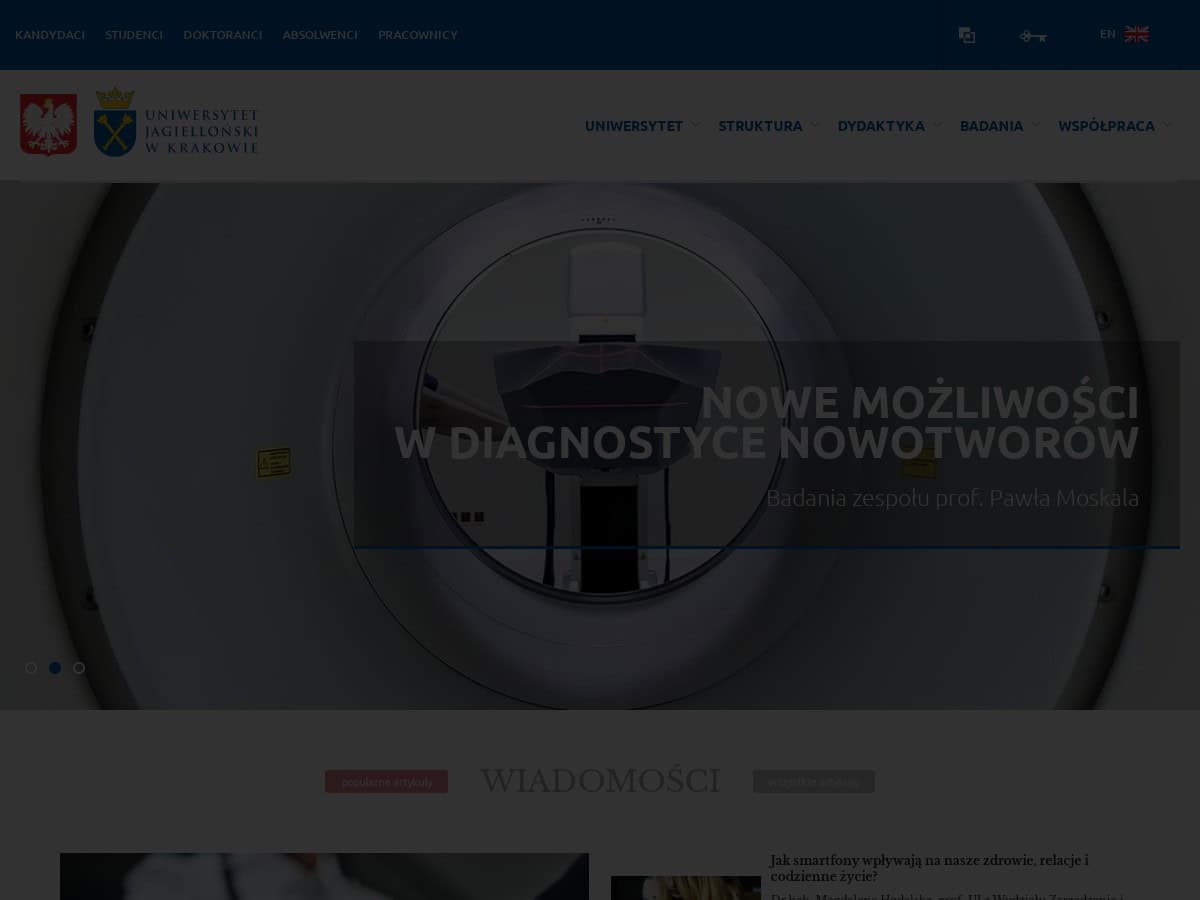
Founded in 1364, JU is the oldest university in Poland and one of the oldest in the world. It is a prestigious comprehensive university with strong programs in humanities, law, medicine, and exact sciences (physics, chemistry, mathematics, computer science).
The Jagiellonian University in Kraków is the oldest university in Poland and one of the oldest in Europe. King Casimir the Great founded it in 1364, and it was refounded in 1400 with funds from Queen Jadwiga and her husband Władysław Jagiełło, whose name it carries. It has about 40,000 students and 7,000 staff. The historic centre is around the Collegium Maius on Jagiellońska street, a Gothic courtyard building that is now a museum, and the address of the rectorate is on Gołębia street.
Nicolaus Copernicus studied at the university in the 1490s, and the Collegium Maius holds the Jagiellonian Globe, an early globe showing America. Karol Wojtyła, the future Pope John Paul II, studied Polish literature and theology here, and Wisława Szymborska, the 1996 Nobel laureate in literature, was a student. In November 1939, the German occupiers arrested 183 professors and staff in the so-called Sonderaktion Krakau, and many died in camps, a moment that remains a symbol of resistance for Polish academics.
Today the university teaches in sixteen faculties and has a medical college, Collegium Medicum, with its own hospital. Physics, chemistry, biology, history, philology, philosophy, law and computer science are well known. A modern campus, the Third Campus, at Pychowice in the south of the city, houses science, chemistry and mathematics departments, and the Małopolska Centre of Biotechnology and the SOLARIS synchrotron are part of the research landscape.
Public universities in Poland teach full-time studies in Polish without tuition for Polish citizens, while programmes in English and studies for foreign students are normally paid, and fees vary by programme. Check the current tariff. Polish applicants use the national online recruitment system with results from the secondary school exam, and international students apply through the university’s own portal.
Kraków is a compact city with a large student population, relatively cheap living costs and a lively cultural scene. Dormitories are available at several student campuses.
Domains taught:
AI and Machine Learning, Astroscience, Bioengineering, Bioinformatics, Chemistry, Computer Vision, Data Analytics, Ecology and Sustainability, Fluid Dynamics, Life Sciences, Manufacturing, Materials, Mathematics, Mechanical Engineering, Microbiology and Genetics, Nanotechnologies, Optics, Physics, Process Control, Signal Processing, Software Engineering, Statistics, Structural Engineering, Telecommunications, Thermodynamics
Diplomas*:
Bachelor, Doctor, Master
Status:
Public
Partnerships:
Member of Coimbra Group, Utrecht Network, Europaeum, Una Europa. Extensive international research collaborations.
Both schools build their programmes around astroscience, bioinformatics and nanotechnologies, and University of Wrocław is the one to compare first within the country, since it is smaller, enrolling about 25,000 students against roughly 40,000 here, and is also a public institution.
Adam Mickiewicz University in Poznań offers a comparable education in astroscience, bioinformatics and nanotechnologies: it covers geotechnics as well, and is slightly smaller, at about 35,000 students against roughly 40,000 here.
Where this institution leans on astroscience, bioinformatics and nanotechnologies, University of Warsaw does the same, and it has almost the same size, at about 40,000 students, and is also a public institution.
Nicolaus Copernicus University in Toruń is the closest domestic counterpart for astroscience, bioinformatics and nanotechnologies; it is also a public institution, and teaches at the same levels, namely bachelor's, master's and doctoral.
University of Gdańsk offers a comparable education in astroscience, bioinformatics and nanotechnologies: it is smaller, enrolling about 23,000 students against roughly 40,000 here, and is also a public institution.
Most Similar Schools Abroad
Seen from abroad, Ruprecht-Karls-Universität Heidelberg (Germany) is a close relative on subject matter, since astroscience, bioinformatics and nanotechnologies are central to both, and it is slightly smaller, at about 29,000 students against roughly 40,000 here, and is also a public institution.
In Germany, Freie Universität Berlin teaches much the same core subjects, astroscience, bioinformatics and nanotechnologies, and it is also a public institution, and teaches at the same levels, namely bachelor's, master's and doctoral.
The closest overseas parallel on astroscience, bioinformatics and nanotechnologies is Universität Zürich, located in Switzerland; it runs the same bachelor's, master's and doctoral programmes, and covers geotechnics and robotics as well.
Seen from abroad, Peking University (China) is a close relative on subject matter, since astroscience, bioinformatics and nanotechnologies are central to both, and it is slightly larger, at about 45,000 students against roughly 40,000 here, and is also a public institution.
Nankai University in China pursues a similar profile in astroscience, bioinformatics and nanotechnologies, and it covers electrical and electronics as well, and is slightly smaller, at about 30,000 students against roughly 40,000 here.
*our own picks (our criteria: a mix between domains, diploma delivered, reputation and size), but obviously too many criteria for an apple-to-apple ranking.
FAQ
Where is the Jagiellonian University?
The rectorate is at ul. Gołębia 24 in Kraków, Poland. The historic Collegium Maius is on Jagiellońska street.
When was it founded?
In 1364 by King Casimir the Great, and refounded in 1400.
How large is it?
About 40,000 students and 7,000 staff.
Who studied there?
Nicolaus Copernicus, Karol Wojtyła, who became Pope John Paul II, and Wisława Szymborska.
What is the Collegium Maius?
A Gothic courtyard building that is the oldest university building in Poland and now a museum. It holds the Jagiellonian Globe.
What was Sonderaktion Krakau?
An arrest of 183 professors and staff by the German occupiers in November 1939.
What is Collegium Medicum?
The university's medical college, with its own teaching hospital.
What does it cost?
Full-time studies in Polish are free for Polish citizens, while programmes in English and studies for foreign students are normally paid. Check the current tariff.
How do you apply?
Polish applicants use the national online recruitment system. International students apply through the university's own portal.
Is Kraków cheap?
Living costs are relatively low, and the city has a large student population.
*: without any judgment of the quality, readers are strongly encouraged to check the official status of the exact diploma envisioned as many universities have a mix of recognized diplomas, not recognized, “co-delivered,” “equivalent to”, “some pathways” (…), can change over time, and can be named differently from one country to another.
**: international reputation: is based on some criteria that do not mean much in some domains or specialties (number of researchers, of scientific publications, on budget ….). Our approximate 1-4 scale:
known locally
known locally and internationally
is listed in some of the world university’s classifications
is listed among the 20 firsts in some of world university’s classifications
***: estimated numbers, based on online sources and/or feedbacks. The numbers can vary greatly depending on school organisation (ex.: school is part of a group, it employs internal staff or external consultants or has public staff without employing them …). Refer to all the links provided to have accurate and updated numbers.
Innovation.world is not affiliated with this school/university. We recommend to contact them directly on their website for any special request.
To complete or correct any information here or share your opinion, please comment below or > send us a direct message <.